Vietnam Pepper Suppliers Guide 2026
Reviewed by Phan Hà Thái, Founder ViRFQ
vietnam pepper suppliers matter because Vietnam supplies about 40% of global pepper exports, according to VPSA, and EU buyer screening is tightening before 30 December 2025 under EU Regulation 2023/1115. This guide gives a practical vetting workflow for grades, documents, payment terms, and RFQ comparison without supplier-list guesswork.
Why Vietnam pepper sourcing is attractive for importers
Vietnam is a major pepper origin because it combines farming clusters, processors, exporters, and container logistics in a relatively compact supply chain. Buyers often evaluate Bình Phước, Đắk Nông, Gia Lai, and the Central Highlands for black pepper, while larger processors near Ho Chi Minh City and Bình Dương handle cleaning, steam treatment, grading, packing, and export paperwork.
The core reason is supply depth. The Vietnam Pepper and Spice Association describes pepper and spices as a strategic export group, while FAOSTAT crop data lets buyers compare Vietnam with other producing countries over time. For trade flows, ITC Trade Map is useful because importers can check exporter, importer, and product-level movements before asking for quotes.
Vietnam pepper sourcing is also practical for mixed spice programs. A buyer may begin with black pepper, then add white pepper, cassia, star anise, turmeric, or chili from the same exporter network. If you are building a wider spice program, you can also post a spice RFQ and compare multiple product categories in one workflow.
The strongest buying cases usually have clear specs before supplier outreach: - Product: black pepper, white pepper, pinhead, crushed, or ground. - Density: common black pepper requests include 500 g/l or 550 g/l, with market context from VPSA. - Process: cleaned, steam-treated, sterilized, or conventional export grade. - Packaging: jute bag, kraft bag, carton, or private label retail pack. - Shipment: FOB Cat Lai, CIF Rotterdam, CIF Jebel Ali, or destination warehouse.
A useful buyer takeaway, paraphrasing FAOSTAT, is simple: Vietnam is not only a trading point; it is a production base with export processing capacity. That matters when you need repeat shipments, traceable lots, and faster replacement quotes.
How to find Vietnam black pepper exporters without directory noise
Search results for Vietnam black pepper exporters often mix real processors, traders, directory pages, social media posts, and outdated supplier lists. A cleaner approach is to treat supplier search as a qualification funnel, not a browsing task. Start with product fit, then verify company identity, processing capability, export history, and document readiness.
A practical funnel has four layers. First, confirm the supplier works with the pepper type you need. A bulk spice trader may handle black pepper but not steam-treated white pepper. A processor may pack retail pouches but avoid bulk container work. Second, check whether the supplier can provide company registration, tax information, bank details, and recent export references. Third, request lot-level documents and photos. Fourth, compare quote structure across suppliers on the same Incoterm, currency, bag type, and inspection requirement.
ViRFQ can help reduce directory noise because the buyer starts with a structured RFQ instead of cold-emailing a long list. If you want a Vietnam-specialist alternative to broad marketplace browsing, compare ViRFQ vs Alibaba sourcing before building your supplier workflow.
Use this short outreach template:
- Product: Vietnam black pepper, cleaned, export grade.
- Spec: density, moisture limit, foreign matter limit, and pesticide requirement.
- Quantity: trial shipment first, then repeat shipment plan.
- Packing: net weight per bag and pallet preference.
- Delivery: FOB Cat Lai or CIF destination port.
- Documents: commercial invoice, packing list, bill of lading, phytosanitary certificate, fumigation certificate if required.
Keep the first quote round narrow. Do not ask ten suppliers for ten different specs. You will get prices that cannot be compared. A precise RFQ makes weak suppliers visible quickly because they avoid details, delay documents, or quote vague product names.
Which pepper grades and product forms should buyers request?
Most international buyers start with black pepper because it has the broadest application in foodservice, seasoning blends, meat processing, snacks, and retail spice lines. White pepper is more specialized. It is used when buyers want a lighter color, a different aroma profile, or a smoother appearance in soups, sauces, and light-colored products. Vietnam also exports pinhead pepper, crushed pepper, ground pepper, and mixed spice packs.
For bulk black pepper, density is a key commercial shorthand. Buyers commonly request 500 g/l or 550 g/l, and should pair that with moisture, foreign matter, mold, and pesticide limits. For white pepper, color, odor, and processing control become more important. For ground pepper, buyers should discuss mesh size, microbiological parameters, and packaging barrier requirements.
Use a simple specification table in your RFQ:
| Item | What to define | Why it matters |
|---|---|---|
| Pepper type | Black, white, pinhead, crushed, ground | Prevents quote mismatch |
| Density | 500 g/l or 550 g/l, benchmarked against VPSA market language | Affects price and use case |
| Moisture | Buyer limit and test method | Reduces storage claims |
| Processing | Cleaned, steam-treated, sterilized | Impacts microbiology and price |
| Packing | Jute, kraft, carton, or retail pouch | Impacts freight and shelf life |
Do not treat every low quote as equal. A cheaper quote may exclude sterilization, inspection, export carton, or destination documentation. Ask the supplier to separate product price, packing cost, inspection cost, inland trucking, port charges, and freight. This makes the comparison fair.
If you are still choosing between origins, compare Vietnam and India pepper for flavor profile, supply timing, and trade route differences. Origin comparison helps buyers avoid forcing a Vietnam quote to match an India spec that was built for a different product style.
What documents do pepper import documents usually include?
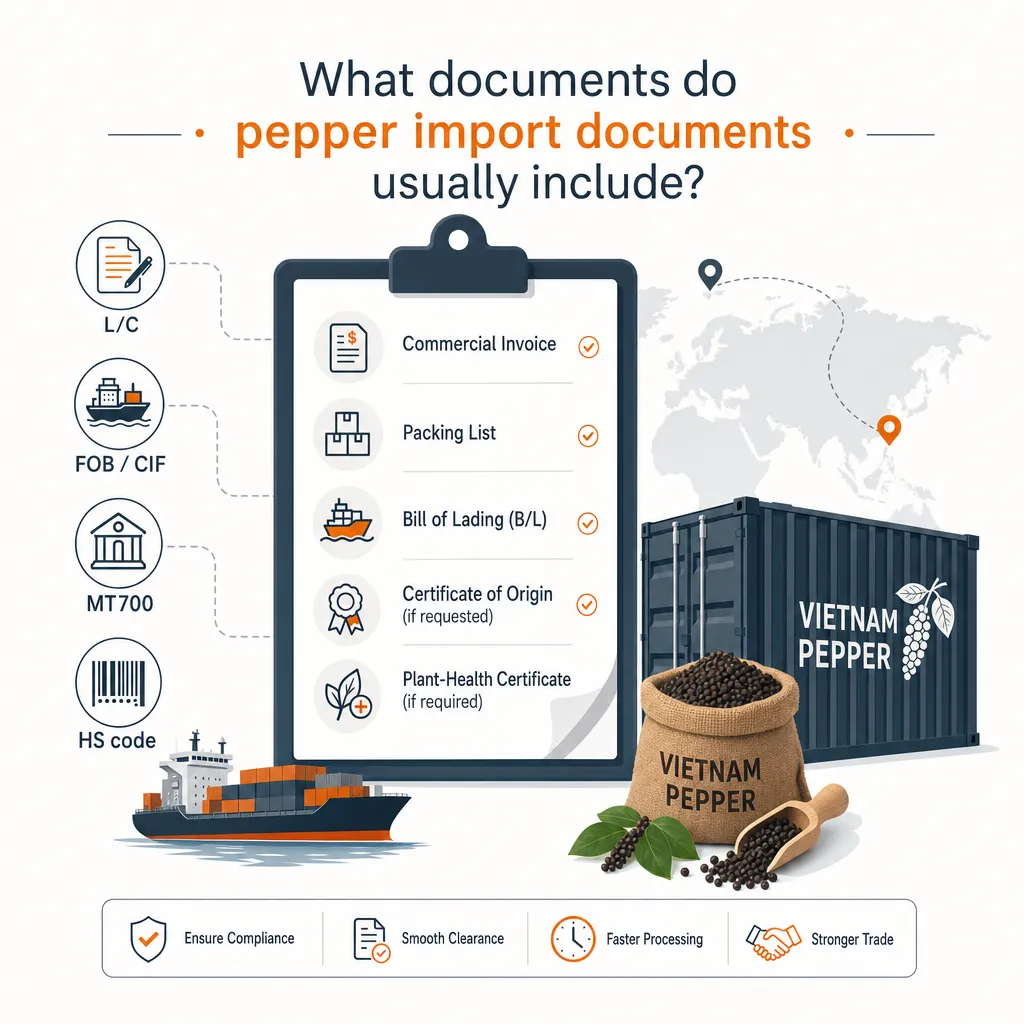
Pepper import documents depend on origin, destination, buyer policy, and payment term. Still, most shipments include a commercial invoice, packing list, bill of lading, certificate of origin when requested, and plant-health documents. Food buyers may also ask for test reports, third-party inspection, and food safety audit evidence.
For plant-health control, the International Plant Protection Convention explains the role of phytosanitary measures through its ISPM resources. If your destination country requires plant-health evidence, ask the supplier early and understand phytosanitary certificates before you confirm the purchase order. Some buyers also need treatment evidence for wooden pallets or commodity handling. In that case, review fumigation certificate requirements before finalizing packing.
For the United States, food importers should also check FDA prior notice guidance. For the European Union, importers can review EU customs import procedures and align with their broker before the shipment leaves Vietnam.
A clean document pack usually includes: - Proforma invoice before payment or letter of credit issuance. - Commercial invoice after shipment details are final. - Packing list with bag count, net weight, and gross weight. - Bill of lading showing shipper, consignee, notify party, and port route. - Certificate of origin if the buyer needs tariff or origin evidence. - Phytosanitary certificate if required by the destination authority. - Fumigation certificate or treatment statement when needed. - Test report for pesticide residue, microbiology, or heavy metals when requested.
Ask for draft documents before cargo is loaded. Small errors in consignee name, net weight, port name, or payment reference can delay customs clearance. A supplier who manages drafts carefully is often easier to work with on repeat shipments.
How should EU buyers assess EUDR and traceability risk?
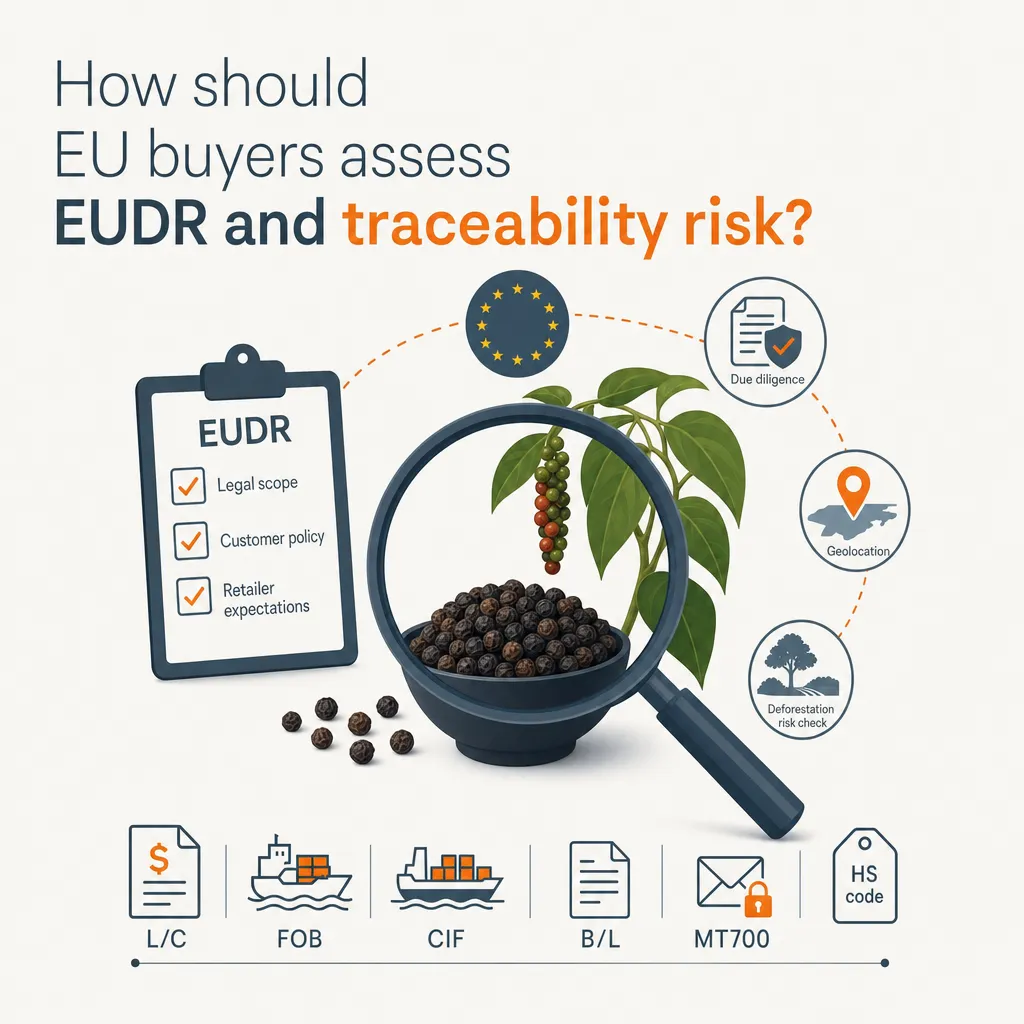
Pepper is not always the first product buyers mention when discussing deforestation rules, but traceability expectations are rising across agricultural sourcing. EU buyers should separate legal scope, customer policy, and retailer expectations. Even when a product is outside a specific legal category, customers may still request origin transparency, farm mapping, and evidence that the exporter understands sustainability documentation.
The reference point for EU commodity due diligence is EU Regulation 2023/1115. Large operators face obligations from 30 December 2025, while smaller entities have a later timeline under the same regulation. Buyers should confirm current legal advice with their EU importer of record because compliance responsibility can differ by role.
For Vietnam pepper suppliers, practical traceability questions include: - Can the exporter identify province, district, cooperative, or farm group? - Can lots be separated by origin and processing date? - Are purchase records linked to the export lot? - Can the supplier provide pesticide residue test reports for the relevant market? - Does the supplier use internal approval for collectors, agents, and processors?
Do not ask for a generic sustainability promise. Ask for a traceability map and a sample lot file. A useful lot file might include farmer group information, intake records, processing date, packing date, laboratory report, and shipment document references. If the supplier cannot provide this for a sample shipment, it may struggle when your retailer asks questions later.
For broader responsible sourcing, the OECD guidance on responsible agricultural supply chains gives a good framework. The World Bank Vietnam overview also helps buyers understand the country context behind agricultural development, infrastructure, and trade capacity.
What price terms and Incoterms should pepper buyers compare?
Pepper prices move with harvest timing, inventory, export demand, freight, and currency. The mistake many buyers make is comparing an FOB quote with a CIF quote, or a bulk bag quote with a private-label carton quote. To compare Vietnam pepper suppliers fairly, lock the same commercial assumptions before asking for final offers.
The International Chamber of Commerce says Incoterms rules explain 11 commonly used trade terms, and its official Incoterms rules page is the buyer reference point. For Vietnam pepper, common terms include FOB Cat Lai, CFR destination port, CIF destination port, and sometimes FCA warehouse. FOB is useful when your forwarder controls freight. CIF is useful when you want the supplier to arrange sea freight and insurance to the named port.
Ask each supplier to quote in the same format: - Product and grade. - Net weight and bag type. - Price currency. - Incoterm and named place. - Validity period. - Loading port. - Shipment window. - Included documents. - Payment term. - Inspection or lab test responsibility.
Payment terms require the same discipline. A small trial order may use telegraphic transfer with a deposit and balance against document copies. Larger orders may use a letter of credit, especially when the buyer and supplier are new to each other. If a supplier requests full advance payment before any verification, slow down and ask for company documents, video factory check, references, and sample inspection.
Use Vietnam Customs for official customs context and MARD for agriculture-sector context. These sources do not replace a broker, but they help buyers ask better questions about export controls and plant-health procedures.
How to verify white pepper suppliers Vietnam and processors
White pepper suppliers Vietnam require extra attention because product appearance, odor, washing, drying, and processing control affect buyer acceptance. A supplier may be strong in black pepper but weaker in white pepper. Ask for recent production photos, sample lot details, and clear sensory notes before ordering.
Verification should cover three areas: company, facility, and lot. Company checks include registration, address, bank account name, export experience, and references. Facility checks include cleaning line, storage area, pest control records, metal detection if used, and packing area hygiene. Lot checks include production date, origin, moisture, odor, color, and lab report scope.
On ViRFQ, buyers can structure the RFQ so suppliers answer the same verification questions. That makes it easier to rank responses without relying on polished brochures. A strong response includes photos of the exact product form, a draft proforma invoice, document list, and clear trade term. A weak response gives only a price per metric ton and says details will come later.
Sample handling is especially important. Ask for a small sample that matches the quoted lot or production style. Label it with supplier name, lot reference, date, and spec. When the sample arrives, compare it with the written quote. If color, odor, density, or packaging differs from the quote, ask why before placing an order.
A simple verification checklist: - Is the legal company name the same on invoice, bank account, and export documents? - Does the supplier answer technical questions directly? - Can the supplier provide a realistic shipment schedule? - Are lab tests relevant to your market? - Does the supplier accept document draft review before shipment?
Verification is not about distrusting every exporter. It is about building a repeatable process so good suppliers can prove fit quickly.
RFQ template for Vietnam pepper suppliers
A strong RFQ removes ambiguity. It tells suppliers exactly what you need and gives them a fair chance to quote. It also protects your team from comparing incomplete offers. Use the template below and edit it for your destination market.
Subject: RFQ for Vietnam pepper shipment
Dear supplier,
We are sourcing Vietnam pepper for import to our market. Please quote based on the details below.
- Product: black pepper or white pepper.
- Grade: density, moisture limit, foreign matter limit, and processing method.
- Quantity: trial order and expected repeat volume.
- Packing: bag or carton type, net weight per unit, pallet requirement.
- Incoterm: FOB Cat Lai, CFR destination port, or CIF destination port.
- Shipment window: preferred month and latest loading date.
- Documents: commercial invoice, packing list, bill of lading, certificate of origin if available, phytosanitary certificate, fumigation certificate if required, and lab report.
- Payment: proposed term and bank details after supplier verification.
- Sample: availability, courier cost, and sample reference.
Please include product photos, company registration details, factory or warehouse photos, recent export market experience, and quote validity.
Before sending the RFQ, align internally on pass or fail criteria. Decide your maximum moisture level, acceptable process, required documents, and payment guardrails. If you are sourcing multiple agricultural categories, source agricultural products from Vietnam with a consistent document checklist across pepper, coffee, cashew, rice, and spices.
If you want to compare responses faster, see verified Vietnam pepper suppliers through a structured RFQ flow. A structured RFQ will not replace buyer judgment, but it will make the first screening round clearer and easier to share with finance, logistics, and quality teams.
FAQ
Where can I find reliable vietnam pepper suppliers online?
Start with a structured RFQ rather than a generic supplier list. Define product type, density, packing, Incoterm, destination, and required documents. Then compare suppliers on company verification, export document readiness, sample consistency, and response quality. Trade data from ITC Trade Map and sector context from VPSA can help you assess whether a quote looks realistic.
Does Vietnam produce pepper for bulk export buyers?
Yes. Vietnam is a major pepper producer and exporter, with farming clusters in Bình Phước, Đắk Nông, Gia Lai, and nearby provinces. Buyers source black pepper, white pepper, pinhead pepper, crushed pepper, and ground pepper. The right supplier depends on your spec, processing requirement, destination rules, and whether you need bulk bags or retail packing.
What is the best pepper in Vietnam for import programs?
There is no single answer for every buyer. Foodservice buyers may prefer black pepper with a clear density spec, while sauce or soup manufacturers may prefer white pepper for color and aroma. Retail brands may care more about clean appearance, consistent grinding, and private-label packing. The right choice is the grade that matches your application and compliance needs.
How do I verify Vietnam black pepper exporters before payment?
Verify the legal company name, tax details, bank account name, address, facility photos, sample consistency, and draft export documents. Ask for a proforma invoice, packing plan, lab report scope, and shipment timeline. For a new supplier, avoid vague full-advance requests until you have checked company identity and product evidence.
Which documents should pepper importers request from Vietnam?
Common documents include proforma invoice, commercial invoice, packing list, bill of lading, certificate of origin when needed, phytosanitary certificate when required, fumigation certificate when applicable, and lab reports requested by the destination market. Buyers should ask for draft documents before loading to catch name, weight, port, or consignee errors early.
Are white pepper suppliers Vietnam different from black pepper suppliers?
Some exporters handle both, but white pepper needs extra checks for color, odor, washing, drying, and lot consistency. A supplier strong in black pepper may not be equally strong in white pepper. Request current photos, samples, lab reports, and a clear production explanation before placing a larger order.
What Incoterm is common when buying pepper from Vietnam?
FOB Cat Lai is common when the buyer controls freight through its own forwarder. CFR and CIF are common when the supplier arranges sea freight to the named destination port. Compare quotes only when product spec, packing, shipment window, and Incoterm are the same.
How can buyers compare Vietnam pepper sourcing quotes fairly?
Use one RFQ template for all suppliers. Require the same grade, packing, Incoterm, document list, shipment window, and payment assumption. Separate product price from packing, inspection, trucking, port charges, and freight. This prevents a low-looking quote from hiding missing services or weaker documentation.
Do EU buyers need EUDR checks for Vietnam pepper suppliers?
EU buyers should review current legal scope with their importer of record and legal adviser. Even when a product is outside a specific legal category, retailer or customer policy may still require traceability. Ask suppliers for origin mapping, lot records, purchase records, and pesticide residue evidence where relevant.
If you are ready to compare Vietnam pepper suppliers, turn your spec into a structured RFQ instead of chasing scattered directory listings. ViRFQ helps buyers request comparable quotes for black pepper, white pepper, and wider spice programs from Vietnam-based exporters. Define your grade, documents, Incoterm, and shipment window, then start with a pepper RFQ at /en/rfq/pepper.
Sources
- Vietnam Pepper and Spice Association
- FAO FAOSTAT Crops and Livestock Products
- International Trade Centre Trade Map
- EUR-Lex EUDR Regulation
- International Plant Protection Convention
- US FDA Food Imports
- European Commission Taxation and Customs Union
- OECD Responsible Agricultural Supply Chains
- World Bank Vietnam
- International Chamber of Commerce Incoterms
- General Department of Vietnam Customs
- Vietnam Ministry of Agriculture and Rural Development