Vietnam Rice Suppliers Guide 2026
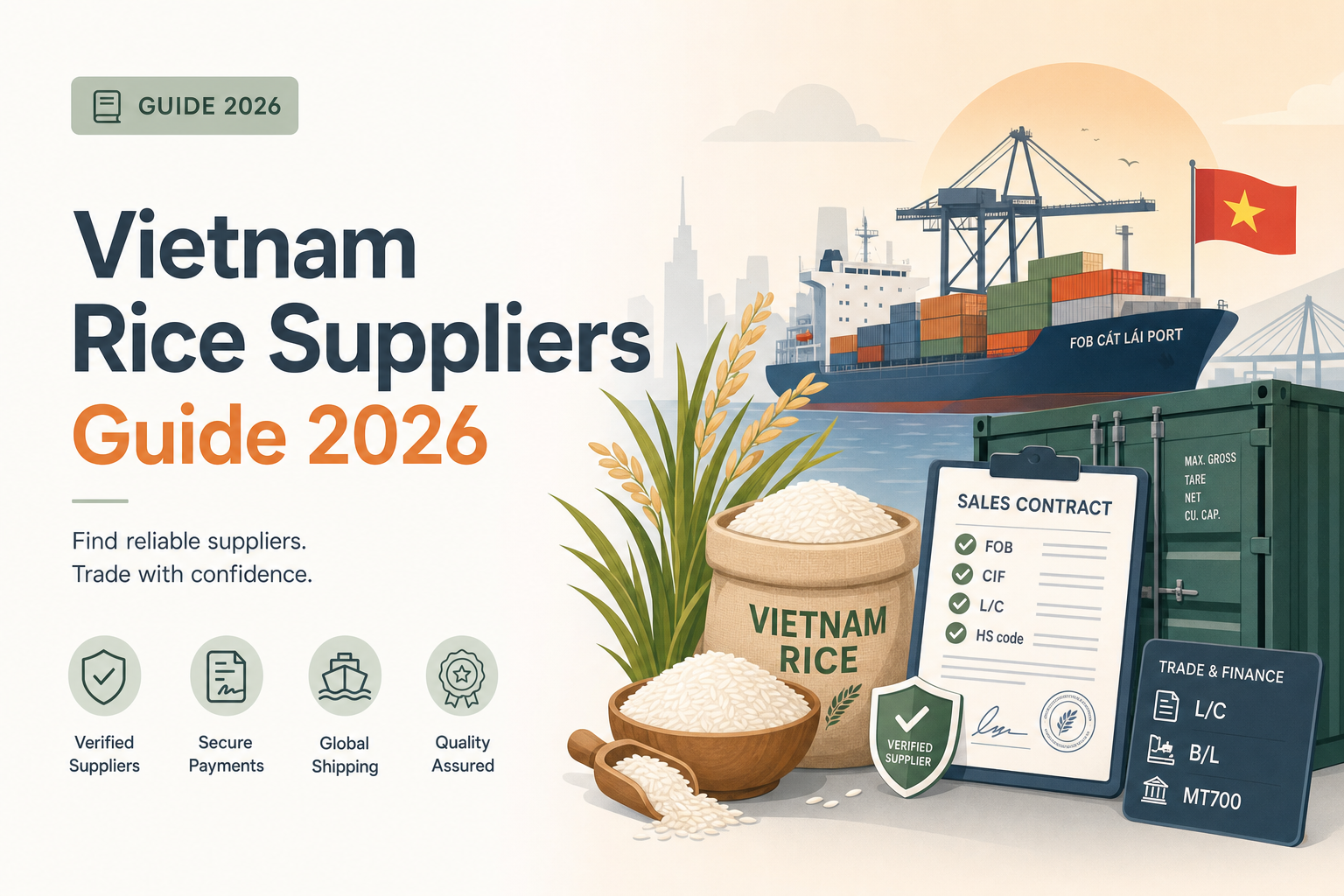
vietnam rice suppliers serve importers buying Jasmine, ST25, fragrant, glutinous and broken white rice from Mekong Delta mills. Vietnam shipped above 8 million tonnes in 2024 (Vietnam Customs), while harvested area was near 7 million hectares in 2024 (USDA). This guide shows how to verify mills, specs and FOB quotes.
Why importers choose Vietnam rice exporters
Vietnam rice exporters sit close to the Mekong Delta, one of Asia’s most active paddy regions. That matters for importers because milling, polishing, bagging and container loading can happen in a tight radius around Long An, An Giang, Đồng Tháp, Cần Thơ and Ho Chi Minh City. Shorter inland movement helps keep moisture and broken-rate control more consistent before rice reaches Cát Lái or other southern ports.
Scale is another reason Vietnam appears on procurement shortlists. Vietnam exported above 8 million tonnes of rice in 2024 (Vietnam Customs), and USDA reported rice harvested area near 7 million hectares in 2024 (USDA). FAO production data also shows Vietnam as a major rice producer in Asia (FAOSTAT crops data). For a buyer, this scale means more grade options, more mills, and more shipping choices during normal seasons.
The SERP for this keyword is crowded with directory pages and broker claims. The gap is practical verification. A buyer does not just need a supplier name. You need to know whether the party controls milling, can issue export documents, understands destination rules, and will hold the agreed specification after sample approval.
Use this article as a procurement checklist rather than a directory. The right supplier depends on your product, destination, packaging, contract size and payment term. A supermarket private-label buyer may need aroma consistency and retail bags. A foodservice distributor may care more about broken percentage and cooking yield. A West African importer may compare white rice and fragrant rice by bag strength, shipment timing and demurrage exposure.
ViRFQ helps buyers compare Vietnamese suppliers through an RFQ-first workflow. Instead of browsing static catalogues, you state the grade, packaging, destination port and target shipment window. Suppliers then quote against the same brief, which makes comparison cleaner.
Main rice varieties from Vietnam suppliers
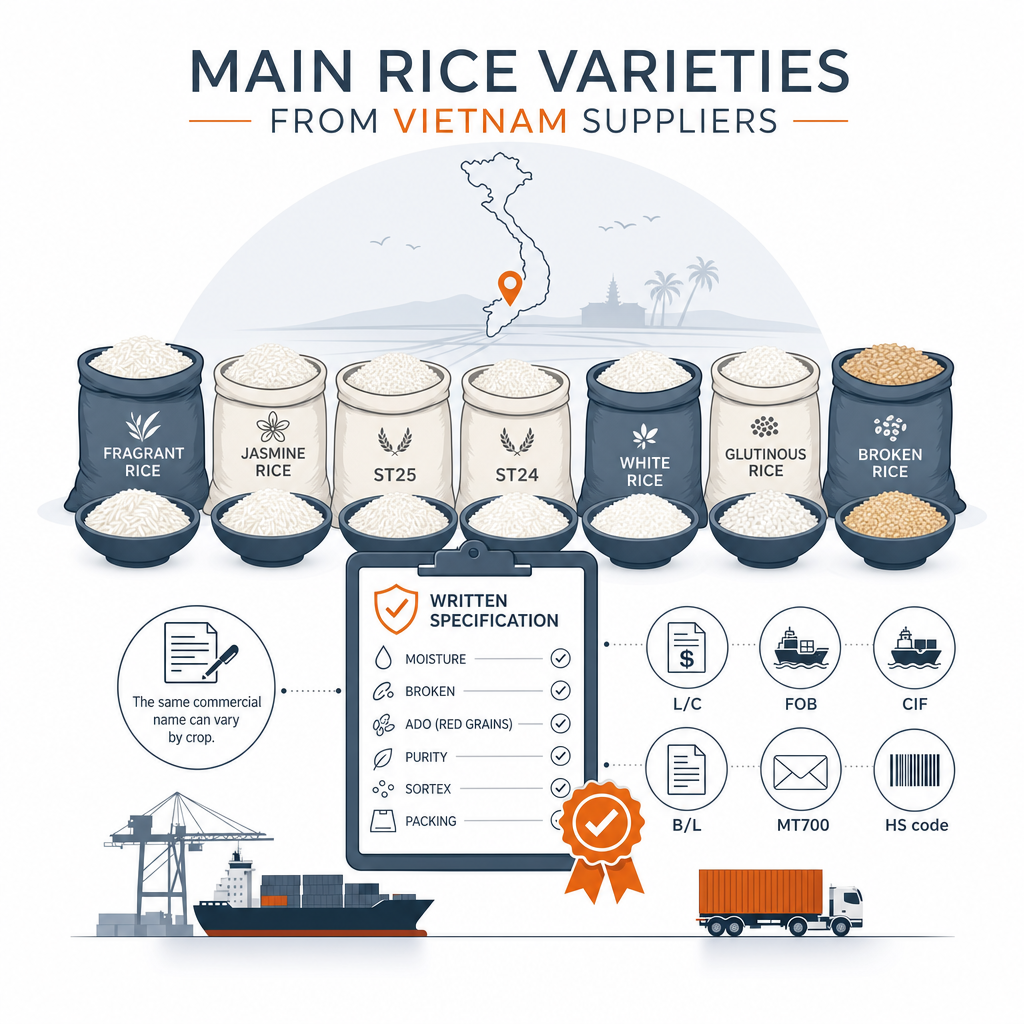
Vietnam suppliers commonly quote fragrant rice, Jasmine rice, ST25, ST24, white rice, glutinous rice and broken rice. The name alone is not enough. You should ask for a written specification because the same commercial name can vary by crop, milling level and buyer market.
A practical shortlist looks like this:
- Vietnamese Jasmine rice supplier: suitable for importers seeking long-grain fragrant rice with soft texture and aroma. Ask for crop season, average grain length, broken percentage, moisture, chalky kernel level and aroma notes.
- ST25 rice supplier Vietnam: useful for buyers who want a premium fragrant profile and stronger consumer branding. Ask for authenticity controls, variety declaration and packaging traceability.
- White rice suppliers: common for foodservice, tenders and wholesale distribution. Compare broken rate, whiteness, polishing level and foreign matter.
- Glutinous rice suppliers: relevant for Asian food manufacturers and distributors. Confirm stickiness, grain uniformity and whether the product is packed for industrial use or retail.
- Broken rice suppliers: used in foodservice, processing and price-sensitive channels. Confirm whether the broken percentage is a ceiling, a range or an approximate commercial grade.
Rice import from Vietnam is also shaped by destination demand. The Philippines, China, Ghana, Côte d’Ivoire, Malaysia and Singapore often appear in Vietnam rice trade flows; import data can be checked through ITC Trade Map. For the United States and European Union, documentation, residue controls and importer responsibility usually receive more scrutiny. For Middle East buyers, bag appearance, cooking performance and reliable shipment windows may decide the order.
For retail programs, request a pre-shipment sample from the production lot, not only a showroom sample. For bulk rice suppliers Vietnam buyers, request container photos, bag marks, fumigation details where needed, and a loading report. A small mismatch in moisture or broken rate can become expensive after arrival, especially if the cargo is sold under a private label.
If your team is new to Vietnamese agriculture categories, the broader Vietnam rice export guide can help you understand exporter vocabulary before you issue an RFQ.
Supplier types: mills, exporters, traders and brokers
Not every supplier advertising Vietnamese rice has the same role. The supplier type affects price control, sample reliability, document speed and dispute handling. Before you compare quotes, ask what function the company performs in the chain.
Mills buy paddy or brown rice, then dry, mill, polish, sort and pack. They usually control quality more directly. Some mills export under their own license; others sell through exporters. A mill can be a strong fit when you need repeat shipments of the same grade and packaging.
Exporters handle contracts, customs paperwork, booking and buyer communication. Some own mills; some contract with partner mills. Exporters are useful when you need export execution and destination-specific documents. Ask whether the exporter will be the shipper on the bill of lading.
Traders source from several mills and may offer flexible supply. They can be helpful during tight crop periods or when you need mixed grades. The trade-off is quality consistency. Ask how they lock the lot after sample approval.
Brokers introduce buyers and sellers, then step away or stay involved for commission. Brokers can help you discover options, but they may not control cargo. Clarify who signs the contract, who receives payment, and who handles claims.
A simple supplier-role table helps during first calls:
| Supplier role | Strength | Buyer question | |---|---|---| | Mill | Direct quality control | Can we inspect the milling and packing site? | | Exporter | Documentation and logistics | Are you the shipper on export documents? | | Trader | Flexible sourcing | How do you reserve the exact lot? | | Broker | Market access | Who is contractually responsible after payment? |
Do not assume the lowest quote is the strongest offer. A slightly higher FOB quote can be better if it includes clearer specs, faster document issuance, and fewer surprises at loading. If your company is replacing a China-based marketplace search, read the Alibaba alternative for Vietnam sourcing article to compare catalogue browsing with RFQ-led sourcing.
How to verify Vietnam rice suppliers before payment
Verification should happen before you send a deposit or open a documentary credit. A polished website is not proof of export capability. Your goal is to connect the supplier’s legal identity, facility, product, bank account and shipment documents into one consistent file.
Start with company identity. Ask for business registration, tax code, export license details where applicable, and the legal name that will appear on the contract. The bank beneficiary should match the contracting party or be explained clearly in writing. If a broker is involved, request a signed authorization from the exporter.
Next, verify facility and production control. Ask for mill address, photos, short videos, and a recent third-party inspection report if available. For food safety certification, request the certificate ID, audit scope, issuing body and expiry date. Avoid accepting a cropped PDF without a certificate number or site address.
Then verify product control. Your purchase file should include:
- Product name and variety
- Crop season or production month
- Broken rate, moisture, foreign matter and grain length
- Packaging material, bag weight and label artwork
- Sample reference code
- Loading port and shipment window
- Claim procedure and inspection point
For destination rules, use official sources. The European Commission explains food import controls for the EU (EU food import controls). The U.S. FDA explains prior notice for imported food shipments (FDA prior notice). These pages do not replace your customs broker, but they help you ask better questions.
ViRFQ supplier checks focus on practical trade signals: identity consistency, export readiness, product fit and responsiveness. The platform does not remove your need for due diligence, but it helps you avoid comparing anonymous screenshots from unrelated sellers.
If you are unsure which documents matter, save the phytosanitary certificate guide and the commercial invoice guide before you approve a proforma invoice.
RFQ specifications for bulk rice suppliers Vietnam
A vague RFQ creates vague quotes. “Need rice price” is not enough. Vietnam rice suppliers need a structured brief so they can price the same product, packing and shipment basis. This is also how you reduce bait-and-switch quotes.
Your RFQ should include the commercial and technical fields below:
- Rice type: Jasmine, ST25, fragrant white, long-grain white, glutinous or broken rice
- Grade: broken percentage, moisture ceiling, foreign matter ceiling and milling level
- Packaging: PP bag, laminated bag, retail pouch, jumbo bag or buyer artwork
- Bag size: common sizes are under the buyer’s market practice; confirm with your distributor
- Quantity: trial container, monthly volume or annual program
- Shipment basis: FOB Cát Lái, CIF destination port or another agreed basis
- Inspection: pre-shipment inspection, loading photos or lab test requirements
- Payment: deposit plus balance, L/C at sight or documentary collection
- Documents: commercial invoice, packing list, bill of lading, certificate of origin, phytosanitary certificate and fumigation certificate where needed
The more precise your RFQ, the easier it is to compare. If one supplier quotes FOB Cát Lái and another quotes CIF Jebel Ali, you are not comparing the same obligation. If one quote includes private-label bags and another uses plain bags, the price gap may be packaging, not rice.
You should also define sample logic. Ask whether the quote is based on a current production sample, a retained sample from a previous lot, or a planned specification. For repeat business, create a reference sample signed by both sides. This reduces arguments when the cargo is milled later.
A strong RFQ also states what is unacceptable. Examples: no mixed variety without written approval, no moisture above the stated ceiling, no change in bag artwork after approval, and no shipment from a different port without notice.
If you want suppliers to quote against the same brief, use the rice RFQ category. For mixed agriculture orders, you can submit a general RFQ and route rice, pepper, cashew or spices to the right supplier pool.
Pricing, Incoterms and payment terms for rice import from Vietnam
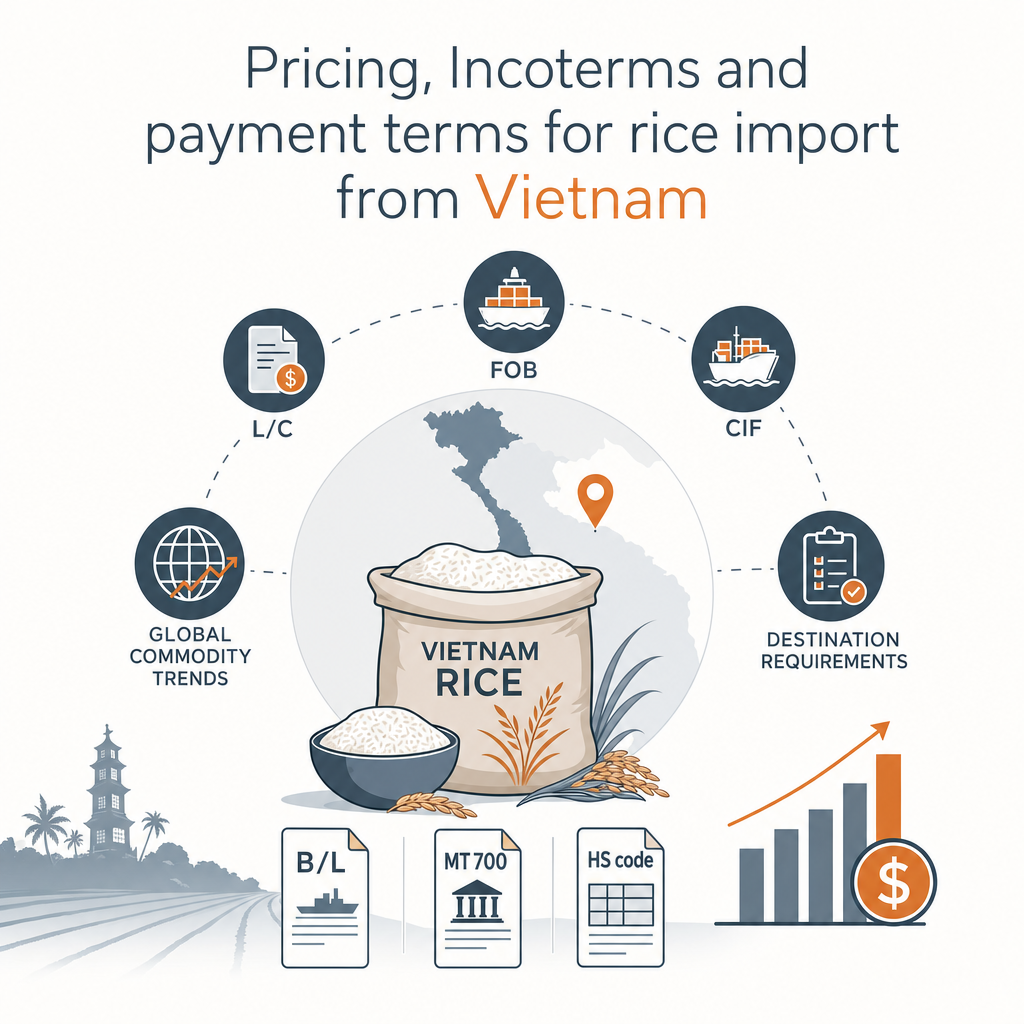
Rice pricing changes with paddy supply, export demand, freight, currency movement and destination rules. The World Bank tracks global commodity trends that can help procurement teams understand the broader environment (World Bank commodity markets). Reuters also follows rice and grain market disruptions that can affect Asian export sentiment (Reuters commodities coverage). These sources are useful context, but your landed cost still depends on a supplier-specific quote.
Most buyers request FOB or CIF. Under FOB, the seller handles export clearance and delivery on board at the named Vietnam port. Under CIF, the seller also arranges main carriage and insurance to the destination port. The International Chamber of Commerce publishes the official Incoterms rule framework (ICC Incoterms rules). For a deeper practical explanation, keep the Incoterms guide for exporters open while reviewing offers.
Payment terms should match order size, relationship history and verification level. Common structures include deposit plus balance against scanned documents, L/C at sight, or documentary collection. Documentary credit practice is guided globally by ICC trade finance rules (ICC trade finance rules). Your bank should confirm exact wording before issuance.
When comparing quotes, build a landed-cost sheet:
- Product price at agreed trade term
- Inland trucking if not included
- Export charges and documentation fees
- Ocean freight and insurance if buyer-controlled
- Import duty, VAT or local charges at destination
- Inspection, testing and financing cost
- Demurrage buffer if port clearance is slow
Ask each Vietnam rice supplier to state quote validity. Rice quotes can expire quickly during active buying windows. If you need board approval, tell the supplier when you can confirm. A serious supplier will either hold the price for a defined period or explain why it must be refreshed.
ViRFQ makes side-by-side comparison easier because suppliers answer one RFQ format. You can see who quoted the same grade, who changed the packing basis, and who answered document questions clearly.
Documents and compliance for Vietnamese rice shipments
Rice documents are not paperwork afterthoughts. They are how your buyer, bank, customs broker and warehouse confirm that the cargo matches the contract. A missing or inconsistent document can delay release, payment or onward sale.
For many shipments, the basic export document set includes commercial invoice, packing list, bill of lading, certificate of origin, phytosanitary certificate and fumigation certificate where required. Some buyers also request a health certificate, analysis report, weight certificate or inspection certificate. Destination rules decide what is mandatory.
The certificate of origin matters when your market grants tariff treatment under a trade agreement. The phytosanitary certificate confirms plant-health inspection. Fumigation documents may be required for wooden packing or destination rules, though rice bag cargo often depends on buyer and port requirements. Check with your customs broker before the supplier prints final documents.
Document consistency is critical. The exporter name, buyer name, product description, bag count, gross weight, net weight, vessel details and port names should align across the invoice, packing list and bill of lading. If the L/C wording says “Vietnamese Jasmine Rice,” but the invoice says “fragrant rice,” your bank may raise a discrepancy.
Use official trade data and ministry updates as background, not as document templates. Vietnam’s Ministry of Agriculture publishes sector information and policy updates (MARD Vietnam). Vietnam Customs publishes trade administration and statistics updates (Vietnam Customs). Your actual document wording should come from the contract, bank instructions and destination broker.
Before shipment, ask the supplier for draft documents. Review them before the vessel departs. This is easier than fixing errors after the original bill of lading is issued. If your shipment uses a letter of credit, have the bank check drafts before final presentation.
Good suppliers welcome document discipline. It protects them too. Clear documents reduce payment delays and prevent disputes caused by translation, product-name or quantity mismatches.
A practical sourcing workflow with Vietnam rice suppliers
Use a staged workflow. It keeps your team from jumping from first email to payment without enough evidence. It also gives suppliers a fair way to compete.
Step one: define the business case. Decide whether you are buying for retail shelves, foodservice, tender supply or manufacturing. Your use case drives the grade, bag, label, shipment size and inspection level.
Step two: issue a structured RFQ. Include product specs, packaging, destination port, trade term, quantity, shipment window and payment preference. Ask suppliers to quote in a fixed template. This prevents hidden assumptions.
Step three: shortlist by capability, not just price. Review legal identity, export role, product fit, response speed, sample quality and document clarity. A supplier who answers every technical question may be more reliable than one who only sends a one-line price.
Step four: approve samples and lock a reference. Keep one signed sample with the buyer and one with the seller. If you need lab testing, agree on the test lab and claim threshold before production.
Step five: confirm contract and payment wording. The contract should state grade, tolerance, packing, shipment basis, inspection point, payment term, document list and claim window. Avoid vague phrases such as “standard quality.”
Step six: monitor loading and documents. Request loading photos, container number, seal number and draft documents. Confirm that bag marks and document descriptions match your import requirements.
Step seven: review arrival feedback. Track cooking performance, breakage, moisture, packaging condition and customer complaints. Use this feedback before the next order.
A USDA trade report notes that Vietnam’s rice sector is shaped by export demand, domestic production and government policy (USDA). In buyer terms, that means you should not rely on last season’s quote forever. Reconfirm supply and price each cycle.
ViRFQ fits this workflow when you want comparable offers from verified Vietnam suppliers without sending the same email to many unknown contacts. Start with one clear RFQ, then move to sample, contract and shipment control.
FAQ
How do I find reliable vietnam rice suppliers for bulk orders?
Start with a structured RFQ that states rice type, broken rate, moisture, packaging, destination port and payment term. Then verify legal identity, export role, facility address, bank beneficiary and document samples. Ask whether the supplier is a mill, exporter, trader or broker. Compare responses on capability and clarity, not only price.
Which Vietnamese rice varieties are common for importers?
Common export varieties include Jasmine, ST25, ST24, fragrant white rice, long-grain white rice, glutinous rice and broken rice. The right choice depends on your market. Retail buyers often focus on aroma, grain appearance and packaging. Foodservice buyers may focus on cooking yield, broken percentage and consistent supply.
Are Vietnam rice exporters usually mills or trading companies?
They can be mills, exporters, traders or brokers. Some companies own milling facilities and export directly. Others coordinate with partner mills and handle contracts, documents and logistics. Ask who controls the cargo, who signs the contract, who appears on the bill of lading and who handles claims after arrival.
What documents are needed to import rice from Vietnam?
A typical shipment may need a commercial invoice, packing list, bill of lading, certificate of origin, phytosanitary certificate and fumigation certificate if required. Some destinations request additional analysis or health documents. Always confirm the final list with your customs broker and bank before shipment.
How should I compare FOB rice quotes from Vietnam suppliers?
Compare quotes only when product grade, broken rate, moisture, packaging, quantity, loading port, inspection terms and quote validity are the same. A cheaper-looking quote may exclude bags, documents or inland handling. Ask each supplier to confirm what is included and what would be charged separately.
Is Jasmine rice from Vietnam suitable for retail brands?
Yes, Vietnamese Jasmine rice can suit retail brands when aroma, grain length, moisture, broken percentage and packaging are controlled. Request current production samples, label mockups and lot traceability. For repeat orders, keep a signed reference sample so later shipments can be compared against the approved standard.
Can I buy ST25 rice directly from Vietnam suppliers?
Yes, but ask for variety confirmation, current crop details, packaging options and supplier identity. ST25 is a branded consumer-facing variety in many markets, so authenticity and label control matter. Use a clear contract and request samples from the lot intended for shipment whenever possible.
What payment terms are common for rice import from Vietnam?
Common payment structures include deposit plus balance before release, balance against scanned documents, L/C at sight, or documentary collection. The right term depends on supplier history, order value and your bank’s requirements. For a first shipment, many buyers prefer stronger document control and bank review.
Ready to compare Vietnam rice suppliers without chasing scattered catalogues? ViRFQ lets you send one structured RFQ for Jasmine, ST25, white, glutinous or broken rice and receive comparable offers from Vietnam suppliers. Include your specs, destination port and shipment window, then review responses in one workflow. Start here: /en/rfq/rice
Sources
- Vietnam Customs
- USDA Foreign Agricultural Service
- FAO FAOSTAT
- ITC Trade Map
- European Commission Food Safety
- U.S. Food and Drug Administration
- World Bank Commodity Markets
- Reuters Commodities
- International Chamber of Commerce
- International Chamber of Commerce
- Vietnam Ministry of Agriculture and Rural Development