How to Verify a Vietnamese Coffee Supplier 2026
Reviewed by Phan Hà Thái, Founder ViRFQ
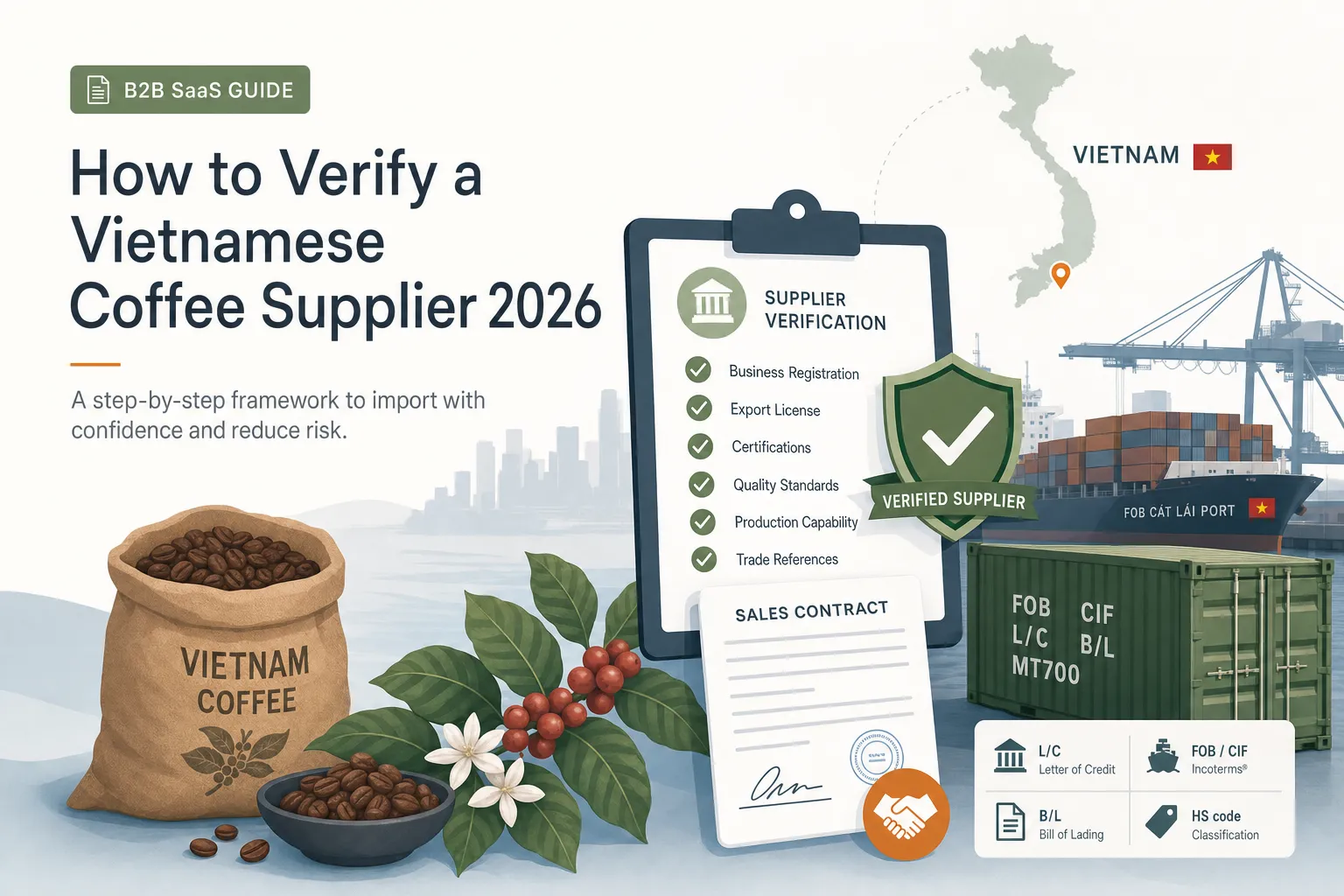
How to verify a vietnamese coffee supplier starts with evidence: Vietnam is the second-largest coffee exporter by volume, with ICO market report data showing Robusta dominance, while Vietnam Customs data reported coffee export value above $5 billion in a recent full year. This guide gives a buyer-side checklist for licenses, samples, documents, and payment controls via ViRFQ.
Start with company identity, export scope, and Vietnam coffee origin
Before you discuss price, verify that the supplier exists, exports coffee legally, and can trace the beans to a real producing area such as Đắk Lắk, Lâm Đồng, Gia Lai, or Đắk Nông. A polished website is not enough. Ask for the Vietnamese business registration name, tax code, registered address, factory or warehouse address, and the name of the export license holder.
Cross-check the company name across the proforma invoice, email signature, bank account, and packing documents. If one entity sells, another entity invoices, and a third entity receives money, pause and ask for a written explanation. Trading companies can be legitimate, but the commercial chain must be clear.
Use market context, not just the supplier’s claims. ICO market report coverage confirms Vietnam’s role as a major Robusta origin, and Vietnam Customs data is the reference point for export value trends. ITC Trade Map can help you check whether a supplier’s claimed destination markets are plausible.
A practical first screen looks like this: - Business registration name matches the invoice issuer. - Export scope includes coffee, agricultural goods, or food products. - Address can be found on maps and matches warehouse photos. - Phone domain, email domain, and staff names are consistent. - The supplier can name origin provinces, crop period, grade, and port.
If you are building a shortlist of coffee suppliers in Vietnam, keep a simple verification file for every candidate. Add screenshots, registration documents, sample photos, email trails, and call notes. This turns sourcing from a memory exercise into an auditable process.
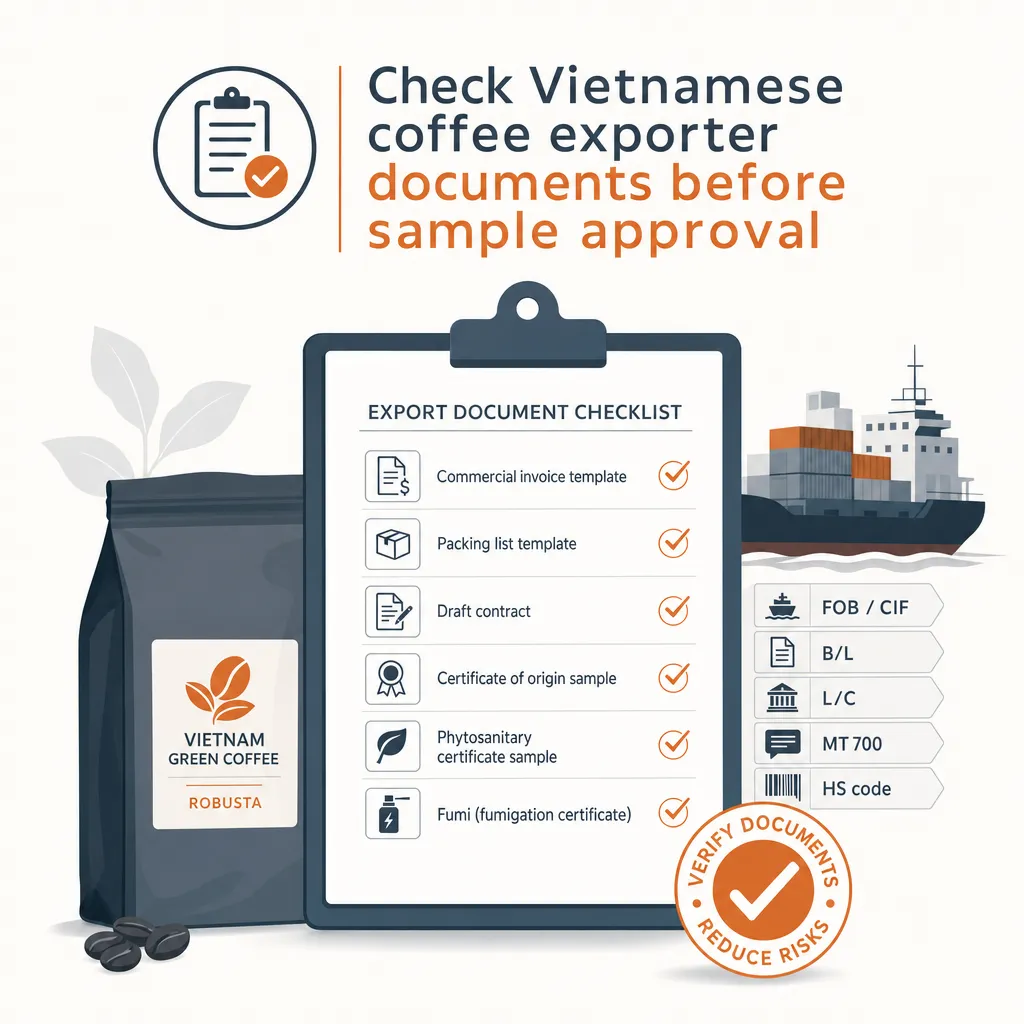
Check Vietnamese coffee exporter documents before sample approval
Documents tell you whether the supplier understands export work. For green coffee, ask for a recent commercial invoice template, packing list template, draft contract, certificate of origin sample, phytosanitary certificate sample, and fumigation document sample if your destination requires it. For roasted coffee or private label coffee, add a label file, ingredient statement, shelf-life statement, and food safety documentation.
Do not accept cropped images or blurred PDF scans. Ask for complete sample documents with sensitive buyer data hidden. The supplier should be able to explain who issues each document, when it is issued, and which information must match the bill of lading.
For payment by letter of credit, ask your bank to align wording with ICC rules on documentary credits. Vague L/C clauses create delays. For wire transfer, match the beneficiary name to the contracting entity and avoid sudden bank-account changes by email.
Here is a simple document logic check:
| Document | What to verify | Red flag |
|---|---|---|
| Proforma invoice | Seller, buyer, grade, price term, shipment window | Bank name differs from seller |
| Packing list | Bag count, net weight, gross weight, marks | Weight does not match invoice |
| Certificate of origin | Country, product, exporter | Issuer or exporter name is unclear |
| Phytosanitary document | Botanical product details | Supplier says it is never needed |
| Bill of lading | Shipper, consignee, port, vessel | Draft arrives after payment pressure |
For deeper reading, use a proforma invoice checklist and bill of lading basics before you approve the final contract. If the paperwork feels improvised, the shipment probably will too.
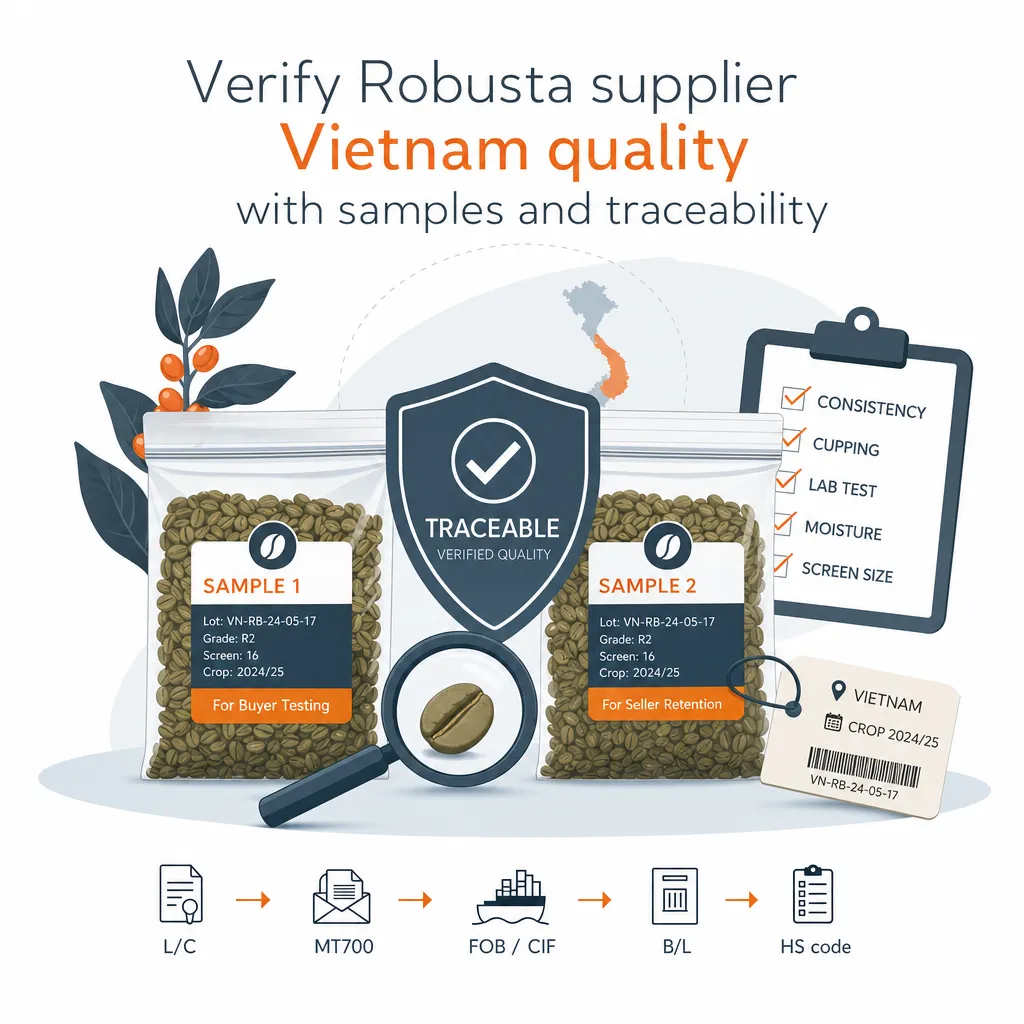
Verify Robusta supplier Vietnam quality with samples and traceability
Sample approval should test consistency, not just taste. Ask for two samples from the same lot when possible: one for your cupping or lab team, and one retained by the seller. Label both with lot code, grade, screen size if applicable, crop period, moisture target, defect tolerance, and warehouse location.
For green Robusta, request clear photos of bags, stitch marks, inner lining, sample seal, and the warehouse floor. Ask whether the lot is already assembled or still being collected. A supplier offering a very low price on a lot that does not yet exist is asking you to accept execution uncertainty.
Use your own cupping notes. Do not rely on the supplier’s description of chocolate, nutty, or clean cup. If you lack a lab, appoint an independent inspection company or a trusted local agent for pre-shipment checks. The goal is not perfection. The goal is to prove that the approved sample and shipped cargo are commercially comparable.
When buyers post your coffee RFQ on ViRFQ, they can request supplier responses in a structured format: origin province, grade, shipment port, sample availability, documentation capacity, and preferred payment term. That makes it easier to compare offers without losing key details in chat threads.
A strong sample process includes: - Lot code written on the sample bag and invoice draft. - Photos taken before dispatch and upon receipt. - Moisture, defect, and screen expectations written in the contract. - A retained counter-sample kept until dispute windows close. - Pre-shipment inspection rights stated before deposit payment.
If you need a broader process map, read how to import Vietnamese coffee and adapt the steps to your destination rules.
Assess EUDR, origin claims, and compliance readiness for EU buyers
EU buyers need more than a good cup profile. Coffee shipments must increasingly be tied to origin evidence, supplier due diligence, and buyer records. The EU deforestation rule is the key reference for importers selling into the European Union, while the USDA Vietnam coffee report is useful for crop and production context.
Ask early whether the supplier can provide farm, cooperative, or collector-level traceability. The answer may vary by product. Estate coffee, cooperative lots, and certified programs are usually easier to trace than spot-market mixed lots. If the supplier only says “Vietnam origin” without province, collector, or warehouse chain, keep asking.
You do not need to turn the first call into a legal audit. You do need to know whether the supplier can support the claims printed on your purchase order. Ask for: - Origin province and district when available. - Lot assembly method: single farm, cooperative, trader lot, or warehouse blend. - Internal traceability record format. - Any third-party audited food safety certificate, with certificate number and audit year shown. - Written statement on deforestation-related records for EU-bound shipments.
Be careful with marketing language. “Direct from farm” can mean a real farmer relationship, or it can mean the exporter bought from a local collector. Ask for photos, purchase records, and traceability fields, not slogans.
For non-EU importers, traceability still matters. It helps you handle customer questions, quality claims, and repeat orders. It also lets you compare suppliers on operational maturity rather than just FOB Cát Lái or FOB Ho Chi Minh City price.
Use payment, contract, and logistics controls to reduce fraud exposure
Verification is not complete until the contract, payment term, and shipment control match the supplier’s risk profile. A new supplier should not receive a large deposit based only on WhatsApp messages, a website, or a low FOB quote. Put the grade, sample reference, shipment window, port, packaging, inspection rights, and dispute process in writing.
Start with a smaller trial order if your business model allows it. If the supplier refuses any sample, refuses a video call, refuses document review, and pushes for immediate payment, treat that as a combined warning sign. One red flag can have an explanation. Several red flags form a pattern.
Common payment structures include partial deposit with balance against document copies, L/C at sight, or payment through an escrow-style workflow where available. Your bank, insurer, and freight forwarder should review the structure before you send funds.
Logistics checks matter too. Ask for the usual loading port, freight forwarder contact, container stuffing process, and draft shipping document timeline. If the supplier cannot explain how coffee moves from warehouse to port, they may be a broker with limited control.
Finally, compare the channel you use. Open directories can be useful for discovery, but they often leave verification work to the buyer. If you want a Vietnam-focused RFQ workflow, compare ViRFQ vs Alibaba sourcing and choose the model that fits your team’s risk tolerance.
A simple rule works: verify identity before price, verify documents before payment, and verify cargo before final acceptance. That discipline prevents most expensive sourcing mistakes.
FAQ
How do I verify a Vietnamese coffee supplier before paying?
Start with the legal company name, tax code, address, export scope, and bank beneficiary. Then request sample documents, hold a video call, approve a labeled sample, and write quality terms into the contract. Do not pay if the invoice entity, bank account, and supplier identity do not match.
What documents prove a Vietnam coffee exporter is real?
No single document proves everything. Ask for business registration, tax details, proforma invoice, commercial invoice template, packing list template, certificate of origin sample, phytosanitary sample, and draft bill of lading format. The names, addresses, product details, and shipment terms should align across all files.
Does the 15-15-15 coffee rule help verify suppliers?
The 15-15-15 rule is not a formal import verification rule. Buyers sometimes use it as a practical sample routine for timing, tasting, or consistency notes. It can support quality review, but it does not replace company checks, export documents, traceability records, or payment controls.
How can EU buyers check EUDR readiness for Vietnamese coffee?
Ask whether the supplier can provide origin province, lot traceability, collector or cooperative records, and deforestation-related due-diligence data. EU buyers should also confirm what information their importer of record, customs broker, and legal team require before signing a long-term supply contract.
Is there a tariff on coffee from Vietnam for importers?
Tariffs depend on destination country, product form, HS classification, and trade agreements. Green coffee, roasted coffee, extracts, and private-label products may be treated differently. Always confirm duty, VAT, and documentation requirements with your customs broker before comparing supplier quotes.
If you want structured quotes instead of scattered supplier chats, use ViRFQ to compare Vietnam coffee exporters by origin, grade, documents, sample readiness, and payment term. You can describe your Robusta or Arabica requirement once, then review supplier responses side by side. Start with a clear buyer brief and post your coffee RFQ on ViRFQ at /en/rfq/coffee.
Sources
Reviewed by
Founder & CEO, ViRFQ
Phan Hà Thái is the founder and CEO of ViRFQ, the buyer discovery and buyer management platform (and B2B marketplace) for Vietnamese agricultural exporters. His background is in international trade finance and Vietnamese agricultural exports. He writes and reviews the ViRFQ blog analyses on FOB pricing, Letter of Credit (L/C) workflows, EUDR compliance, and supplier verification.
Related articles
Vietnam Black Pepper Price 2026 Guide
9 phút
Robusta coffee Vietnam FOB: price + quality grades 2026
9 phút
How to Import from Vietnam — Full Process Guide 2026
9 phút
Vietnam supplier verification — 10-step due diligence 2026
9 phút
Vietnam pangasius fillet supplier — sourcing playbook 2026
9 phút