Vietnam Black Pepper Price 2026 Guide
Reviewed by Phan Hà Thái, Founder ViRFQ
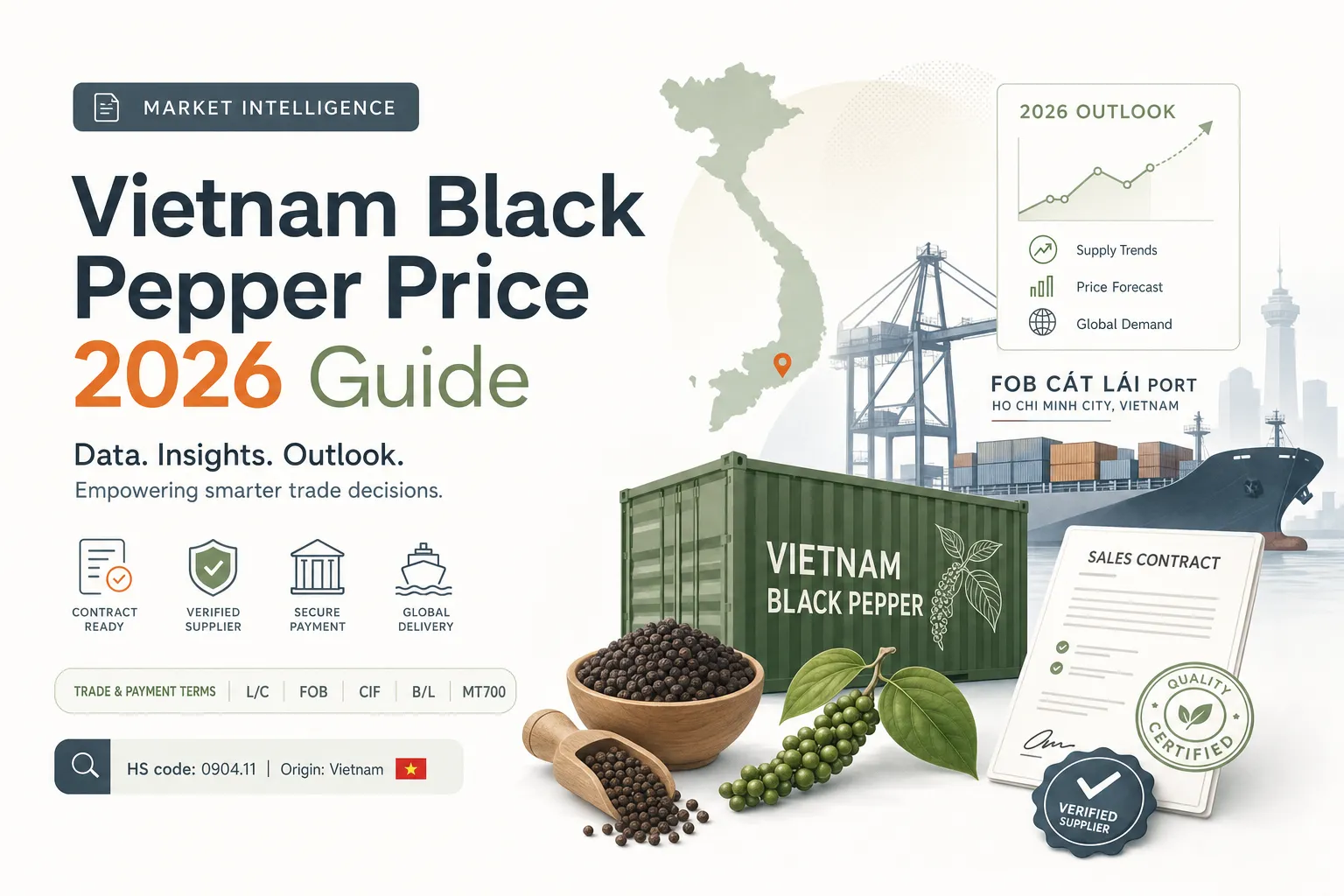
Vietnam black pepper price — 2026 market intelligence (IPC) starts with live origin quotes: Viet Nam black pepper 500 g/l at $6,100/t (IPC) and the black pepper indicator at $7,158/t (IPC). This guide turns those numbers into buying actions for importers using ViRFQ.
What current Vietnam pepper export price signals mean
The current Vietnam pepper export price is not just a spot quote. It reflects farmgate holding power in Bình Phước, Đắk Nông, Gia Lai, warehouse stock in Ho Chi Minh City, and buyer urgency from the USA, EU, MENA, Korea, and Japan. When the International Pepper Community posts Viet Nam black pepper 500 g/l at $6,100/t (IPC), buyers should read it as an origin benchmark, not a landed cost.
For importers, the practical question is: what is included in the quote? A supplier may quote FOB Cat Lai, FOB Ho Chi Minh City, CFR Jebel Ali, or CIF Rotterdam. The number changes when freight, insurance, fumigation, banking charges, and document handling are included. If you compare one FOB offer with one CIF offer, the spread can look larger or smaller than reality.
Use three quote layers: - Origin benchmark: IPC and exporter indications. - Supplier offer: grade, moisture, density, packing, payment terms, shipment window. - Landed comparison: freight, insurance, duty, inland trucking, finance cost.
A clean RFQ should specify black pepper per ton Vietnam, grade, packing, loading port, destination, and payment term. Ask suppliers to separate product price, local charges, and freight. That makes counteroffers easier and prevents confusion during contract approval.
If you are still building your supplier list, see verified Vietnam pepper suppliers and compare each offer against the same specification sheet. The gap between a fast quote and a usable quote is often the missing detail.
Why black pepper price forecast models show tight supply
A useful black pepper price forecast starts with supply, not with a chart. Vietnam remains a central origin for global black pepper trade, but supply can tighten when farmers delay selling, coffee competes for land and labor, and carryover stock is thin. The IPC market review is a good recurring source for origin movement, while FAOSTAT crop data helps buyers understand longer production cycles.
Pepper is a perennial crop. Farmers cannot add major new supply in a few weeks. If prices rise quickly, more material may come out of farm storage, but new crop volume still depends on acreage, weather, and disease pressure. In the Central Highlands and Southeast Vietnam, many growers compare pepper margins with coffee, durian, and other cash crops before reinvesting.
Demand is also changing. Food manufacturers want stable grind yield, low foreign matter, and reliable shipment dates. Distributors want smaller lots but faster replenishment. Retail spice brands ask for traceability and third-party audited processing. These needs can push buyers toward factories with stronger cleaning lines, metal detection, steam treatment access, and document teams.
A forecast should therefore be a scenario, not a single promise: - Base case: firm prices if supply stays tight and buyers cover only near-term demand. - Upside case: stronger prices if multiple destinations restock at the same time. - Downside case: softer prices if farmers release stock and freight eases.
The practical move is to split coverage. Secure core volume with trusted exporters, then keep a smaller floating portion for later tenders. That approach works better than waiting for one perfect entry point.
How to time FOB Vietnam pepper contracts
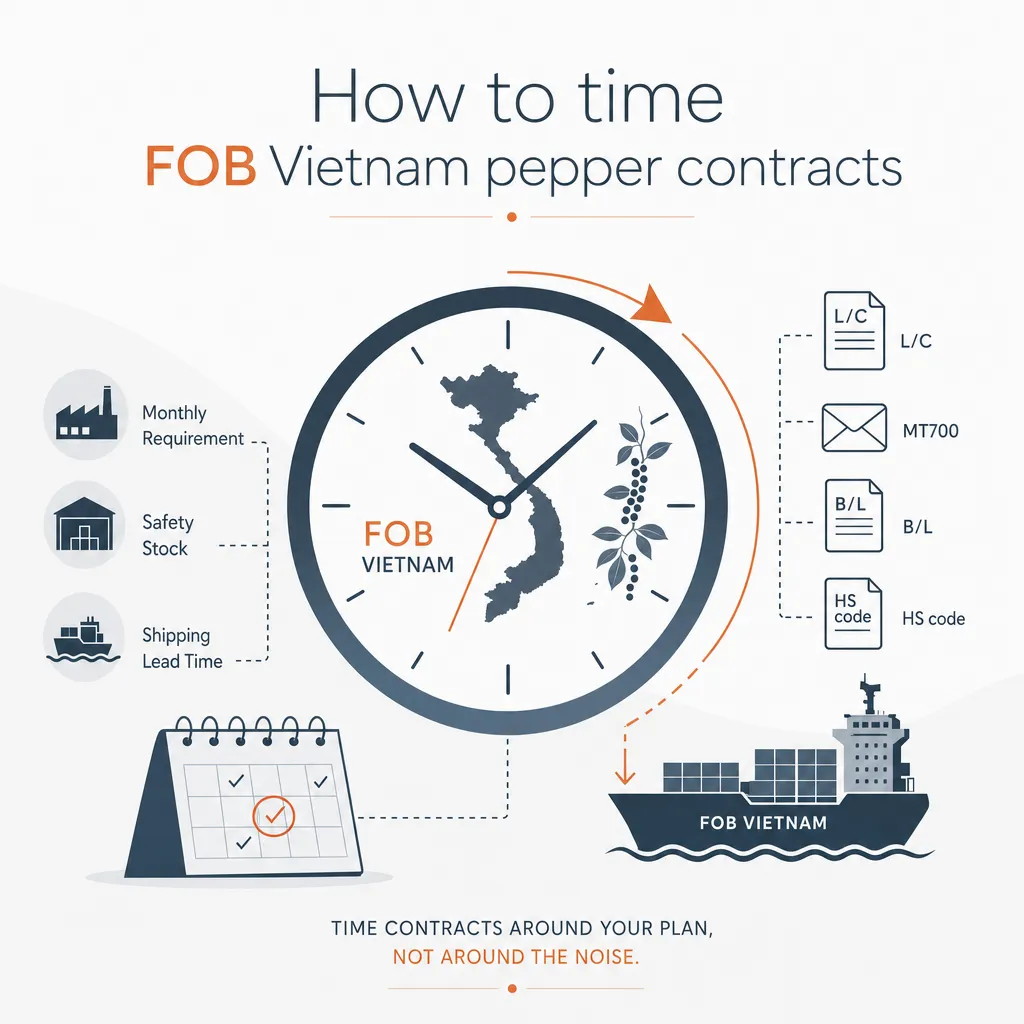
FOB Vietnam pepper contracts should be timed around your consumption schedule, not around social media price calls. Start with your factory’s monthly requirement, safety stock, and shipping lead time. Then work backward from the latest acceptable arrival date. A buyer in Rotterdam, Los Angeles, Jeddah, Busan, or Yokohama will have different freight and customs buffers.
For FOB comparisons, the main costs sit after the cargo crosses the ship’s rail or the agreed handover point under Incoterms rules. The ICC Incoterms rules explain how responsibility is divided, but your commercial team should still check local charges, booking control, and insurance. If you need a refresher, the FOB vs CIF exporter guide gives a simple comparison you can share internally.
Contract timing is easier when your RFQ asks suppliers for validity. A quote valid for one day is not the same as a quote valid for one week. In a firm market, exporters may quote conservatively because they must replace raw material quickly. ViRFQ users often request quote validity, sample timeline, and shipment window in the same message so procurement can decide faster.
Use this contract checklist: - Product: black pepper, FAQ or ASTA style specification, density, moisture, foreign matter. - Packing: PP bags, kraft bags, cartons, or buyer label. - Trade term: FOB Cat Lai or another named port. - Payment: deposit plus balance, T/T, or L/C at sight. - Documents: commercial invoice, packing list, bill of lading, phytosanitary certificate, fumigation certificate if required.
When prices are moving, ask for partial shipment options. A split schedule can protect your production line without forcing you to buy all volume at one daily quote.
Quality factors that change black pepper per ton Vietnam
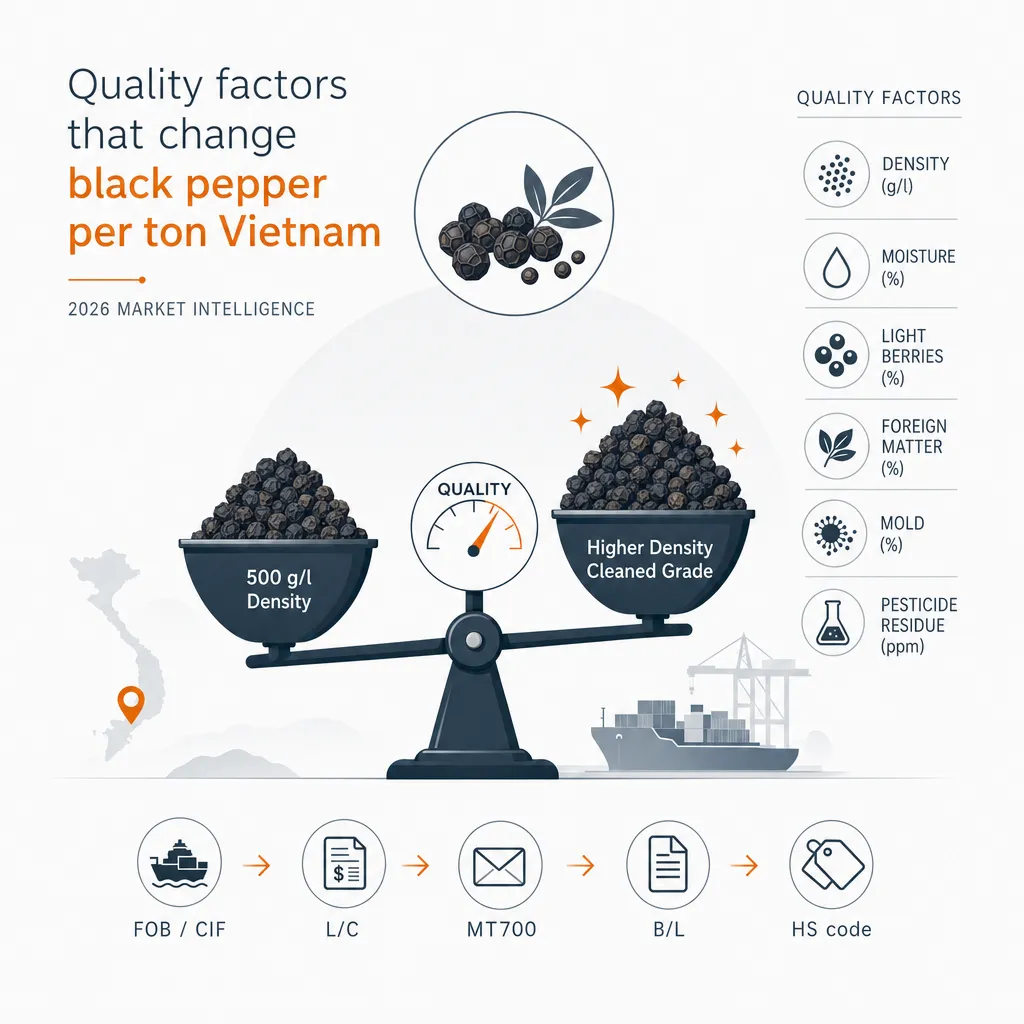
Black pepper per ton Vietnam changes with grade. Two offers may both say “black pepper,” yet one may be 500 g/l density and another may be a higher-density cleaned grade. Density, moisture, light berries, foreign matter, mold, pesticide residue, and microbiological control all affect value. A lower quote can become expensive if it fails arrival inspection or needs extra cleaning.
Start with intended use. A spice grinder may accept a different spec than a retail brand packing whole peppercorns. A meat processor may focus on steam-treated material and microbiological control. An importer serving EU customers may request residue screening and traceability. These requirements should be in the RFQ before price negotiation begins.
Trade classification also matters. Black pepper is commonly traded under HS 090411 (ITC Trade Map), and buyers can use trade databases to study origin flows and destination demand. For Vietnam-specific export monitoring, Vietnam Customs is the official source to watch for monthly value and volume releases. MARD is also useful for agriculture policy and crop context.
Ask suppliers for a recent lot photo, pre-shipment sample, and lab parameters. If the cargo is for a regulated buyer, request the certificate name, issuing body, audit date, and certificate ID where relevant. Avoid relying on a badge in a brochure. A serious exporter can explain which processing step supports each claim.
For supplier diligence beyond pepper, the Vietnam supplier verification due diligence guide is a helpful checklist. It shows how to review business registration, export history, site photos, references, and document consistency before you place a larger order.
RFQ workflow for comparing Vietnam pepper suppliers
A structured RFQ turns a volatile market into comparable decisions. Instead of asking “what is your price,” ask for a full offer format. This helps Vietnam pepper suppliers quote the same cargo, the same trade term, and the same shipment month. It also helps your finance team compare payment terms without slowing down procurement.
Use this RFQ template: - Product: Vietnam black pepper, whole, cleaned. - Grade: density, moisture, foreign matter, light berries, mold tolerance. - Quantity: trial lot first, then repeat monthly volume. - Packing: bag type, net weight, pallet requirement. - Term: FOB Cat Lai, CFR, or CIF destination. - Shipment: earliest shipment date and latest acceptable shipment date. - Documents: commercial invoice, packing list, bill of lading, phytosanitary certificate, certificate of origin if needed. - Offer validity: exact expiry time and currency.
On ViRFQ, buyers can post a pepper RFQ and receive supplier responses in one place. That is useful when you need to compare exporters in Bình Phước, Đắk Nông, Ho Chi Minh City, and other sourcing points without managing scattered email threads. You can also reference the Vietnam pepper suppliers guide or the Vietnam vs India pepper comparison when your team is deciding whether to diversify origin coverage.
The final step is shortlisting. Keep two or three qualified exporters active, not just one. Request samples from the strongest candidates, compare lab results, then negotiate shipment schedule and payment terms. For repeat business, track on-time shipment, claim handling, document accuracy, and responsiveness. Price matters, but repeat reliability is what protects your production plan.
FAQ
Will Vietnam black pepper prices increase this season?
Prices can rise if farmers hold inventory, buyers restock together, or nearby origins quote firmer levels. They can also soften if more farm stock is released. Use IPC updates, supplier offers, and freight checks together. Do not rely on one forecast post; run an RFQ and compare firm validity windows.
How much is black pepper per ton in Vietnam now?
A recent IPC reference showed Viet Nam black pepper 500 g/l at $6,100/t (IPC) and a black pepper indicator at $7,158/t (IPC). Treat those as benchmarks. Your real landed cost depends on grade, packing, trade term, freight, insurance, documents, and destination charges.
What drives Vietnam pepper export price changes?
Main drivers include crop size, farmer selling pace, warehouse stock, export demand, exchange rates, and freight. Quality requirements also matter. A steam-treated or tightly screened lot can price above a basic cleaned lot because processing cost and rejection control are different.
When should importers lock FOB Vietnam pepper?
Lock core volume when the offer matches your quality spec, shipment window, and budget. Keep some flexible volume if your production plan allows it. In a firm market, waiting for a sharp dip can leave you short on approved suppliers and samples.
How do I compare Vietnam pepper suppliers safely?
Use one RFQ template, request business registration, ask for recent lot photos, check sample quality, and verify document consistency. Compare payment terms and claim handling, not only price. A supplier with clear documents and realistic validity is often easier to manage.
If you need live Vietnam pepper quotes, build one clear specification and let suppliers compete on the same terms. ViRFQ helps importers compare offers, samples, documents, and shipment windows from Vietnam exporters. Start with a focused request for grade, packing, trade term, and destination, then post a pepper RFQ at /en/rfq/pepper.
Sources
- International Pepper Community price reference
- International Pepper Community market review
- FAOSTAT crops and livestock products
- International Chamber of Commerce Incoterms rules
- International Trade Centre Trade Map
- General Department of Vietnam Customs
- Vietnam Ministry of Agriculture and Rural Development
Reviewed by
Founder & CEO, ViRFQ
Phan Hà Thái is the founder and CEO of ViRFQ, the buyer discovery and buyer management platform (and B2B marketplace) for Vietnamese agricultural exporters. His background is in international trade finance and Vietnamese agricultural exports. He writes and reviews the ViRFQ blog analyses on FOB pricing, Letter of Credit (L/C) workflows, EUDR compliance, and supplier verification.
Related articles
Robusta coffee Vietnam FOB: price + quality grades 2026
9 phút
How to Import from Vietnam — Full Process Guide 2026
9 phút
Vietnam supplier verification — 10-step due diligence 2026
9 phút
Vietnam pangasius fillet supplier — sourcing playbook 2026
9 phút
Vietnamese Cashew W320 Exporter Specifications 2026
9 phút