Vietnam vs India Pepper Comparison 2026 Guide
Reviewed by Phan Hà Thái, Founder ViRFQ
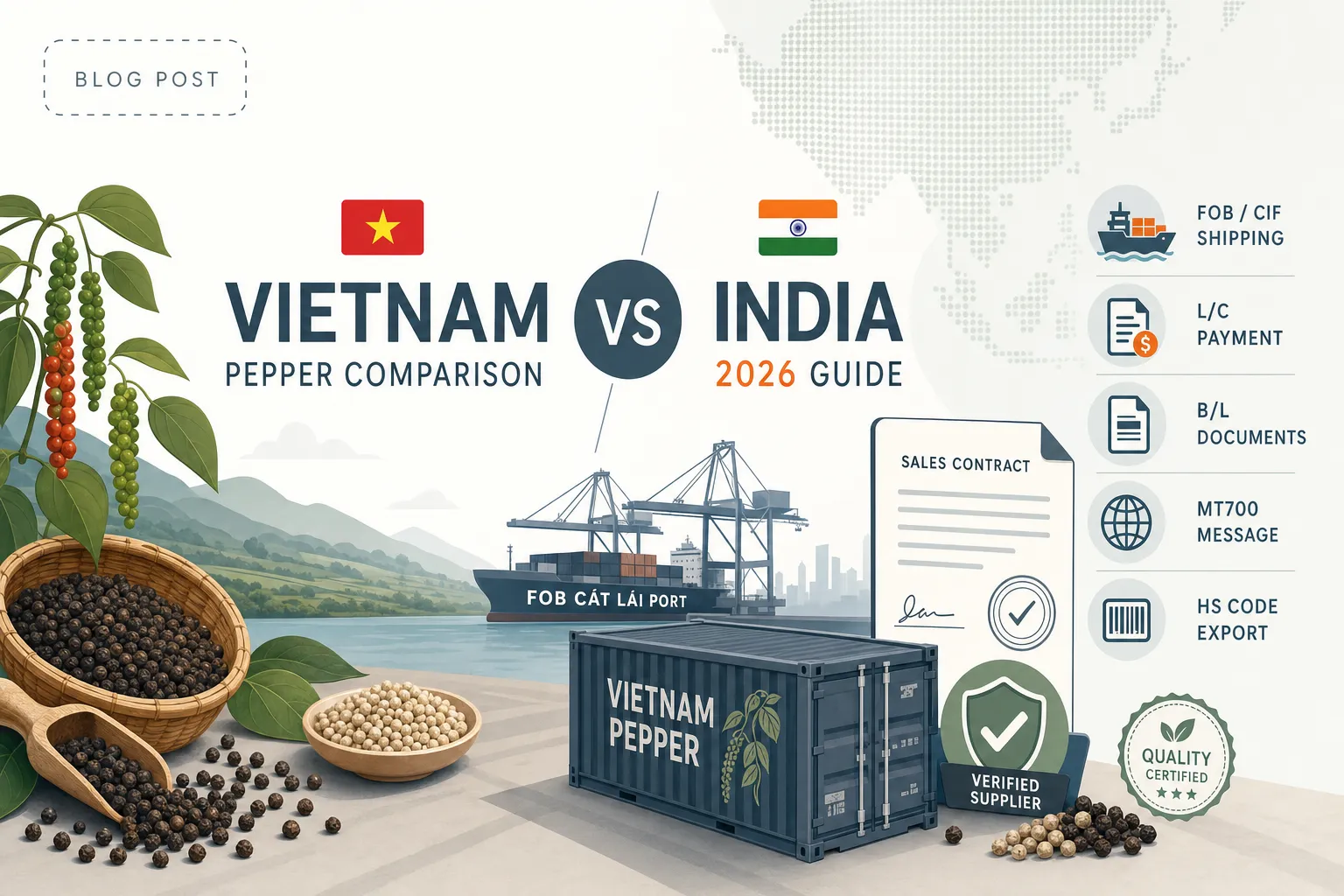
Vietnam vs India pepper comparison starts with scale and use case: Vietnam supplies about 40% of global pepper trade VPSA, while India’s export share is commonly below 10% ITC Trade Map. The practical angle: choose Vietnam for volume, consistent specs, and RFQs through ViRFQ; choose India for terroir-led retail.
Vietnam black pepper vs India black pepper: the short answer
Vietnam black pepper is usually the better fit when you need container-scale supply, repeatable grading, and quick supplier comparison. India black pepper is usually the better fit when your buyer values a known origin story, especially Malabar or Tellicherry-style positioning, and can accept smaller lots or higher premiums.
For importers, the real question is not which origin is universally better. It is which origin matches your channel. A food manufacturer buying ground pepper for sauces wants different things from a specialty grocer selling whole peppercorns in glass jars. Vietnam serves the first need well because exporters in Bình Phước, Đắk Nông, Gia Lai, and Đắk Lắk are used to bulk export documentation and uniform lots. India serves the second need well because Kerala and Karnataka have strong culinary recognition.
The scale gap matters. Vietnam is widely cited near 40% of global pepper trade VPSA. India is a large producer and consumer, but its export share is commonly below 10% ITC Trade Map. That means Vietnam tends to offer more supplier options for standard black pepper, white pepper, and processed pepper products.
Use Vietnam when you need: - Several comparable quotes for the same moisture, density, and cleanliness target. - Faster sampling across black pepper, white pepper, cracked pepper, and powder. - Exporters familiar with phytosanitary documents, fumigation, and commercial invoices.
Use India when you need: - A premium origin message for retail shelves. - Malabar pepper or another recognized regional story. - A smaller but more culinary-focused procurement brief.
Flavor, aroma, and quality differences by origin
Vietnamese pepper is often described as bold, sharp, and clean. It can be very practical for industrial buyers because the heat is direct and the profile blends well into seasoning mixes, meat processing, instant noodles, sauces, and frozen meals. The flavor may feel simpler than a premium Indian lot, but that is not a flaw if the product needs consistency rather than a long finish.
India black pepper, especially Malabar pepper, is often bought for aroma and origin identity. Buyers may describe it as warmer, more rounded, and more complex. That makes it attractive for specialty retail, gourmet spice blends, and restaurants that want to tell an origin story. The trade-off is that availability and pricing may vary more because local consumption absorbs much of India’s crop.
A buyer should compare lots by specification, not only by country name. Ask each supplier for: - Moisture level and drying method. - Bulk density range and foreign matter limit. - Defect tolerance, light berry percentage, and cleaning process. - Sterilization option if your market requires low microbial counts. - Recent pesticide residue test from an accredited lab.
Vietnamese pepper suppliers can deliver a wide range of profiles, from standard FAQ-grade black pepper to higher-density cleaned lots. Indian exporters can also supply excellent quality, but the best lots are often positioned for premium channels. According to Spices Board India, pepper remains a core Indian spice category with strong domestic relevance.
If you are buying for a private-label jar, run triangle tasting with your sales team. If you are buying for a factory recipe, run lab tests and pilot production first. Sensory preference matters, but rejection risk usually comes from specs, residues, moisture, or inconsistent documentation.
Supply reliability, export paperwork, and pepper sourcing Vietnam
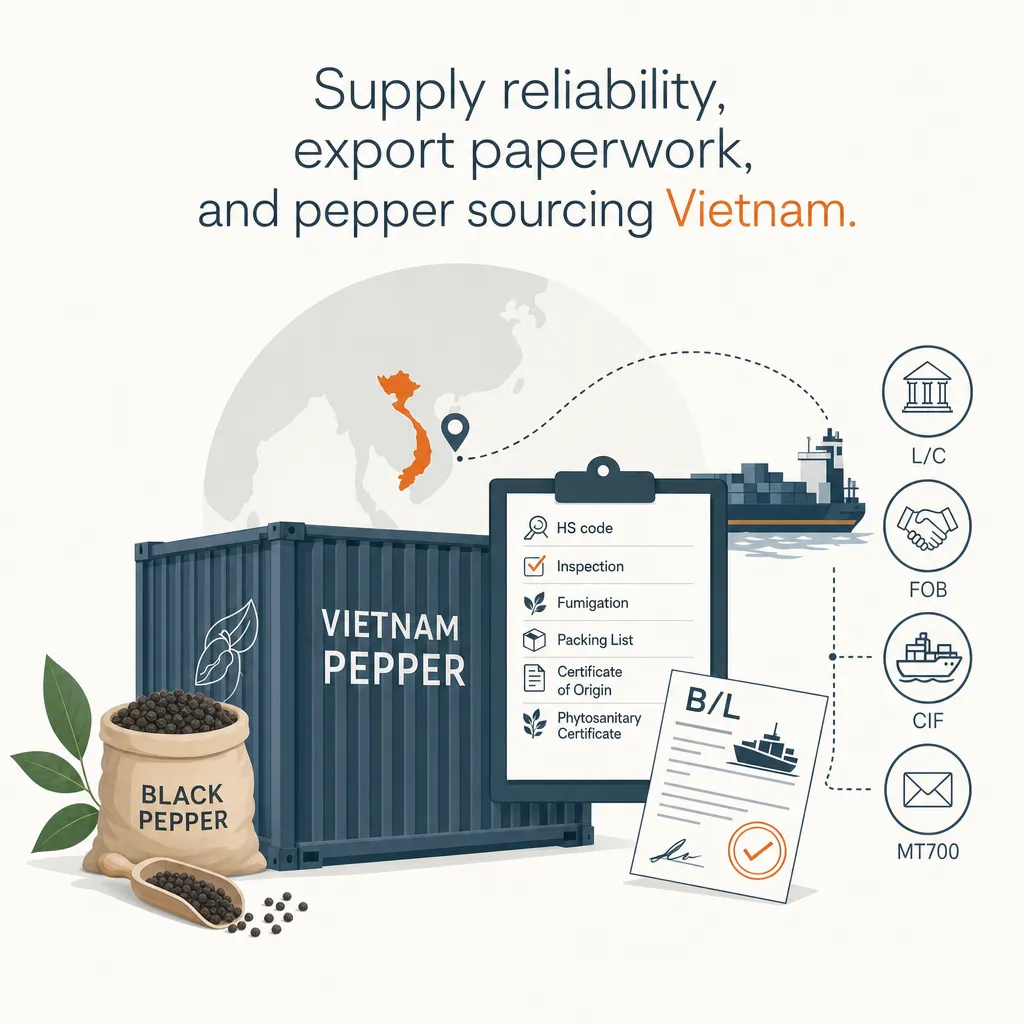
Pepper sourcing Vietnam is attractive because the export ecosystem is built around repeated international shipments. In practice, this means buyers can often find exporters that understand container booking, inspection timing, fumigation, phytosanitary certificates, and buyer-specific packing formats. If you need a broad overview of related categories, the Vietnamese spice export guide is a useful next read.
Vietnam also has concentrated growing and trading regions. Bình Phước, Đắk Nông, Gia Lai, and Đắk Lắk give buyers a clear map for supplier discovery. Ho Chi Minh City and Cát Lái port support export execution. This does not remove risk, but it makes supplier comparison easier because many exporters quote similar grades and shipment terms.
India’s supply chain is different. It has strong domestic demand, older spice trading hubs, and a premium food culture around pepper. That can be a benefit when you want origin depth. It can be a challenge when your RFQ requires repeated monthly lots at a narrow target price.
For paperwork, both origins can support export. The difference is how quickly you can compare suppliers on the same terms. For Vietnam, ask every exporter for the same quote format: - Product name, grade, origin province, and crop period. - Packing format, net weight per bag, and pallet option. - Target moisture, density, and cleanliness parameters. - Port, shipment window, and payment term. - Documents included, such as commercial invoice, packing list, bill of lading, and plant health paperwork.
Use a phytosanitary certificate checklist before you confirm the purchase order. It helps you avoid last-minute confusion between exporter documents, importer permits, and destination-market rules. FAO production data also helps buyers compare long-term origin patterns through FAOSTAT.
Price, volume, and Vietnamese pepper suppliers: what to compare
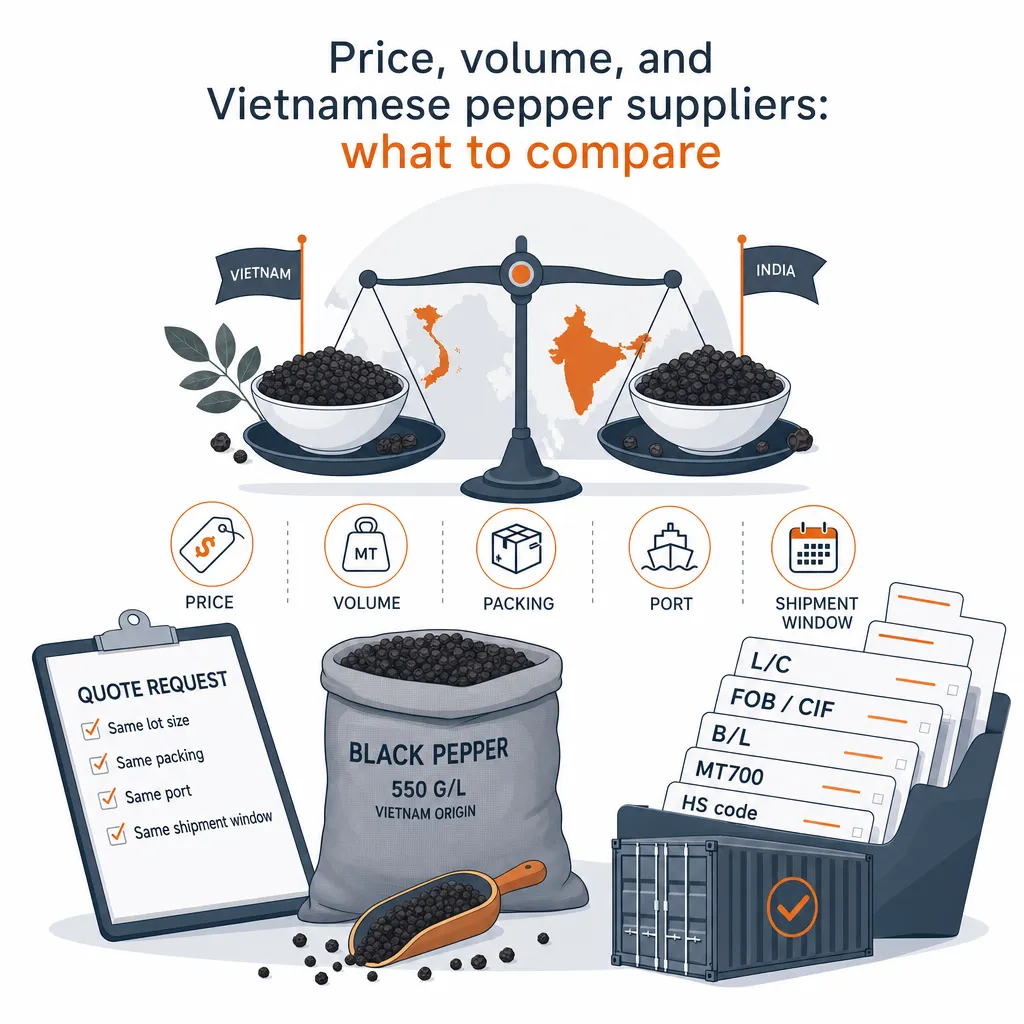
Vietnamese pepper suppliers are often competitive for black pepper because more exporters are quoting similar standard grades. That makes price discovery easier. You can request the same lot size, packing, port, and shipment window from several suppliers, then compare apples with apples. On ViRFQ, a clean pepper RFQ should describe the grade, intended use, target country, and lab-test expectations in plain language.
India can command a premium when the lot has a strong retail story. A Malabar pepper offer may not be trying to beat Vietnam on bulk price. It may be trying to win on aroma, packaging potential, and shelf differentiation. In many buying teams, that distinction is missed. Procurement sees pepper as a commodity, while marketing sees it as a brand ingredient.
A useful comparison table looks like this:
| Buying factor | Vietnam | India |
|---|---|---|
| Bulk availability | Strong for standard export lots | More variable for export-focused lots |
| Flavor positioning | Clean heat, practical blending | Aromatic, origin-led retail story |
| Price discovery | Easier to benchmark across suppliers | More dependent on origin and lot |
| Documentation | Export-focused supplier base | Available, but supplier profiles vary |
| Best fit | Manufacturing, food service, distributors | Specialty retail, gourmet, culinary brands |
Do not compare only the unit price. Compare landed cost and rejection risk. A lower quote can become expensive if the shipment misses moisture, residue, or documentation requirements. Check the exporter’s product photos, recent lab results, and packing details. For broader supplier strategy, compare ViRFQ vs Alibaba sourcing to understand why an RFQ-first flow can be faster for Vietnam-specific categories.
You can also review Vietnam Customs updates when checking export activity and policy context.
Which origin should your buying team choose?
Choose Vietnam if your priority is dependable export execution. It is the practical choice for distributors, food manufacturers, seasoning companies, and importers that need repeatable lots. Vietnam is also a strong starting point when you are entering pepper for the first time and want several comparable offers before selecting a supplier.
Choose India if your priority is origin identity. It is a strong fit for premium retail jars, chef-led brands, and spice lines that benefit from a story around Kerala, Malabar pepper, or traditional Indian cuisine. You may pay more, but the added value can make sense when the final product sells on aroma, origin, and culinary trust.
A simple buying workflow is: - Define the sales channel first: factory, food service, distributor, or retail. - Decide whether the buyer values heat, aroma, origin story, or low variance. - Request samples from at least two origins when the product is new. - Test moisture, foreign matter, residues, and microbial parameters before contract signing. - Confirm documents and shipment responsibilities before paying a deposit.
If you are still unsure, start with a dual-origin RFQ. Ask for Vietnam black pepper and India black pepper under the same target use. Then compare quote clarity, response speed, sample quality, and total landed cost. USDA market tools such as USDA FAS can support broader agri-market checks, although supplier-level verification still needs direct document review.
For Vietnam-specific buying, see Vietnam spices suppliers and the black pepper RFQ hub. These pages help you move from research to supplier conversations without browsing hundreds of generic listings.
FAQ
Is Vietnam pepper good for importers comparing India?
Yes. Vietnam pepper is good when the importer needs volume, consistent export specs, and several comparable supplier quotes. It is especially useful for distributors, processors, and food service buyers. India may be stronger when the buyer wants a premium origin story, especially for whole peppercorn retail.
Does Vietnam have good peppercorns for retail packs?
Vietnam can supply good peppercorns for retail packs, but you need to specify density, color, cleanliness, and sterilization requirements. Do not buy only by country name. Ask for samples, photos, lab results, and packing details before confirming a private-label or branded retail order.
Which is better, India or Vietnam pepper?
Neither origin is better for every buyer. Vietnam is usually better for scalable sourcing and repeatable bulk supply. India is usually better for premium origin positioning and aroma-led products. The right choice depends on channel, specification, target price, and how much your customer values origin storytelling.
Does India import black pepper from Vietnam?
India can import black pepper from Vietnam when domestic prices, processing needs, or re-export economics make sense. Trade flows change with crop size, local demand, tariffs, and quality needs. Buyers should check current customs data and supplier documentation instead of relying on old market assumptions.
How should I source Vietnamese pepper suppliers safely?
Start with a written RFQ, not a vague message. Include grade, target use, packing, destination country, shipment window, and required documents. Request samples and lab tests before purchase. Use structured platforms, direct verification, and document checks to reduce misunderstanding before payment.
Ready to compare offers from Vietnam instead of guessing from listings? Create one clear brief with grade, destination, packing, and test requirements, then post your pepper RFQ on ViRFQ. You can also browse Vietnam spices suppliers or start from the black pepper RFQ hub to reach relevant exporters faster: /en/rfq/pepper.
Sources
Reviewed by
Founder & CEO, ViRFQ
Phan Hà Thái is the founder and CEO of ViRFQ, the buyer discovery and buyer management platform (and B2B marketplace) for Vietnamese agricultural exporters. His background is in international trade finance and Vietnamese agricultural exports. He writes and reviews the ViRFQ blog analyses on FOB pricing, Letter of Credit (L/C) workflows, EUDR compliance, and supplier verification.
Related articles
Vietnam Black Pepper Price 2026 Guide
9 phút
Robusta coffee Vietnam FOB: price + quality grades 2026
9 phút
How to Import from Vietnam — Full Process Guide 2026
9 phút
Vietnam supplier verification — 10-step due diligence 2026
9 phút
Vietnam pangasius fillet supplier — sourcing playbook 2026
9 phút