By Phan Ha Thai, Founder of ViRFQ|Updated: 25 April 2026|~16 min read
How to Import Vietnamese Coffee: Complete Guide for International Buyers 2026
Được duyệt bởi Phan Hà Thái, Founder ViRFQ
TL;DR
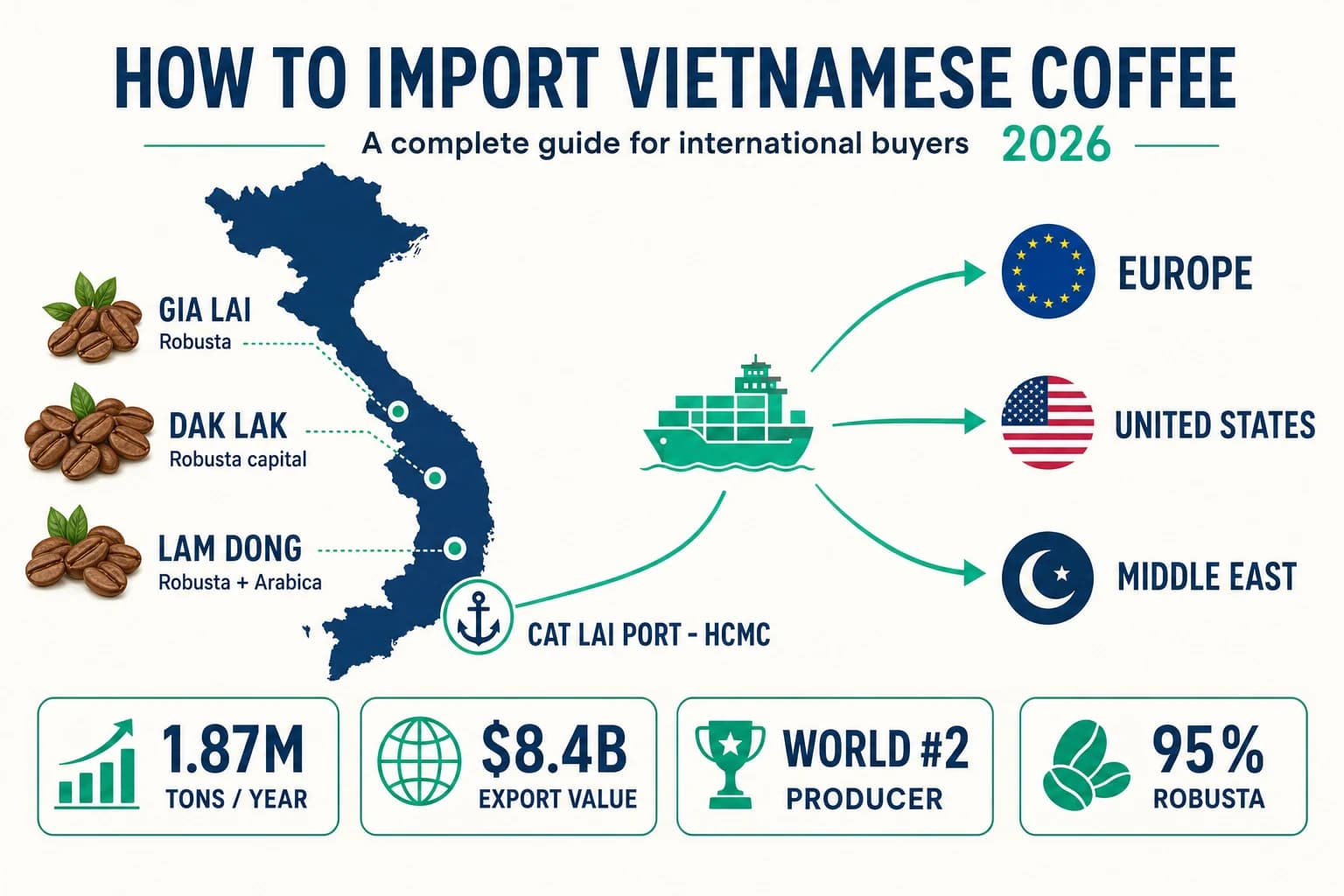
Vietnam is the world's #2 coffee exporter (1.87 million tons in 2024, $8.4 billion per VICOFA), specialising in Robusta Grade 1 from Dak Lak – Lam Dong – Gia Lai (95% of national output). International buyers source FOB Cat Lai at $2,850-3,450 per MT for Q2 2026 by grade, with L/C at-sight payment through Vietcombank, VietinBank, MBBank, and VPBank. EU enforces EUDR from 30 December 2026 — requiring GPS farm coordinates plus Due Diligence Statement. 4C and Rainforest Alliance certifications are baseline for EU buyers; SGS or Vinacontrol PSI is mandatory for L/C clearance.
1. What makes Vietnamese coffee unique?
Vietnamese coffee is a strategic agricultural export from the Central Highlands plateau, predominantly Robusta (Coffea canephora) Grade 1 under HS code 0901.11.10. Vietnam ranks second worldwide in total coffee output (after Brazil) and first worldwide in Robusta, supplying roughly 40% of global Robusta volume per ICO 2024 data.
In 2024, Vietnam exported 1.87 million tons of coffee for revenue of $8.4 billion — up 33% from 2023 thanks to global Robusta price highs. Top 5 import markets: Germany (15%), Italy (8%), United States (7%), Spain (6%), Japan (5%). Source: Vietnam General Department of Customs + VICOFA.
3 strategic growing regions
- Dak Lak — the “Robusta capital” with ~210,000 ha (32% of Vietnam's coffee area). Buon Ma Thuot is the international trading hub; the biennial Buon Ma Thuot Coffee Festival draws global buyers.
- Lam Dong — diverse Robusta + Arabica terrain at 800-1,500m elevation suited to specialty Arabica (Cau Dat, Da Lat). ~175,000 ha.
- Gia Lai + Kon Tum + Dak Nong — Robusta + fine Arabica, ~150,000 ha. Several farms hold organic + 4C certification for Japanese buyers.
Robusta vs Arabica — split and characteristics
Robusta accounts for ~95% of output in Vietnam; Arabica ~5% (mainly Son La, Lam Dong, Quang Tri). Vietnamese Robusta carries 1.7-4% caffeine (vs Arabica 0.8-1.4%), with low acidity and full body — ideal for espresso blends and instant coffee. Specialty Da Lat Arabica scores 80-86 SCA, competing directly with Brazilian Santos.
Reference classifications: Robusta — Coffea canephora, HS code 0901.11.10 per ICO. Arabica — Coffea arabica, HS code 0901.11.20. Roasted coffee: HS 0901.21 (regular), 0901.22 (decaffeinated).
2. How to verify a Vietnamese coffee exporter
Verifying a Vietnamese coffee exporter is the process of validating production capacity, financial health, legal standing, and quality systems before signing a contract. Per ViRFQ Q1-Q2 2026 internal data, ~67% of suppliers registering on the platform clear SGS / Vinacontrol audits — the rest are rejected for missing certifications, insufficient production capacity, or inadequate traceability.
5 core certifications to check
- 4C (Common Code for the Coffee Community) — baseline sustainability standard, ~40% of Vietnam coffee area certified
- Rainforest Alliance / UTZ — critical for premium EU roasters (Lavazza, illy, Tchibo)
- USDA Organic / EU Organic — for specialty + organic markets, ~3-5% of Vietnam area
- Fair Trade USA / FLO — for ethical buyers (Equal Exchange, Pachamama)
- GLOBALG.A.P. CoC — supply-chain certification required by major EU retailers (Carrefour, Tesco, Edeka)
4 independent inspection companies
Pre-shipment inspection (PSI) is a standard L/C payment condition. 4 inspection firms recognised by Vietnamese banks + international buyers:
- SGS Vietnam — offices in HCMC, Hai Phong, Da Nang. Fees $350-500 per 20ft container
- Vinacontrol — inspection certificates accepted by Vietnamese customs + buyers in 80+ countries
- Bureau Veritas — preferred by French + broader EU buyers
- Intertek — global network, suited to US + UK buyers
Verify via VICOFA membership
The Vietnam Coffee and Cocoa Association (VICOFA) is the official industry body. Its public membership directory lists ~150 large coffee exporters — buyers can cross-check supplier legitimacy. Top members: Intimex Group, Simexco Daklak, Tin Nghia Corp, 2-9 Group, Olam Vietnam, Volcafe Vietnam.
Vetting on ViRFQ: every RFQ gets a 0–100 quality score and only RFQs scoring ≥80 are shown to exporters. On the supplier side, the Verified badge is granted only after the ViRFQ team manually reviews the business registration and the last 24 months of export evidence.
For more on supplier verification structure, see Vietnam Coffee Suppliers — Verified List.
3. Vietnamese coffee FOB prices Q2/2026
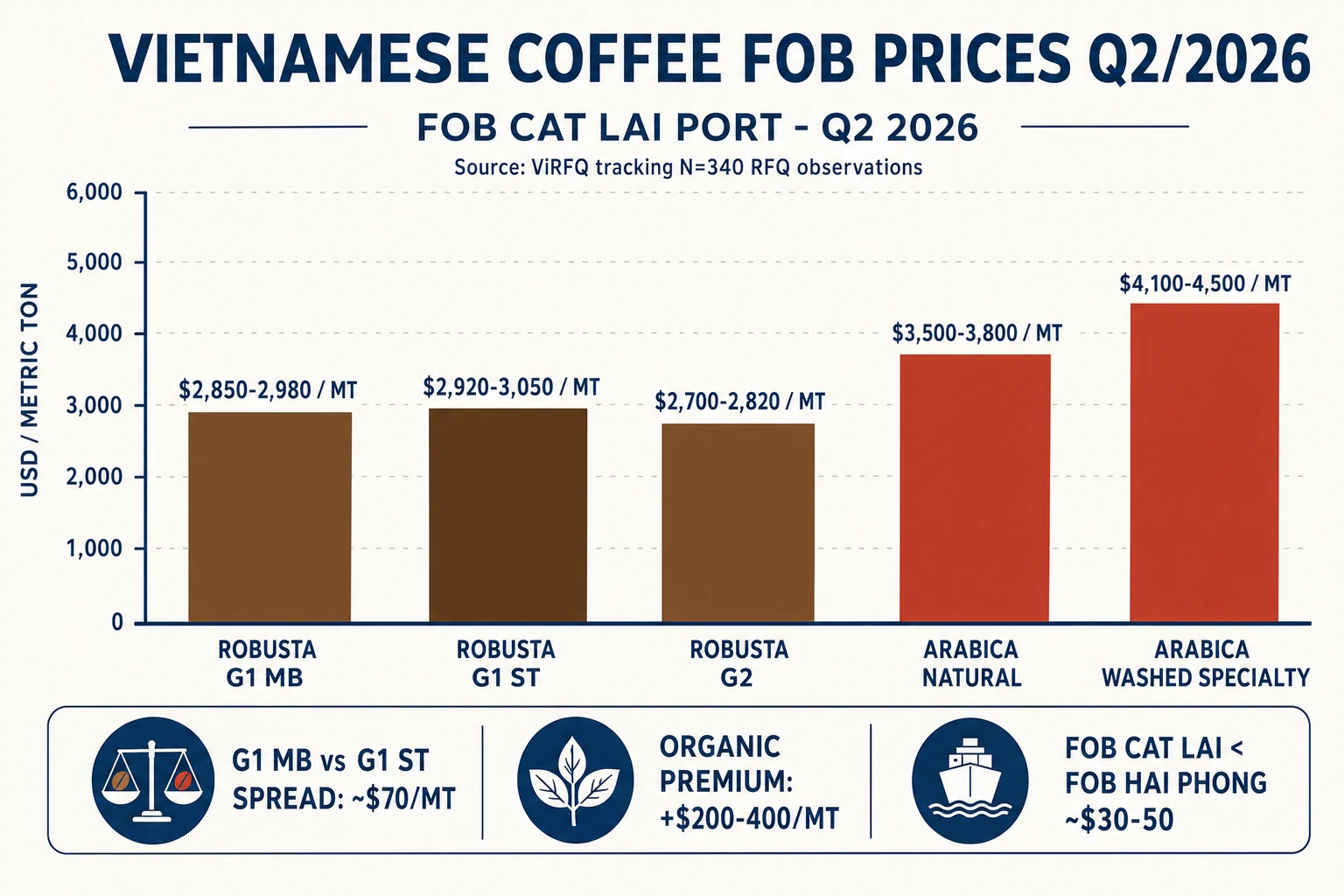
Vietnamese coffee FOB pricesvary by grade, growing region, harvest timing, and global reference (London ICE Robusta Futures for Robusta, New York ICE Coffee “C” for Arabica). The table below summarises Q2/2026 FOB Cat Lai pricing from ViRFQ N=340 RFQ tracking weeks 14-26 (internal benchmark, cross-checked against VICOFA weekly bulletin).
| Type + grade | FOB Cat Lai Q2 2026 (USD/MT) | Main source region | Typical buyer |
|---|---|---|---|
| Robusta Grade 1 MB (S18) | $2,850 – $2,980 | Dak Lak, Gia Lai | Italy (espresso blend), Spain |
| Robusta Grade 1 ST (S16/S18) | $2,920 – $3,050 | Dak Lak, Lam Dong | Germany (Tchibo), Netherlands |
| Robusta Grade 2 (S13) | $2,700 – $2,820 | Dak Nong, Gia Lai | Middle East, Africa (instant) |
| Arabica natural (washed grade) | $3,500 – $3,800 | Lam Dong, Son La | South Korea, Japan |
| Arabica washed (specialty 80+ SCA) | $4,100 – $4,500 | Cau Dat, Da Lat | US + EU specialty roasters |
| Fine Robusta (cupping 80+ SCA) | $3,400 – $3,700 | Son La, Quang Tri | EU specialty (Lavazza Reserve) |
3 factors driving price
- Season: lowest in December-January (peak harvest), highest July-September (low inventory). Annual swing ~10-15%.
- Departure port: FOB Cat Lai is $30-50/MT cheaper than FOB Hai Phong (closer to the Central Highlands).
- Premium certifications: 4C +$50/MT, Rainforest +$80-120/MT, Organic +$200-400/MT versus conventional.
Reference prices fluctuate continuously with London ICE Robusta Futures. Buyers should peg the contract price to a differential against LIFFE close on the shipment date to hedge volatility — the default standard in international Robusta contracts.
4. Incoterms FOB vs CIF vs CFR vs DDP for coffee
Incoterms 2020 is the ICC rule set defining cost and risk allocation between seller and buyer. 95% of Vietnam coffee contracts use FOB (Free On Board) or CIF (Cost, Insurance, Freight) — buyers must understand these before negotiating.
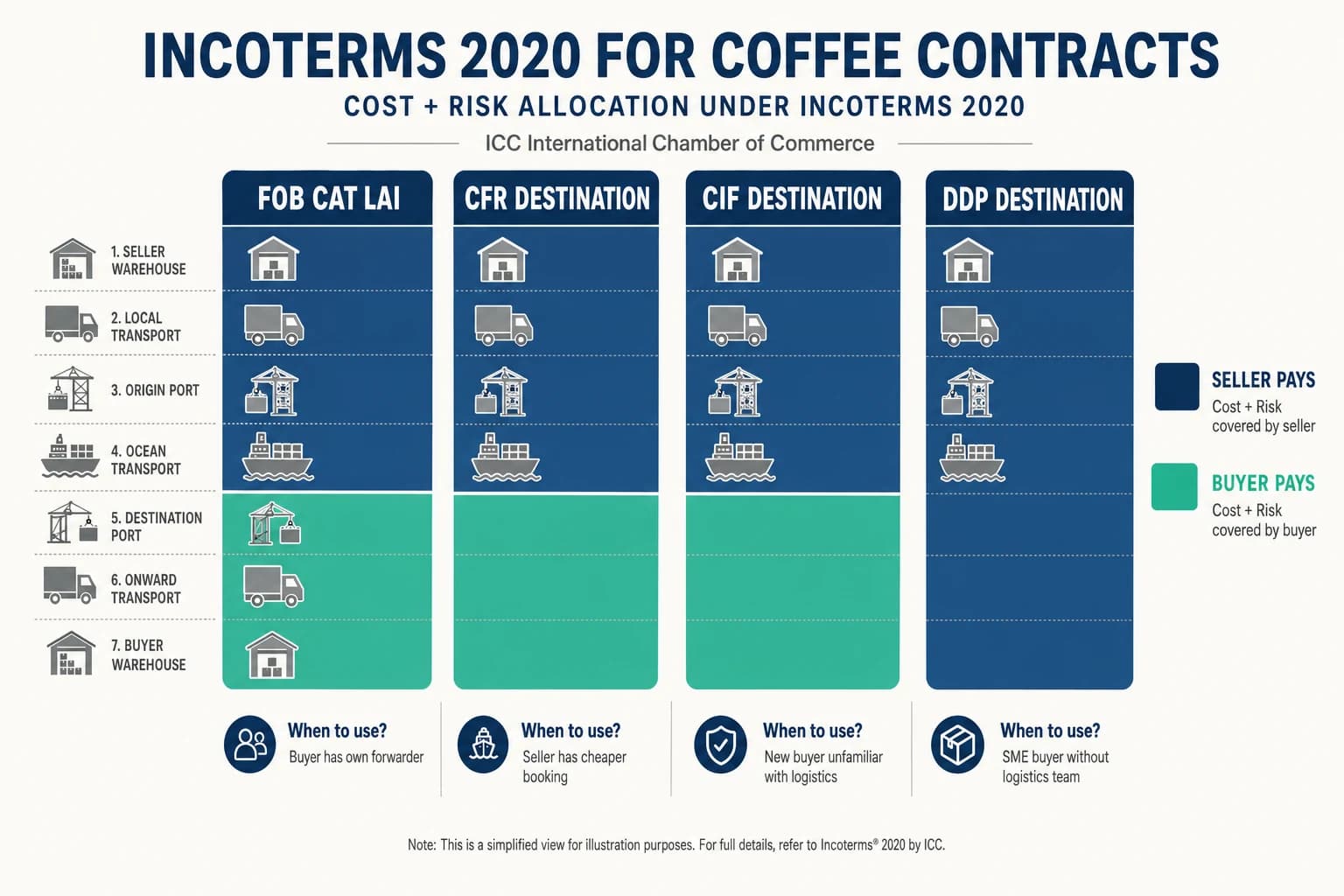
| Incoterm | Seller pays | Buyer pays | When to use |
|---|---|---|---|
| FOB Cat Lai | Goods + export clearance + loading on board | Ocean freight + insurance + import clearance | Buyer has preferred forwarder (Maersk, MSC contract) |
| CFR destination | FOB + ocean freight | Insurance + import clearance | Seller has cheaper booking rate |
| CIF destination | CFR + marine cargo insurance | Import clearance + inland | New buyer unfamiliar with international logistics |
| DDP destination | CIF + import clearance + duties + delivery to warehouse | Receive goods at warehouse only | SME buyer without logistics team |
Key note for FOB: per Incoterms 2020, risk transfers from seller to buyer when goods are placed on board the vessel, not at the ship's rail as in Incoterms 2010. The Bill of Lading (B/L) must carry an explicit “Shipped on Board” or “Loaded on Board” date stamp.
5. L/C payment for Vietnamese coffee imports
L/C (Letter of Credit) is a conditional payment commitment issued by the buyer's bank, the international standard for 80% of Vietnamese coffee contracts above $50,000. The process follows ICC UCP 600, with document examination within 5 business days per Article 14.
3 common L/C types for coffee
- L/C at sight — payment upon presentation of compliant documents. Most common, ~70% of coffee deals. Tier-1 EU/US buyers.
- L/C usance (deferred 30/60/90 days) — buyer receives short-term credit from shipment date. Suited to buyers with weak cashflow, interest ~3-5%/year.
- L/C confirmed — adds a Vietnamese bank's payment guarantee (VCB, VietinBank). Mandatory for buyers in Middle East, Africa, Pakistan. Fee 0.1-0.3%/quarter.
4 best Vietnamese banks for coffee L/C
- Vietcombank (VCB) — market leader in trade finance, correspondent network of 1,700+ banks worldwide
- VietinBank — specialises in large L/C (>$500K), particularly strong on Middle East deals
- MBBank — competitive fees, prioritises SME exporters
- VPBank — digital L/C portal, processes within 4 hours
Standard L/C document set for coffee
- Commercial Invoice (3 originals + 3 copies)
- Packing List
- Bill of Lading (B/L) marked “Shipped on Board”
- Certificate of Origin (C/O) Form A or Form D (ASEAN)
- Phytosanitary Certificate (issued by Plant Protection Department)
- Certificate of Analysis (COA) — moisture, screen size, defect count
- Pre-shipment Inspection Certificate (SGS / Vinacontrol / Bureau Veritas)
- Insurance Policy (if CIF) or Insurance Certificate
- Beneficiary's Certificate (for EUDR — including DDS from Q4 2026)
ViRFQ tracking insight: per internal data Q1-Q2 2026 from confirmed L/C coffee deals, the first-pass zero-discrepancy rate is ~70% (matching ICC global benchmark). The remaining 30% typically fail on: Bill of Lading wrong date / port, Certificate of Origin missing chamber-of-commerce signature, or Phytosanitary Certificate expired (only valid 14 days from issuance).
6. EUDR + 2026 regulatory compliance
EUDR (EU Deforestation Regulation 2023/1115) is a mandatory EU rule requiring every coffee shipment (alongside rubber, soy, palm oil, wood, cocoa, cattle) to prove no link to deforestation after 31 December 2020. Effective from 30 December 2026 for large operators and 30 June 2027 for SMEs (per EU SME criteria).
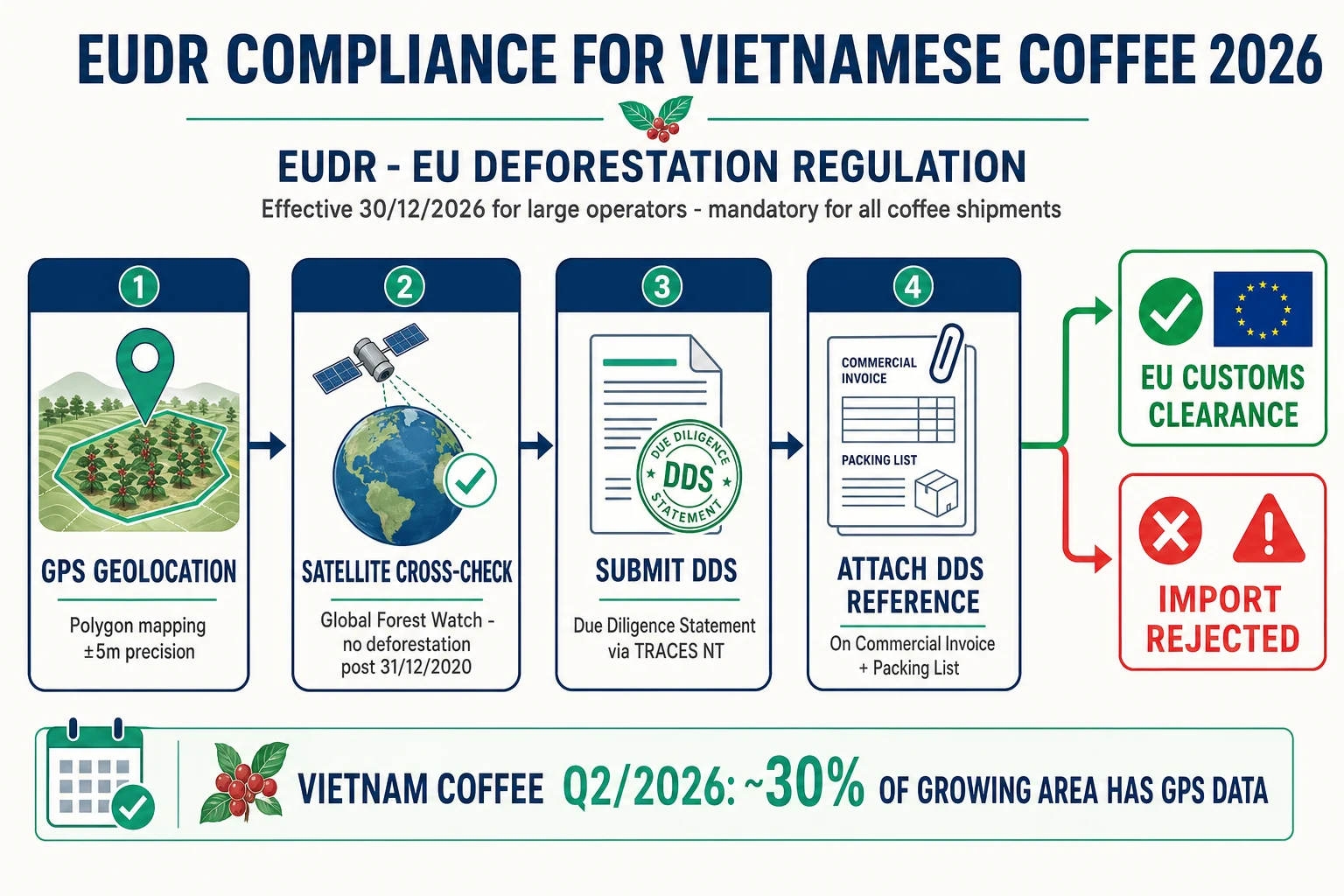
4-step EUDR compliance workflow
- Collect GPS coordinates of growing plots— every coffee plot (polygon or point geolocation by area) must be GPS-mapped to ±5m precision. Plots >4 ha require polygon mapping. Tools: Trimble, John Deere Operations Center, or open-source apps like Farmonaut.
- Cross-check against satellite deforestation data — use Global Forest Watch or EU Forest Observatory to verify coordinates fall outside deforested areas after 31 December 2020.
- Submit Due Diligence Statement (DDS)— the EU buyer (operator) submits the DDS through the EU Commission's TRACES NT system, including GPS coordinates + risk assessment. Vietnamese exporters supply raw data to the buyer.
- Attach DDS reference number to shipping documents — the DDS number must appear on the Commercial Invoice + Packing List. EU customs verify before clearance; missing DDS = shipment rejected.
EUDR readiness in Vietnamese coffee Q2 2026: per ViRFQ internal estimates and announcements from MARD + VICOFA, only ~30% of Vietnam's coffee area has complete geolocation data as of Q2 2026. Within ViRFQ's registered supplier pool, ~45% have polygon GPS ready (skewed toward larger exporters with established EU partnerships). EU buyers should prioritise suppliers carrying 4C + Rainforest Alliance certification — they have the traceability infrastructure already in place.
Other key 2026 regulations
- FDA FSVP (Foreign Supplier Verification Program) — US buyers must verify Vietnamese suppliers comply with FSMA. Documents: HACCP plan, sanitation SOP, allergen control.
- UAE / Saudi Halal certification — mandatory for instant + decaf coffee. Issued by JAKIM (Malaysia), HFCE (UAE), or HCA Vietnam (official)
- Japan JAS Organic — for organic specialty Arabica, annual audit + chain-of-custody to end consumer
- Korea Food Safety Ministry — pre-export approval for instant coffee + extracts
7. Vietnamese coffee vs Brazil vs Indonesia — buyer comparison
Vietnam, Brazil and Indonesiaare the world's top 3 coffee exporters. Buyers select sources based on grade, price, lead time, and certification. The table below compares 6 core criteria (data: ICO 2024 + USDA FAS Q1/2026).
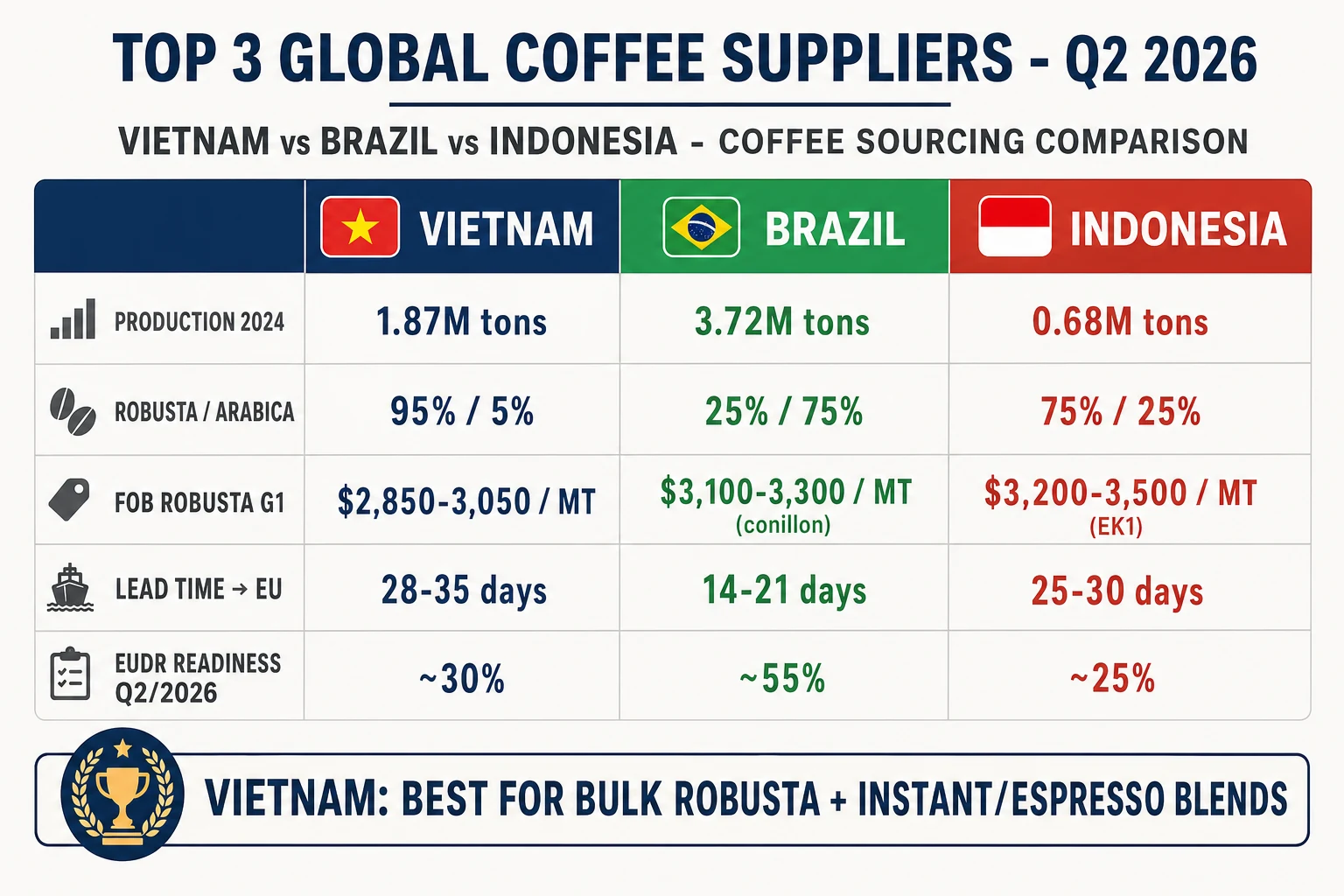
| Criterion | Vietnam | Brazil | Indonesia |
|---|---|---|---|
| 2024 production (M tons) | 1.87 | 3.72 | 0.68 |
| Robusta vs Arabica split | 95% Robusta / 5% Arabica | 25% Robusta / 75% Arabica | 75% Robusta / 25% Arabica |
| FOB Robusta G1 Q2 2026 ($/MT) | $2,850 – $3,050 | $3,100 – $3,300 (conillon) | $3,200 – $3,500 (EK1) |
| Lead time → EU (days) | 28-35 (Cat Lai → Hamburg) | 14-21 (Santos → Hamburg) | 25-30 (Belawan → Hamburg) |
| EUDR readiness Q2 2026 | ~30% area GPS-mapped | ~55% (CECAFE-led program) | ~25% |
| Sweet-spot buyer profile | Bulk Robusta, instant, espresso blend | Specialty Arabica + Brazilian naturals | Single-origin Robusta (Mandheling, Lampung) |
Recommendation: for bulk Robusta (>500 MT/year) for instant coffee or espresso blends, Vietnam offers the lowest landed price. For specialty Arabica cupping 85+ SCA, Brazilian Santos or Colombian sources are stronger. Indonesia suits single-origin Robusta with unique flavour profiles (Lampung, Mandheling).
8. How to source Vietnamese coffee via ViRFQ
ViRFQ is the platform where Vietnamese agri exporters find and manage international buyers: buyers submit RFQs free of charge, each RFQ is vetted (quality score ≥80) before it reaches exporters, and Verified-badge suppliers have passed a manual document review. The 7-step workflow from RFQ submit to delivery:
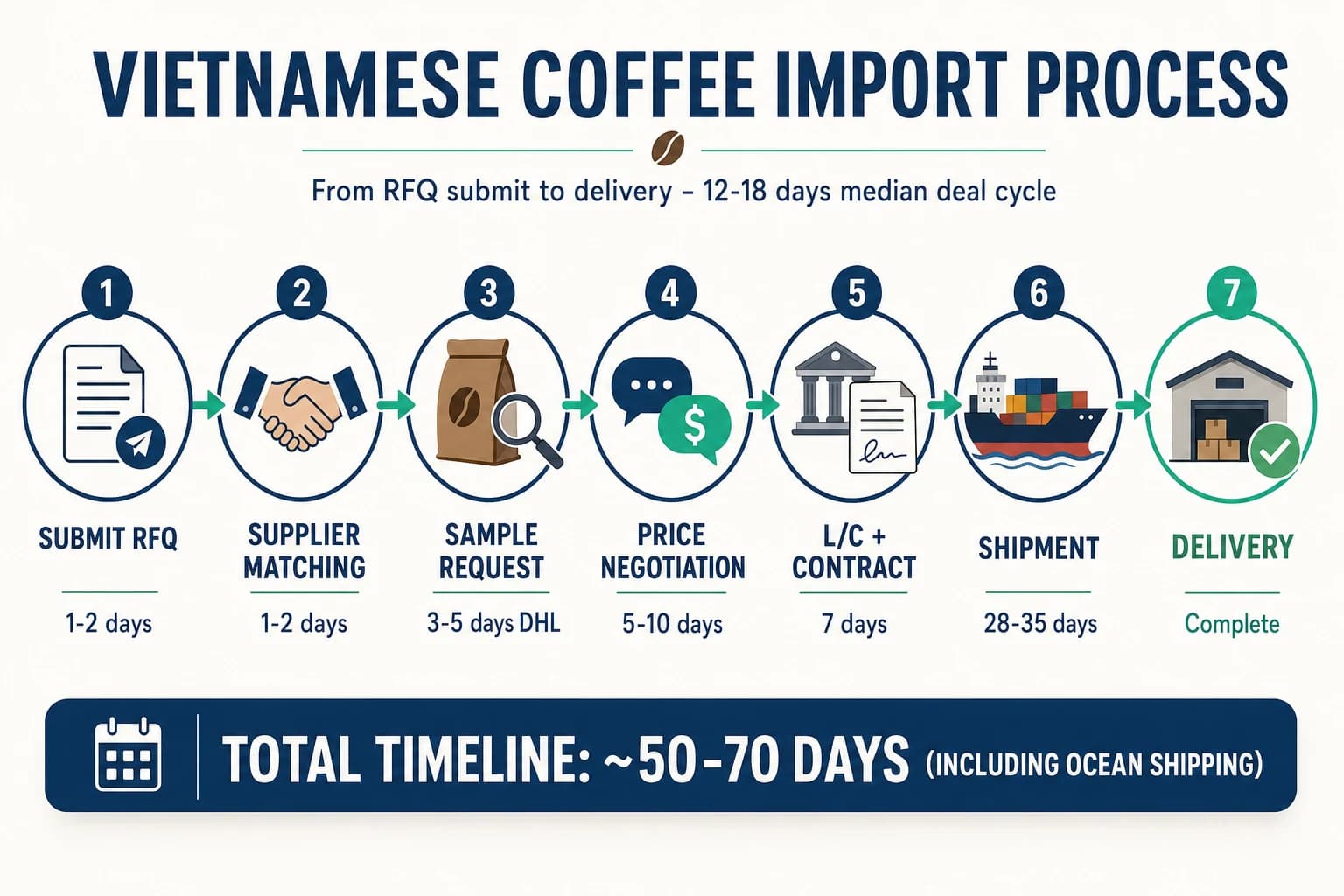
- Submit RFQ free of charge — describe grade, MOQ, packaging, target FOB price, port
- Admin review within 24 hours — only RFQs scoring quality ≥80 publish to the platform
- Match with verified suppliers — exporters on the paid Platform plan get 4-hour early access before public listing
- Sample request — 100-500g shipped via DHL/FedEx, 3-7 days
- Negotiate price + documents — price quote + proforma invoice via platform chat
- Sign contract + open L/C — through VCB / VietinBank / MBBank / VPBank
- Shipment + delivery — FOB Cat Lai → destination port, lead time 28-35 days to EU
Quick start for new buyers: visit the coffee RFQ page to view active demand or submit a custom RFQ. Buyers already familiar with Vietnamese trade can review the verified Vietnam Coffee Suppliers list (commercial landing page) for direct supplier introductions.
What experienced importers say on Reddit and LinkedIn
Long-form guides like this one cover the formal process. To round it out, here is a synthesis of recurring concerns from real coffee importers who have shared their experience on Reddit (mainly r/roasting, r/Coffee) and LinkedIn sourcing-manager posts in 2024–2026.
1. “Verify the bank account name, not just the company”
The most upvoted advice across community threads is to insist the beneficiary on the bank wire matches the Vietnamese company that issues the commercial invoice. Buyers who skipped this check lost money to broker-only sellers who pivoted to a personal account at the deposit stage. Cross-check the company tax code on masothue.com before any wire — this is exactly the verification flow we recommend in how to verify a Vietnamese coffee supplier.
2. “Smaller MOQ is possible — but expect spot pricing”
New importers often read that 19.2 MT (one 20-foot container) is the minimum. Community veterans clarify: sample lots of 1–5 MT are real, but the per-kilo price is 12–25% above container FOB, and lead time stretches because the exporter consolidates with another buyer. Acceptable for roasters validating origin or specialty buyers; not viable for industrial-scale.
3. “Inspect Đắk Lắk warehouses in October, not at signing”
Several LinkedIn posts from EU and US importers stress that warehouse visits should be timed during the October–December harvest peak, when you can see raw bean intake, drying yards, and grading tables in operation. A warehouse tour in March only confirms the building exists. Add this to your VICOFA-cross-referenced supplier shortlist before locking annual contracts.
4. “EUDR is real, but most VN exporters are still scrambling”
Community sentiment about the 30 December 2026 EUDR deadline ranges from prepared to panicked. As of Q2 2026 roughly 30% of Vietnamese coffee growing area is GPS-mapped — well behind Brazil (~55%). EU buyers report that the few suppliers who can deliver a full geolocation polygon set commanded a 2–4% price premium in 2026 H1 contracts. If you are buying for the EU market, the EUDR-ready supplier is now the differentiator, not the cheapest FOB.
5. “Use a freight forwarder familiar with Cát Lái”
Repeated advice: pick a forwarder with their own staff at Cát Lái port (Ho Chi Minh), not just a Vietnamese partner. Forwarders without on-the-ground presence add 3–7 days to common steps like fumigation booking, phytosanitary scheduling, and B/L issuance. This is one of the most frequent regrets surfaced in community retros.
These community-grounded points complement the formal checklist above. For buyers who want to skip directly to a vetted supplier shortlist, post your coffee RFQ on ViRFQ — the platform pre-filters companies on tax code, export licence, and harvest-area declarations so the bank-account and warehouse-visit risks above are mitigated upfront.
Frequently asked questions
What is the minimum order quantity (MOQ) to import Vietnamese coffee?▼
Standard MOQ for green Robusta or Arabica from Vietnam is 1 x 20ft container = 19.2 metric tons (320 bags of 60kg). Larger exporters such as Intimex Group, Simexco Daklak, and Olam Vietnam accept half-containers of 9.6 MT, but FOB pricing rises 80-150 USD/MT. Instant coffee and specialty Arabica accept lower MOQ: 5-10 MT from specialty-focused exporters.
How long does it take to receive a coffee sample from Vietnam?▼
Green bean samples of 100-500g shipped via DHL Express, FedEx, or UPS from Vietnam to Europe or the US arrive in 3-7 business days. Roasted samples need an extra 1-2 days for the roasting process. Buyers should request a cupping sample (20-30g freshly roasted) for flavour evaluation, plus a Certificate of Analysis (COA) covering moisture, screen size, and defect count per SCA standard.
Can I request private label or OEM packaging?▼
Yes. Most Vietnamese coffee exporters (especially in instant and roasted segments) offer private-label OEM with MOQ of 5-10 MT for first-time buyers and 1 container for repeat buyers. Buyers must supply design files (.AI or .PDF), barcode (EAN-13 or UPC), and FDA / EU food-contact compliance documentation if shipping to the US or EU. Lead time for packaging design plus production: 30-45 days.
How do I verify quality before shipment?▼
Request a pre-shipment inspection (PSI) from SGS Vietnam, Vinacontrol, Bureau Veritas, or Intertek at 300-500 USD per container. The inspector checks: moisture (max 12.5%), screen size (13/16/18), defect count per SCA Green Coffee Grading, cupping score (specialty), and sampling per ISO 4072. The PSI report is a payment condition under L/C — without PSI, the bank may refuse to release payment.
When does EUDR apply to Vietnamese coffee?▼
EUDR (EU Regulation 2023/1115) becomes mandatory on 30 December 2026 for large operators and 30 June 2027 for SMEs (per EU SME criteria). Every coffee shipment imported into the EU must carry a Due Diligence Statement (DDS) proving no link to deforestation after 31 December 2020, plus GPS coordinates of the farm plot. Vietnamese exporters lacking complete geolocation data will be blocked at EU customs.
What is the difference between Robusta Grade 1 MB and Grade 1 ST?▼
Grade 1 MB (Machine Buchung) is sorted by machine on screen size + density with defects ≤30/300g. Grade 1 ST (Sorted by Type) uses type codes (S16, S18) plus manual sorting with defects ≤15/300g — higher quality. Q2 2026 FOB Cat Lai prices: G1 MB ~2,850-2,980 USD/MT, G1 ST ~2,920-3,050 USD/MT (~70 USD spread). EU buyers typically prefer ST for roasting consistency.
Is confirmed L/C necessary for the first coffee deal?▼
Yes if the deal is over 50,000 USD or the buyer has no prior trading history. Confirmation fee is 0.1-0.3% per quarter, charged to the Vietnamese seller per ICC convention. For EU/US buyers using tier-1 banks (HSBC, Citibank, Deutsche Bank), an irrevocable L/C without confirmation is sufficient. Middle East buyers using local banks: confirmed L/C via Vietcombank or VietinBank is mandatory.
Which port is optimal for Vietnamese coffee export?▼
Cat Lai Port (Saigon New Port, HCMC) handles ~80% of Vietnam coffee export volume, directly connected to the Central Highlands growing region via National Highway 14. North Asia buyers (Japan, Korea) often choose Hai Phong Port to save 3-5 days of shipping time. Quy Nhon Port serves Central Highlands + Phu Yen for smaller lots. FOB Cat Lai is the market reference price — buyers should quote FOB Cat Lai for apples-to-apples comparison.
When is the Vietnamese coffee harvest season?▼
Robusta harvests October-December (peak in November), accounting for 95% of Vietnam coffee output. Arabica harvests later: November-February, concentrated in Son La, Lam Dong, and Quang Tri. FOB prices typically bottom out in December-January right after harvest peak (oversupply) and peak in July-September (low inventory). Strategic buyers should sign Q4 forward contracts to lock in the lowest prices of the year.
Is Swiss Water Process decaf available from Vietnam?▼
Yes, but suppliers are limited (~5-7 exporters). Swiss Water Process (SWP) decaf is either outsourced to dedicated facilities in Canada or Germany then reimported to Vietnam for packaging, or processed at the new SWP-licensed plant opened 2024 in Binh Duong. Premium over conventional: +500-800 USD/MT. MOQ 5 MT. Lead time 60-90 days including offshore decaf processing.
📚 Related — coffee + import cluster
Reviewed by
Founder & CEO, ViRFQ
Phan Hà Thái is the founder and CEO of ViRFQ, the buyer discovery and buyer management platform (and B2B marketplace) for Vietnamese agricultural exporters. His background is in international trade finance and Vietnamese agricultural exports. He writes and reviews the ViRFQ blog analyses on FOB pricing, Letter of Credit (L/C) workflows, EUDR compliance, and supplier verification.