Vietnam Cinnamon Suppliers Guide 2026
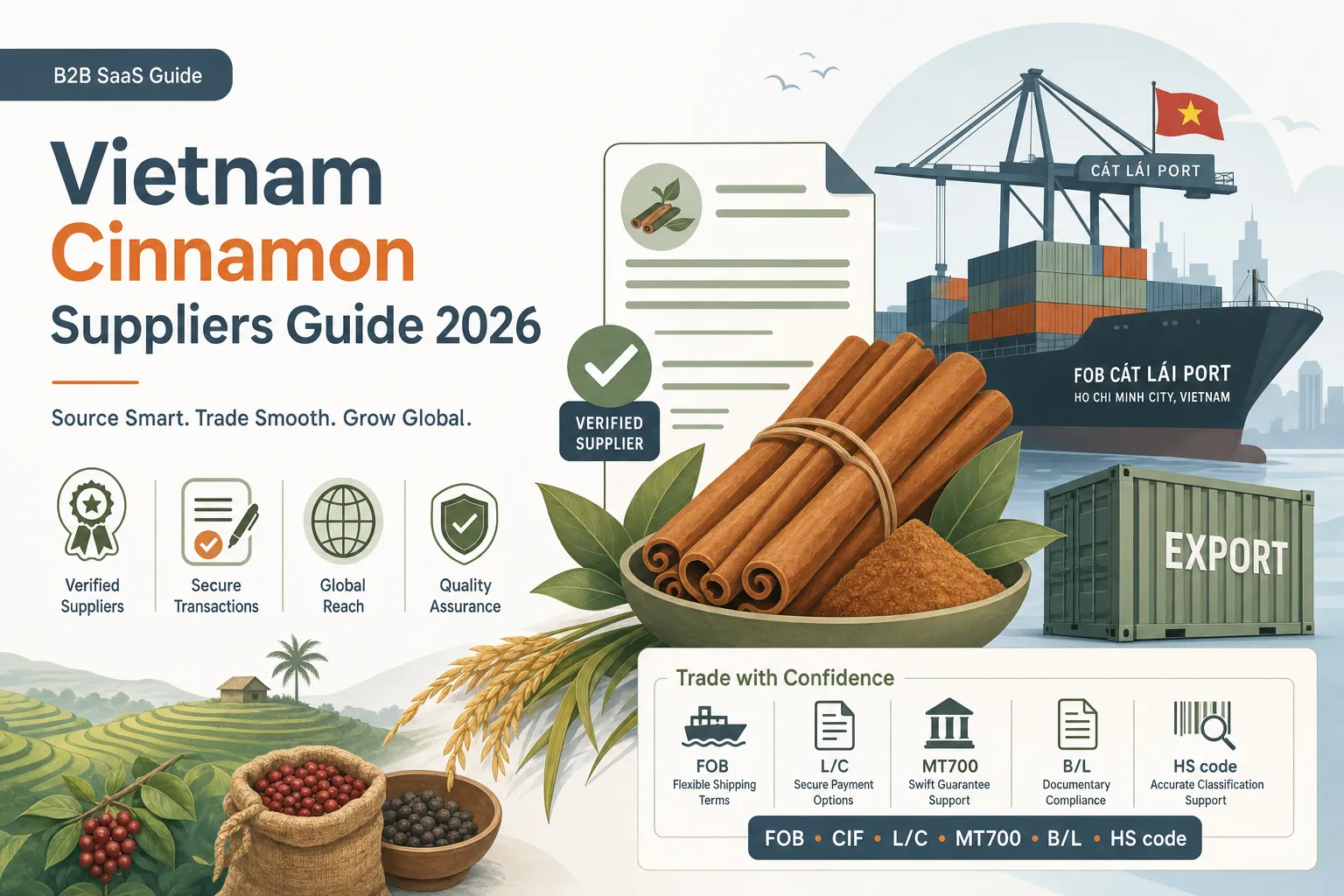
vietnam cinnamon suppliers are a practical source for Saigon cassia when buyers need strong aroma, cut bark, stick, or powder formats. Yên Bái is widely cited at nearly 90% of Vietnam's cinnamon base by Agrideco, and bulk specs often market 5% oil on SpiceJungle; this guide turns those facts into a sourcing workflow.
What makes Saigon cinnamon suppliers Vietnam different?
Vietnamese cinnamon is usually traded as Saigon cinnamon or cassia. Buyers choose it for a warm, sweet, and spicy profile that works in bakery mixes, beverages, spice blends, tea, confectionery, and private-label retail jars. It is not the same product as Ceylon cinnamon. Ceylon is lighter and milder; Vietnamese cassia is darker, stronger in aroma, and often sold where bold flavor matters.
The main buyer question is not only whether the cinnamon smells good. You also need a supplier who can repeat moisture, cut size, oil aroma, microbiology, pesticide screening, and documentation across multiple shipments. That is where many catalogue listings feel thin. A product photo cannot prove harvest lot control, metal detection, fumigation status, or whether powder was milled from clean inner bark rather than mixed low-grade bark.
For market context, World Spice Vietnamese Cinnamon describes the variety as dark, rich, and spicy. FAOSTAT crop data tracks cinnamon and cassia in agricultural datasets, while ITC Trade Map helps buyers review trade flows under the cinnamon category. Those sources are useful for demand research, but supplier selection still needs factory-level checks.
A good RFQ should separate product form from compliance expectations: - Form: split cassia, tube, cigarette stick, broken, powder, or oil-related material. - Origin: Yên Bái, Lào Cai, Quảng Nam, Thanh Hóa, or mixed Vietnam origin. - Use case: retail spice, food service, industrial extraction, tea blend, or bakery ingredient. - Market: EU, USA, Japan, Korea, MENA, or domestic re-export. - Documents: phytosanitary certificate, fumigation record if required, certificate of origin, invoice, packing list, bill of lading, and lab report.
This article focuses on buyer control. You will learn how to compare suppliers, write an RFQ, check export documents, and use ViRFQ to turn a vague cinnamon request into comparable offers.
Where is Yen Bai cinnamon grown, and why does origin matter?
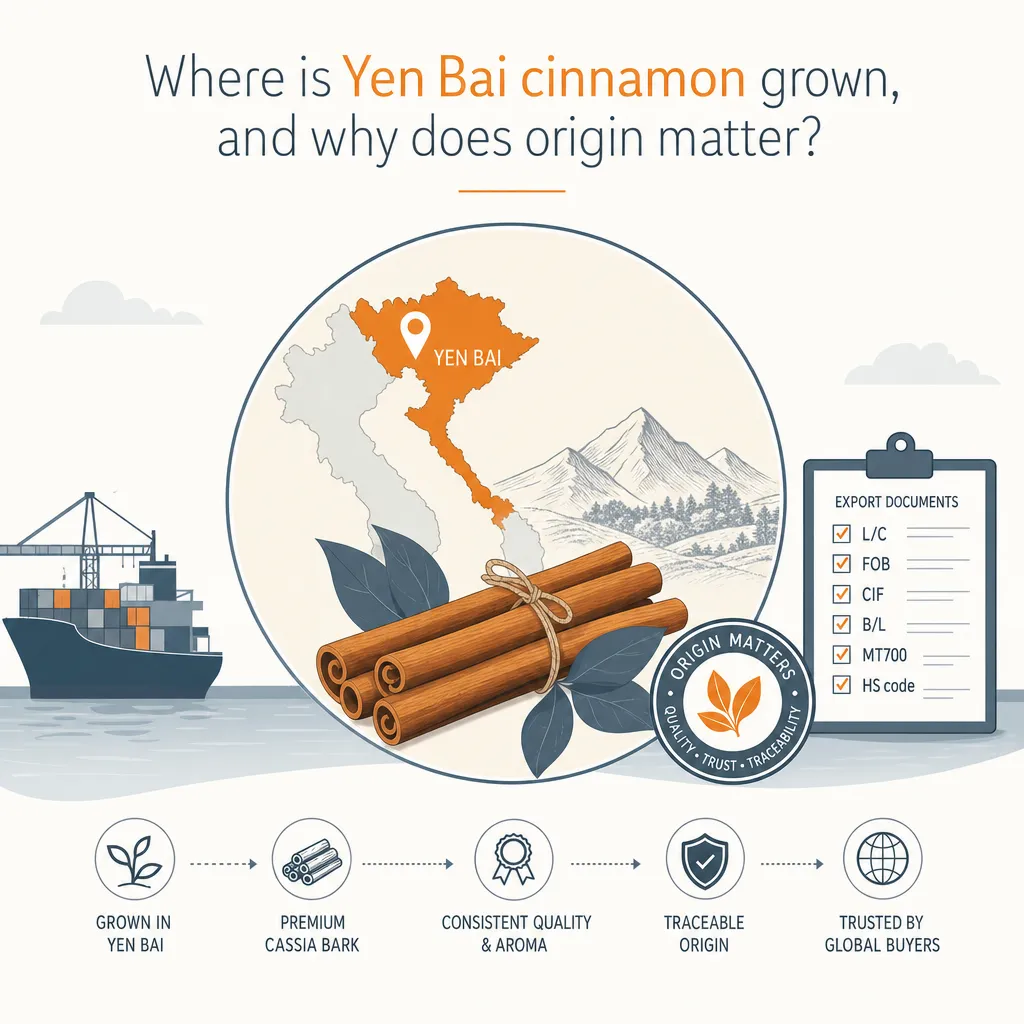
Yên Bái cinnamon has strong recognition because the province is closely tied to Vietnam's cassia production story. Importers often ask for Yên Bái when they want aromatic bark, consistent color, and a clearer traceability claim for retail packaging. Other provinces also supply cinnamon, especially in northern and central highland areas, so origin should be treated as a claim to verify, not a decorative phrase.
When a supplier says "Yên Bái origin," ask how that origin is documented. A trader may buy from several collectors. A processor may own drying yards and buy from contracted households. A cooperative may aggregate bark from farmer groups. Each model can work, but the evidence differs. Useful proof includes purchase records, local collection sheets, warehouse intake logs, batch codes, and photos of lots before processing.
Vietnam Ministry of Agriculture publishes sector updates for agricultural production and rural value chains. Vietnam Customs is useful for export procedures and customs notices. These two sources will not replace supplier due diligence, but they help buyers understand why Vietnamese agricultural exports depend on both provincial supply and port execution.
Origin matters for three practical reasons. First, aroma and bark thickness vary by growing area, tree age, harvest handling, and drying method. Second, traceability requirements are getting stricter, especially for EU buyers screening land-use and supplier records. Third, origin claims affect price. If two offers look similar but one uses vague mixed-origin wording, the cheaper quote may not be comparable.
Ask for a simple origin table in every offer:
| RFQ field | What to request |
|---|---|
| Province | Yên Bái, Lào Cai, Quảng Nam, or mixed origin |
| Lot code | Supplier batch code linked to warehouse intake |
| Processing site | Cutting, drying, cleaning, milling, and packing location |
| Traceability proof | Collection records, farm group records, or supplier declaration |
| Shipment route | Inland trucking to Hải Phòng, Cát Lái, or another export point |
If you also source pepper, star anise, or cassia from nearby networks, review Vietnam spice RFQs to compare how suppliers handle origin claims across multiple spice products.
Which bulk Vietnamese cinnamon forms should buyers request?
Bulk Vietnamese cinnamon is not one specification. The product form changes the supplier pool, price logic, container utilization, and food safety checks. A retail spice buyer may need clean sticks with uniform size. A tea blender may accept broken bark if aroma is strong. A bakery manufacturer may prefer powder, but powder needs tighter control because defects are harder to see after milling.
Common forms include split cassia, cigarette sticks, tube, broken pieces, chips, and powder. Some suppliers also offer fine powder for seasoning brands or coarser powder for industrial buyers. A Vietnamese cassia exporter may quote several forms, but not every factory controls every step. For powder, ask whether the supplier mills in-house or outsources milling. For sticks, ask how the supplier sorts length, diameter, color, and broken pieces.
Oil content is a frequent selling point. Commercial listings such as SpiceJungle bulk Vietnamese cinnamon often highlight 5% oil positioning, while World Spice Vietnamese Cinnamon emphasizes strong flavor and aroma. Treat these as category cues, not a substitute for your own lab test. Your specification should state the test method you accept and whether the test must be performed before shipment.
A clear RFQ reduces quote noise. Include: - Product form and use case. - Cut size, stick length, or powder mesh range. - Moisture expectation, written as a target range rather than a vague phrase. - Foreign matter limit and metal detection expectation. - Microbiological and pesticide screening requirements for your market. - Packaging: carton, kraft bag, woven bag, inner liner, retail jar, or private label. - Required documents and language for labels.
Do not ask only for "good cinnamon." That phrase invites incomparable offers. Instead, attach photos, current supplier specs, or buyer-side acceptance criteria. If you are still building a spec, ask suppliers to quote two options: standard export grade and a stricter grade for retail packing. You can then sample both and decide whether the extra sorting cost is justified.
How should you verify a Vietnamese cassia exporter?
Supplier verification should happen before you pay for samples or reserve production. Start with identity checks. Confirm legal business name, tax registration, export experience, factory address, and the person authorized to sign contracts. Then check whether the supplier is a processor, trader, cooperative, or packaging company. Each model can be reliable, but the controls are different.
Use the Vietnam supplier verification checklist as a working document. Ask for recent export documents with sensitive buyer information redacted. Request warehouse photos, processing-line photos, and a short video showing the product lot or similar stock. Ask who owns the goods at each step: farmer group, collector, processor, trader, or exporter. This matters when a dispute appears after shipment.
A strong verification flow covers five areas: - Company identity: registration, address, bank account name, signer authority. - Product control: lot coding, incoming inspection, sorting, drying, milling, metal detection. - Compliance: food safety certification, lab reports, pesticide plan, allergen statement if relevant. - Export readiness: English documents, booking process, container loading photos, port experience. - Communication: response speed, sample discipline, ability to explain deviations.
For payment, avoid changing bank details based only on email instructions. Confirm account changes through a second channel. If the supplier asks for a deposit, align the payment milestone with a real action: sample approval, production start, pre-shipment inspection, or document release. For larger orders, use a written sales contract, not only a proforma invoice.
ViRFQ screening helps buyers compare verified Vietnam suppliers without relying on open social posts or copied catalogue pages. Still, you should run your own checks. Platform vetting reduces noise; buyer-side due diligence protects your company’s product, brand, and cash flow.
If you are new to Vietnam sourcing, read the Vietnam import process guide before negotiations. It explains how RFQ, sample, contract, payment, booking, customs documents, and final delivery connect in one timeline.
What documents do Vietnam spices suppliers need for export?
Vietnam spices suppliers usually prepare a standard export document set, then add market-specific papers. For cinnamon, the common baseline includes commercial invoice, packing list, sales contract or proforma invoice, bill of lading, certificate of origin when requested, phytosanitary certificate, and fumigation record if the destination or buyer requires it. Food products may also need lab results and label documents.
The phytosanitary certificate matters because cinnamon is a plant product. It confirms inspection status for plant health requirements, not general food quality. If your buyer team is unsure what to request, use the phytosanitary certificate guide as a reference before issuing the RFQ. For wooden packaging, bark products, or destination rules that call for treatment evidence, the fumigation certificate guide can help your logistics team ask the right questions.
For the USA, importers must consider food facility registration, preventive control expectations, and importer obligations under FDA FSMA. For the EU, buyers should monitor food alerts, residue rules, and traceability expectations. The EU RASFF portal helps buyers search alerts for spices, contaminants, pesticide residues, and microbiology concerns. For general hygiene principles, Codex food hygiene guidelines provide a useful baseline.
Document quality is often a better supplier signal than a sales brochure. Review whether the supplier can issue consistent lot codes across invoice, packing list, lab report, and carton labels. Check whether net weight and gross weight match the packing plan. Confirm whether the certificate of origin must be issued by a chamber or via another approved process for your market.
Ask suppliers to share a document sample pack with buyer names removed. A serious exporter should know how to redact documents while preserving structure. If the supplier cannot explain who issues each paper, who pays for it, and when it is available, build extra time into your shipment plan.
How do EUDR, residues, and food safety affect cinnamon buying?
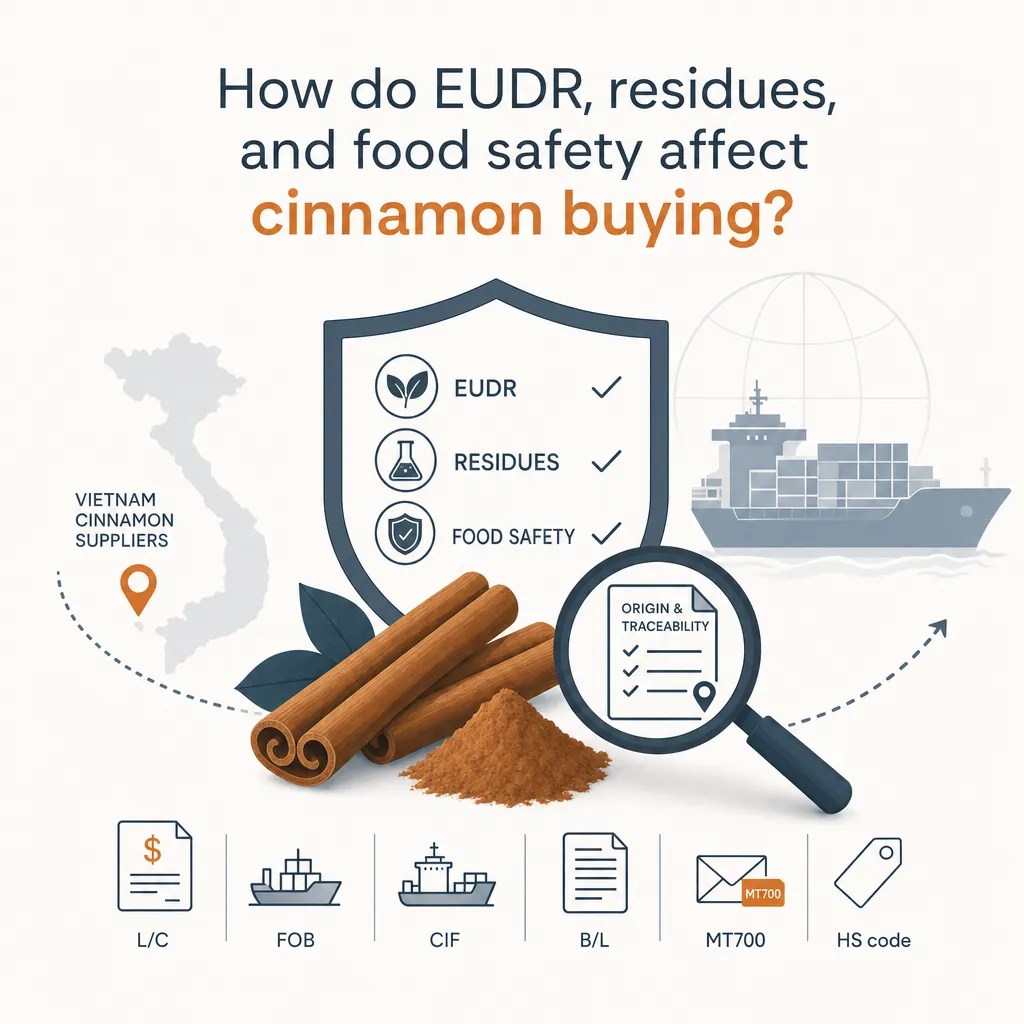
EU buyers need to watch EUDR because cinnamon sits in a broader agricultural supply chain where traceability expectations are rising. The core issue is whether an importer can collect credible origin data and supplier declarations before placing product on the EU market. The regulation text is published as EU Regulation 2023/1115. Buyer teams should check current enforcement dates and company-size rules with counsel or customs advisers before contracting.
A practical quote from the regulation is this: "operators must exercise due diligence" before relevant products are placed on the market. For cinnamon buyers, the operational lesson is simple. Do not wait until the container is ready to ask for origin records. Put traceability documents in the RFQ, sample approval, and contract terms.
Residue control is also important. Spices can face alerts for pesticide residues, salmonella, aflatoxin concerns, foreign matter, or labeling gaps. The EU RASFF portal is useful for checking patterns by product and origin. For global hygiene principles, the Codex food hygiene guidelines help align buyer and supplier language.
Build a food safety checklist into the RFQ: - Supplier food safety certification or recent audit summary. - Lot-level lab report before shipment. - Pesticide screening aligned with destination market. - Microbiology testing for powder and ready-to-pack products. - Metal detection or sieving controls for milled goods. - Clear allergen and cross-contact statement. - Packaging material declaration for food contact use.
Coumarin is another point for cassia buyers because cassia naturally contains more coumarin than Ceylon cinnamon. Requirements depend on final product, market, recipe, and label claim. Do not rely on supplier assurance alone. Ask your regulatory team to define acceptable limits for your use case and require a test report when needed.
ViRFQ helps structure these questions in the RFQ so suppliers answer in comparable fields. That saves time because buyers can sort offers by document readiness, not only by price.
How should pricing and Incoterms work for cinnamon RFQs?
Cinnamon pricing depends on origin, harvest timing, bark quality, cut size, moisture, sorting level, oil aroma, packaging, lab testing, and shipment term. A quote for powder packed in retail jars cannot be compared with a quote for broken bark in bulk bags. Ask suppliers to quote the same product form, same packing, same delivery term, and same document set.
Most international buyers request FOB Vietnam port or CIF destination port. FOB gives you more control over freight and insurance. CIF is useful when you want a landed comparison, but you still need to know which costs are included and which are excluded. For delivery-rule definitions, use ICC Incoterms rules as the reference. Do not let a supplier define trade terms casually in email.
A clean RFQ pricing table can look like this:
| Price field | Buyer instruction |
|---|---|
| Product | Form, grade, cut size, and origin |
| Packing | Inner liner, carton or bag, pallet requirement |
| Term | FOB Hải Phòng, FOB Cát Lái, CIF named port, or another term |
| Validity | Quote validity window and currency |
| Sample | Sample fee, courier account, and refund policy if any |
| Testing | Included lab tests and who pays for extra tests |
| Documents | Which export documents are included in price |
For sample handling, ask for a representative sample, not a polished display sample. The sample should match the intended lot or intended production method. Keep one sealed reference sample on the buyer side and ask the supplier to keep one. When the shipment is packed, compare color, smell, cut size, and lab results against the approved reference.
Avoid over-negotiating price before confirming specs. A small discount can disappear if the supplier changes packing, uses mixed-origin bark, or excludes testing. Your goal is not the cheapest line item. Your goal is an offer that is clear enough to approve, finance, ship, and resell.
What RFQ template should buyers send to cinnamon suppliers?
A strong RFQ turns vague interest into comparable supplier replies. On ViRFQ, good RFQs usually describe the buyer, use case, destination market, and acceptance criteria before asking for price. That helps serious exporters reply with the right product and discourages weak responses.
Use this structure when you post a cinnamon RFQ:
- Buyer profile: importer, distributor, manufacturer, brand owner, or broker.
- Destination: country, port, and any retailer or regulatory constraints.
- Product form: split cassia, stick, tube, broken, chips, powder, or private label.
- Origin preference: Yên Bái, Vietnam origin, or open to supplier proposal.
- Spec: moisture target, cut size, color, oil aroma, foreign matter, and test needs.
- Packaging: bulk bags, cartons, jars, pouches, labels, pallets, and language.
- Quantity plan: sample order, trial order, and recurring forecast written qualitatively if not fixed.
- Documents: invoice, packing list, certificate of origin, phytosanitary certificate, fumigation record if required, lab report, and bill of lading.
- Commercial terms: currency, Incoterms rule, payment proposal, quote validity, and production timing.
- Supplier evidence: registration, export history, factory photos, recent document samples, and quality-control flow.
Here is a short RFQ message you can adapt:
"We are sourcing Vietnamese cassia for food use in the EU and need supplier offers for cut bark and powder. Please quote FOB Hải Phòng and CIF Rotterdam options, confirm origin records, packing, lab testing, and document availability. Include photos, sample policy, quote validity, production timing, and any food safety certification or recent audit evidence."
If you buy several spices, the spices suppliers Vietnam page can help you compare cinnamon with star anise, cassia, turmeric, and pepper categories. If you are ready to test supplier response quality, post a cinnamon RFQ with complete specs rather than asking only for a catalogue.
How do you onboard a supplier after sample approval?
After sample approval, move quickly but keep controls visible. Ask the supplier to issue a proforma invoice or sales contract that matches the approved specification. The contract should include product form, origin claim, packing, quantity, tolerances, delivery term, payment schedule, inspection plan, document list, and dispute process. Keep the language plain enough that both teams can execute it.
Before production, agree on a timeline for raw material collection, sorting, milling if needed, packing, lab testing, inspection, container booking, customs clearance, and document release. Ask for photos at key steps: raw material, sorted product, packaging, carton marks, loaded container, seal number, and shipping documents. Photos are not proof by themselves, but they create a practical audit trail.
During pre-shipment review, check these items: - Product matches approved sample in form, color, smell, and cut size. - Lot codes appear on carton labels and lab report. - Net weight, gross weight, and carton count match the packing list. - Shipping marks match the buyer instruction. - Phytosanitary certificate and fumigation record are planned before vessel departure when required. - Bill of lading consignee, notify party, port, and description match your payment process.
For payment, align the milestone with documents and inspection. Some buyers use deposit plus balance before document release. Others use letter of credit or documentary collection for larger shipments. Choose a method that fits your relationship, order value, and finance controls.
The first shipment is a supplier test, not only a purchase. Track communication speed, document accuracy, production discipline, and how the supplier handles small problems. If the first container performs well, build a quarterly review covering complaint rate, lab results, on-time shipment, packaging damage, and cost changes. That creates a durable Vietnam cinnamon sourcing program instead of one isolated transaction.
FAQ
Is cinnamon from Vietnam acceptable for food importers?
Yes, Vietnamese cinnamon is widely used in food service, manufacturing, and retail spice products. The key is not origin alone. Buyers should verify product form, lab testing, moisture, foreign matter control, pesticide screening, and export documents. For EU and USA markets, ask suppliers to align the quote with your regulatory checklist before sampling.
What is special about Vietnamese cinnamon for buyers?
Vietnamese cinnamon, often called Saigon cinnamon or cassia, is known for a bold, sweet, spicy aroma. Buyers often choose it for bakery mixes, beverages, tea blends, and seasoning products where strong flavor is needed. It should be specified by form, origin, cut size, moisture, packaging, and test requirements.
Where can I find reliable vietnam cinnamon suppliers?
You can find suppliers through sourcing platforms, trade fairs, referrals, and direct outreach to processors in cinnamon-producing provinces. Reliability depends on verification. Check business registration, export documents, factory photos, sample discipline, lab reports, and bank details. RFQ platforms help because suppliers reply against the same buyer specification.
How do I compare Saigon cinnamon suppliers Vietnam offers?
Compare offers only after the specification is aligned. Confirm product form, origin, moisture, cut size, packing, Incoterms rule, sample policy, lab testing, document list, and quote validity. A lower price may exclude testing, use mixed-origin bark, or quote different packing, so build a side-by-side matrix before negotiation.
What documents should a Vietnamese cassia exporter provide?
Common documents include commercial invoice, packing list, certificate of origin when requested, phytosanitary certificate, bill of lading, and fumigation record if required. Food buyers may also request lab reports, allergen statements, food contact packaging declarations, and supplier audit evidence. Requirements vary by destination and product use.
Should I buy cinnamon powder or bark from Vietnam?
Choose bark if you need visible quality control, flexible milling, or spice blending at your own facility. Choose powder if you need ready-to-use ingredients or private-label packing. Powder needs stricter testing because defects are harder to inspect visually after milling. Ask whether milling is in-house or outsourced.
How much sample checking is needed before a cinnamon order?
At minimum, compare smell, color, cut size, moisture, foreign matter, packaging, and lab results against your specification. Keep a sealed reference sample and ask the supplier to keep one too. For powder or retail goods, add microbiology and pesticide screening that matches your destination market.
Can Vietnam spices suppliers handle mixed spice RFQs?
Many exporters handle cinnamon with star anise, cassia, pepper, turmeric, or other spices, but capability varies. Ask whether the supplier processes each item directly or trades some products from partners. Mixed RFQs can reduce sourcing work, yet every product still needs its own specification, sample, and document checklist.
If you are sourcing cinnamon for retail, food service, or manufacturing, turn your spec into a structured RFQ before comparing prices. ViRFQ can help you collect comparable offers from verified Vietnamese exporters, review document readiness, and move from sample to shipment with fewer blind spots. Start with one clear product form, one destination market, and one required document set: post a cinnamon RFQ.