Vietnam supplier verification — 10-step due diligence 2026
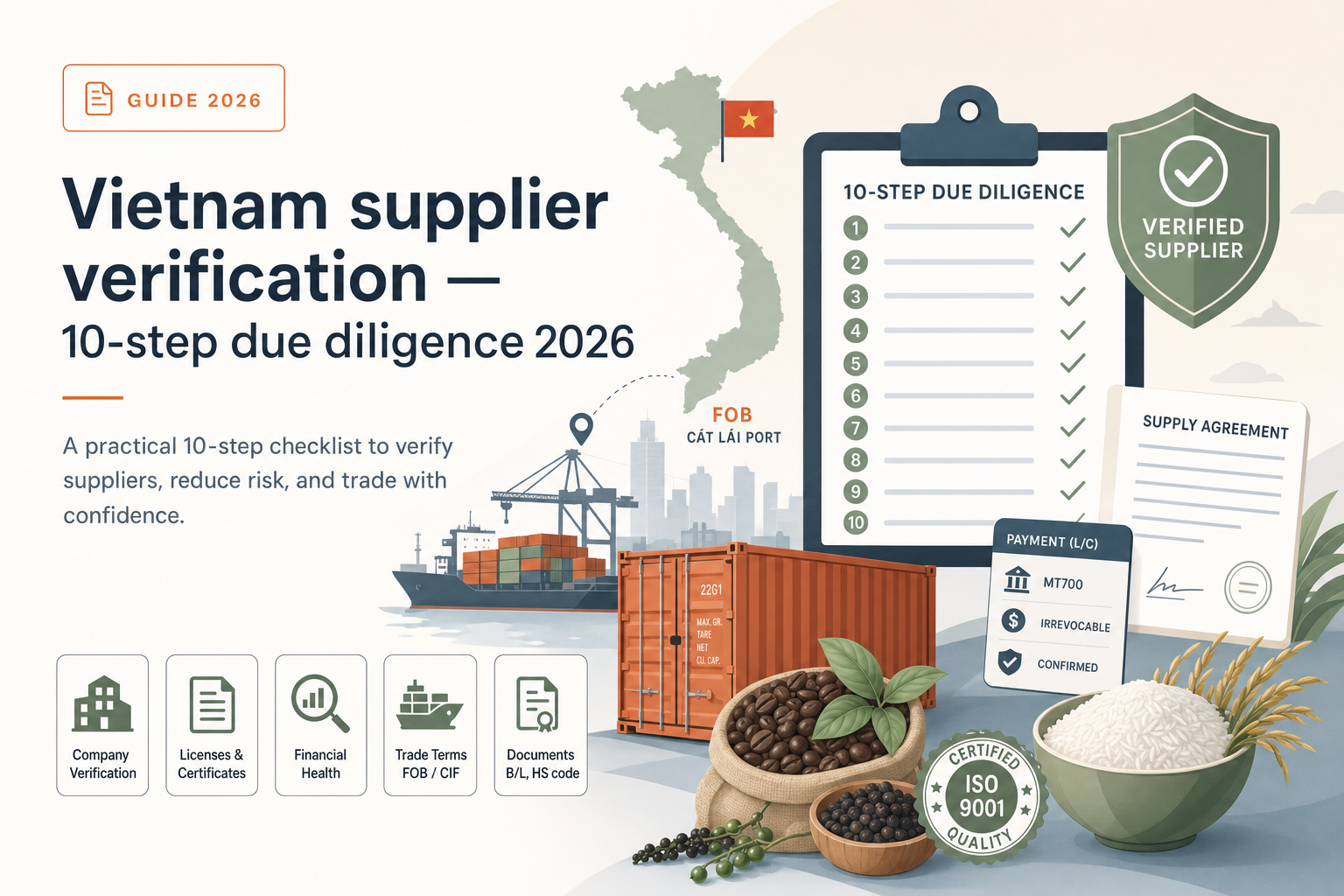
Vietnam supplier verification — 10-step due diligence helps importers screen exporters before samples, deposits, or L/C issuance. Vietnam recorded US$354.7 billion in merchandise exports in 2023 (World Bank), while EU buyers face EUDR Regulation (EU) 2023/1115 (EUR-Lex). This guide turns legal, factory, document, and payment checks into one practical workflow for sourcing teams.
What does Vietnam supplier verification cover?
Vietnam supplier verification is not one check. It is a layered review of the company, people, factory, product, documents, bank account, and trade behavior. The goal is simple: decide whether the exporter is real, capable, and aligned with your purchase order before money moves.
A practical supplier due diligence process should separate evidence into three buckets: - Legal existence: company name, tax code, registered address, legal representative, and business lines. - Operational capability: factory visit, production equipment, export history, product grades, packing, and quality controls. - Transaction safety: quotation consistency, bank account ownership, Incoterms, payment terms, and shipping documents.
ViRFQ uses this split because many weak suppliers look convincing in one bucket but fail another. A trader may have a valid company registration but no control over a mill. A factory may produce good samples but ask for payment to a third-party personal account. A seller may quote FOB but avoid naming the port, shipment window, or inspection point.
Use this 10-step workflow: - Confirm the legal entity. - Match the tax code, address, and representative. - Check the business scope and export category. - Review website, marketplace, and trade references. - Request product specifications and sample policy. - Validate food safety certification through the issuing body. - Run a Vietnam factory audit or video walk-through. - Verify bank account ownership. - Align Incoterms, documents, and inspection terms. - Start with a controlled RFQ and small shipment.
For coffee, where origin, moisture, defects, and EUDR evidence matter, you can also verify a Vietnamese coffee supplier before requesting samples.
How to verify Vietnamese company records and documents
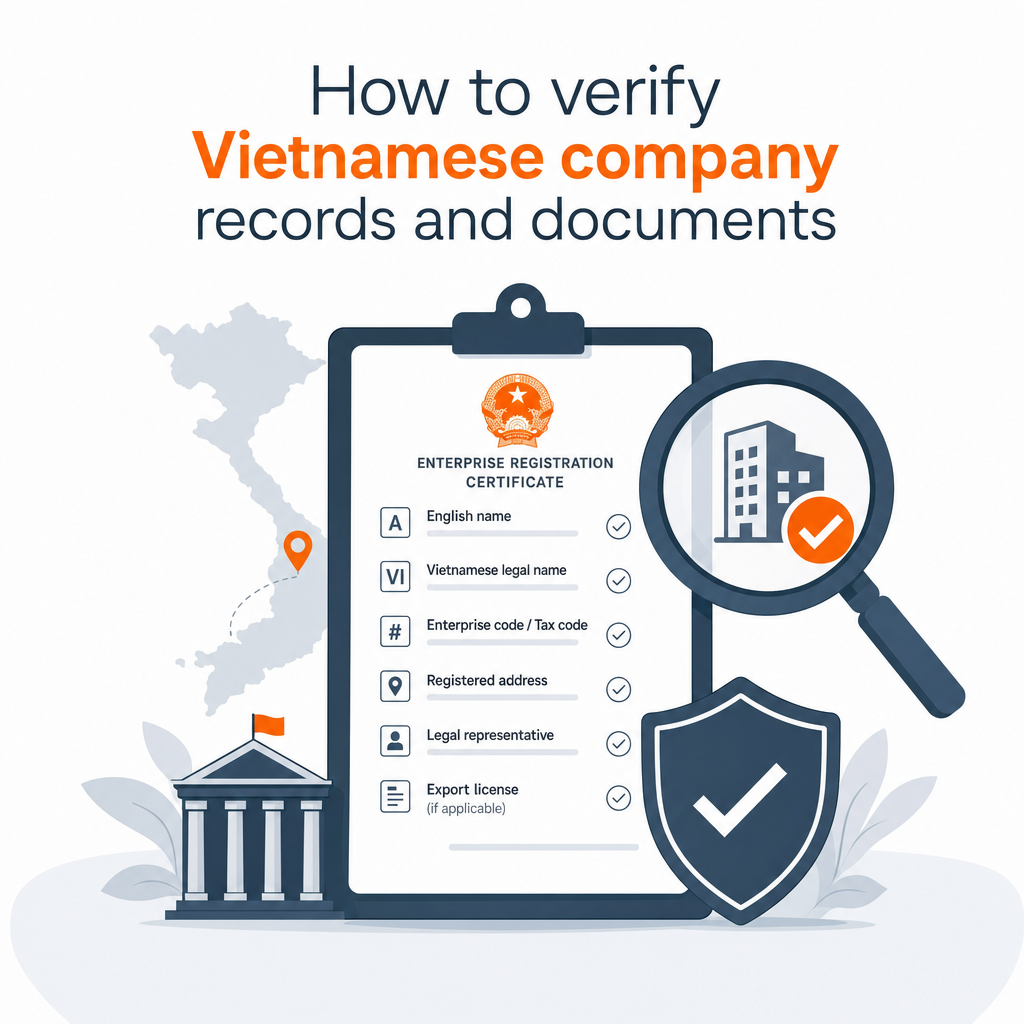
Start with the registered entity. Ask the supplier for its English name, Vietnamese legal name, enterprise code or tax code, registered address, legal representative, and export license details if the product requires extra controls. Then compare those details against the official Vietnam business registration portal. A mismatch does not always mean fraud, but it needs a clear explanation.
Next, compare the company profile with its documents. The seller name should be consistent across the proforma invoice, sales contract, packing list, bank beneficiary, and bill of lading draft. If a trading company uses a related factory, ask for a written authorization letter and factory contact. If the seller refuses, treat the transaction as higher risk.
For export categories such as coffee, pepper, rice, cashew, seafood, and spices, confirm whether the supplier has shipped similar goods before. You can ask for redacted customs declarations, past bills of lading, or buyer references. Do not accept screenshots alone. Ask for PDFs with consistent names, dates, product descriptions, and port details. Vietnam Customs publishes official trade and customs information through Vietnam Customs, which is useful for understanding document norms and export procedures.
Document checks should include: - Company registration certificate and tax code. - Signed quotation on company letterhead. - Product specification sheet with grade, origin, packing, and tolerance. - Sample invoice or proforma invoice. - Draft sales contract with seller name matching registration. - Bank confirmation letter or beneficiary statement.
Before you approve paperwork, check commercial invoice requirements. Invoice errors can delay customs clearance, create HS code disputes, or make the bank reject documents under an L/C.
Vietnam factory audit checks for product and capacity
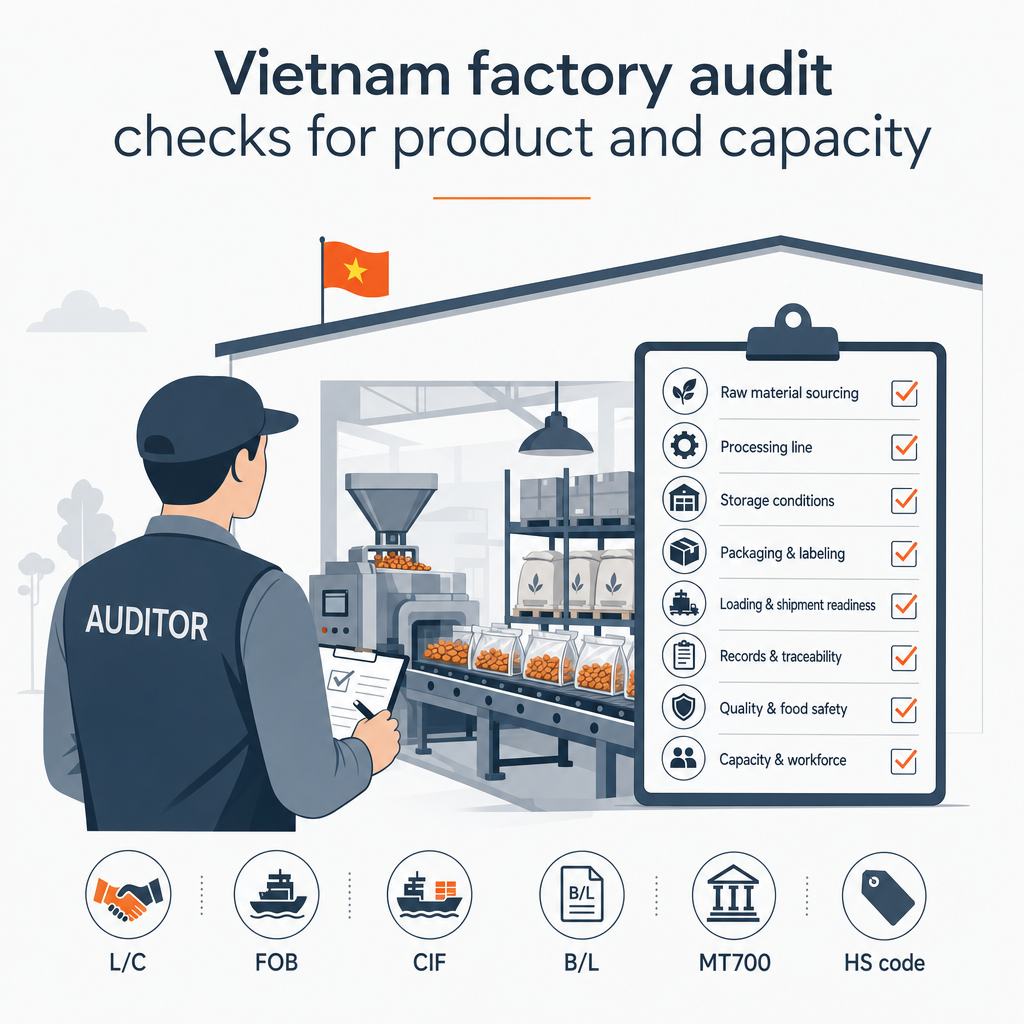
A Vietnam factory audit answers a different question from company registration: can this supplier produce, pack, and ship what you are buying? For agricultural goods, the audit should focus on raw material sourcing, processing line, storage, moisture control, pest control, packaging, traceability, and loading practice.
A useful audit does not need to be complicated. For a first order, ask for a live video call from the facility, not just an office call. Request a walk-through from the gate to storage, processing, packing, and loading area. Ask the supplier to show the company signboard, machinery plate, warehouse lots, and current packing. For higher-value orders, use an independent inspector or local sourcing partner.
Product-specific checks matter. Coffee buyers in Đắk Lắk or Lâm Đồng should verify grade, screen size, defect count, moisture, and origin records. Pepper buyers in Bình Phước or Đắk Nông should check density, sterilization options, and pesticide test history. Cashew buyers should confirm W320 or W240 grade handling, broken percentage, vacuum packing, and carton markings. Rice buyers should review variety, broken ratio, crop season, fumigation needs, and container stuffing practice.
On ViRFQ, buyers can compare supplier responses across the same RFQ instead of relying on one catalogue listing. If your product is black pepper or white pepper, see verified Vietnam pepper suppliers and request the same specification from multiple exporters. For broader sourcing strategy, you can also compare ViRFQ vs Alibaba sourcing.
Use trade data only as context, not proof. ITC Trade Map can show whether Vietnam is active in a product category, but it does not verify one named supplier. Your purchase decision still needs company, factory, document, and payment checks.
Payment, Incoterms, and bank-account due diligence
Payment risk often appears late, after a buyer feels comfortable with the supplier. Move it earlier. Before you pay a deposit, confirm the beneficiary name, bank name, branch, account currency, SWIFT code, and registered company address. The beneficiary should match the contracting entity. If the supplier asks you to pay a different company or an individual, pause and request a written explanation plus corporate linkage evidence.
Incoterms should also be clear before the proforma invoice is signed. FOB Cát Lái, CIF Hamburg, and FCA factory gate create different responsibilities for loading, freight, insurance, and risk transfer. Use the ICC reference for Incoterms 2020 when your team checks whether the quotation matches the shipment plan.
For larger orders, buyers may use documentary credit. The ICC rules for UCP 600 explain how banks examine documents, not physical goods. That means an L/C can reduce document and payment risk, but it does not replace inspection, sampling, or factory verification. If you are new to this payment method, review L/C at sight basics before issuing instructions to your bank.
A safer first transaction usually has these controls: - Small trial quantity tied to approved samples. - Deposit paid only to the registered supplier account. - Pre-shipment inspection before balance payment. - Clear document list in the contract. - Photo or video evidence of container stuffing. - Bill of lading consignee and notify party checked before release.
Keep all communication in one thread or platform. Scattered WhatsApp, email, and PDF revisions make it easier to miss changed bank details.
How to score supplier due diligence and decide
After collecting evidence, convert it into a simple decision score. Do not rely on a vague feeling that the supplier seems professional. A written score helps procurement, finance, and quality teams see the same risk picture.
Use four categories: legal, operational, commercial, and transaction risk. Legal covers registration, tax code, representative, and document consistency. Operational covers factory access, production capacity, product fit, packaging, and inspection readiness. Commercial covers price logic, communication speed, sample policy, and willingness to answer detailed questions. Transaction risk covers bank-account match, payment terms, Incoterms, document quality, and shipment control.
A simple scoring model can look like this:
| Area | Green signal | Red signal | |---|---|---| | Legal | Names and tax code match | Seller uses unrelated entity | | Factory | Live audit or third-party visit allowed | Only stock photos provided | | Product | Specs match RFQ and sample | Vague grade or origin | | Payment | Company bank account matches contract | Personal or offshore account | | Documents | Drafts are consistent | Frequent unexplained changes |
Use public logistics context as a reality check. The World Bank Logistics Performance Index can help your team compare customs, infrastructure, and shipment reliability across markets, but it will not replace supplier-level checks.
A good decision is not always “approve” or “reject.” Sometimes the right answer is “approve with controls.” For example, you may proceed with a smaller lot, inspection before balance payment, or escrow-style milestone. ViRFQ can collect comparable quotes, keep RFQ details consistent, and help you shortlist suppliers who answer the same questions in the same format. That makes due diligence faster and easier to defend internally.
FAQ
How do I verify a company in Vietnam before paying?
Ask for the Vietnamese legal name, tax code, registered address, legal representative, and bank beneficiary details. Compare those items with the Vietnam business registration portal, then check whether the same entity appears on the quotation, contract, invoice, and bank account. If another company or individual requests payment, pause and ask for written linkage evidence.
What is the supplier due diligence process for Vietnam?
A practical process starts with company registration, then moves to document review, product specification, factory audit, certification validation through the issuing body, bank-account verification, Incoterms alignment, inspection planning, and a controlled first order. The aim is to confirm legal existence, operational capacity, and transaction safety before you scale purchase volume.
What are the 4 P's of due diligence in sourcing?
For sourcing, the 4 P's can be framed as people, premises, product, and payment. People means the legal representative and sales contacts. Premises means the office, factory, or warehouse. Product means specifications, samples, and quality controls. Payment means beneficiary name, bank account, terms, and document release process.
What are the 4 types of supplier due diligence?
The four practical types are legal due diligence, operational due diligence, commercial due diligence, and transaction due diligence. Legal checks confirm the entity. Operational checks confirm production ability. Commercial checks test pricing and responsiveness. Transaction checks reduce payment, document, and shipment risk.
Is a Vietnam factory audit needed for every supplier?
Not always. A small sample order may only need registry, document, and video checks. A larger order, private-label product, regulated food item, or first shipment with a new exporter should include a factory audit or independent inspection. The higher the value and compliance burden, the more important on-site verification becomes.
Supplier due diligence works better when every exporter answers the same questions. ViRFQ helps buyers send structured RFQs, compare verified Vietnamese suppliers, and keep documents, samples, and payment terms organized in one sourcing flow. If you are ready to test the market, post your Vietnam RFQ on ViRFQ and receive comparable supplier responses for your next shipment.