Robusta coffee Vietnam FOB: price + quality grades 2026
Reviewed by Phan Hà Thái, Founder ViRFQ
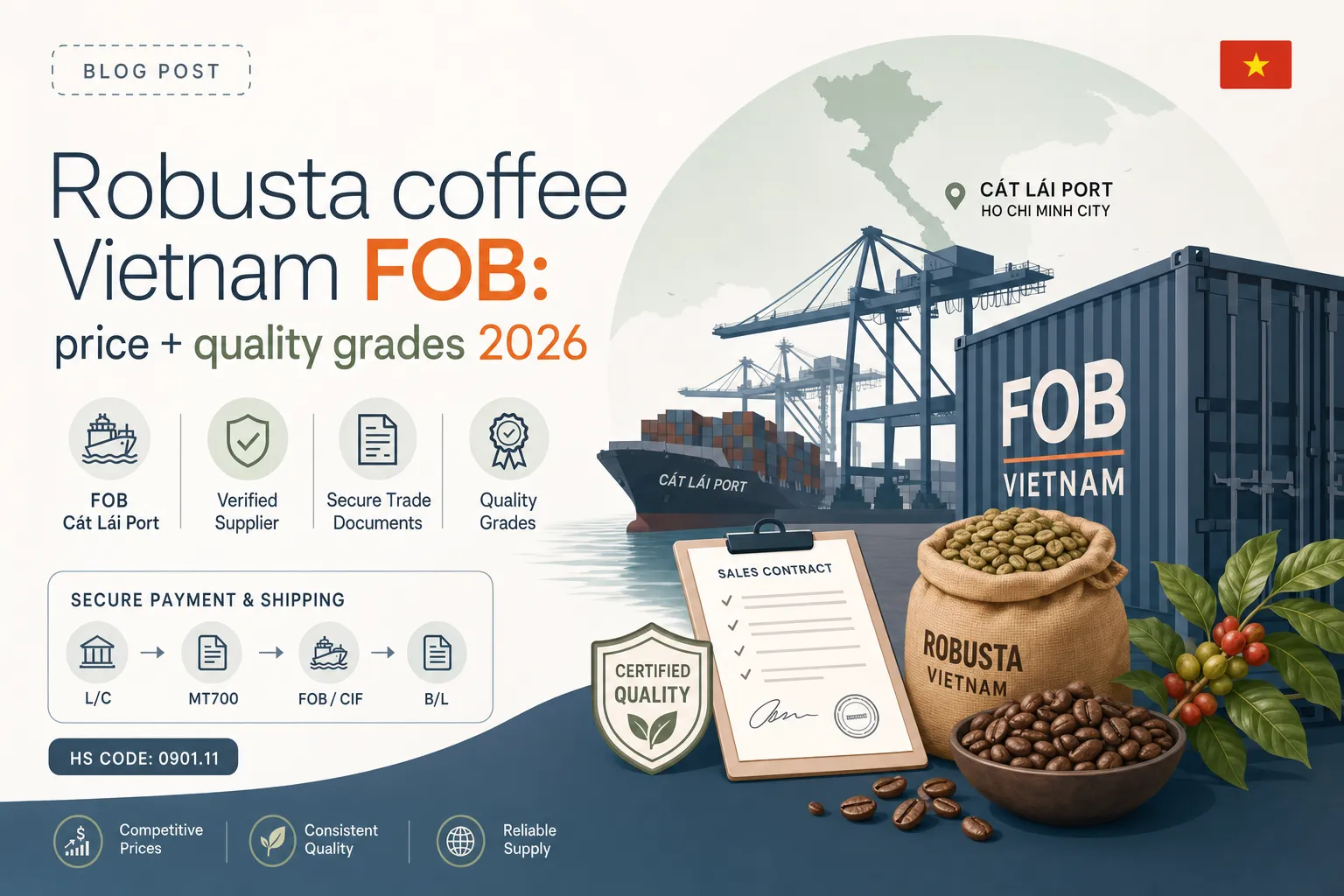
Robusta coffee Vietnam FOB — price + quality grades depend on futures, differential, screen size, defects, and shipment month. Vietnam’s crop is about 30 million 60-kg bags per season USDA coffee outlook, while indicative Cat Lai FOB quotes were USD 3.70–4.40/kg (estimated from ViRFQ N=286 RFQs Apr-Jun 2026); this guide translates grade language into buyer checks.
How Vietnam robusta coffee FOB price is built
A Vietnam robusta coffee FOB price is not one fixed export number. It is usually built from three layers: the London robusta futures reference, the Vietnam physical differential, and the exact grade the buyer requests. The futures layer changes daily. The differential moves with harvest timing, farmer selling speed, local stock, financing costs, and vessel availability at Cat Lai or other southern ports.
Use public market data as a benchmark, not as a purchase order. World Bank commodity data is useful for monthly robusta direction, while ICO trade statistics helps frame Vietnam inside global green coffee trade. A supplier’s FOB offer may sit above or below those references because the quote includes cleaning, grading, export packing, inland trucking, documentation, and port handling before the cargo crosses the ship’s rail.
For buying, the key question is: what exactly is included in the FOB line? Ask the seller to separate: - Green coffee grade and screen size - Maximum moisture and black or broken bean limit - Bag type, net weight, and marking - Shipment port, commonly Cat Lai for many Ho Chi Minh City exporters - Shipment window and quote validity - Payment term, such as T/T deposit or L/C at sight
If you are still comparing supplier responses, post your coffee RFQ on ViRFQ with one clear grade, one port, and one shipment month. That makes quotes easier to compare and reduces the chance that a low line hides weaker specifications.
What robusta coffee quality grades mean in Vietnam
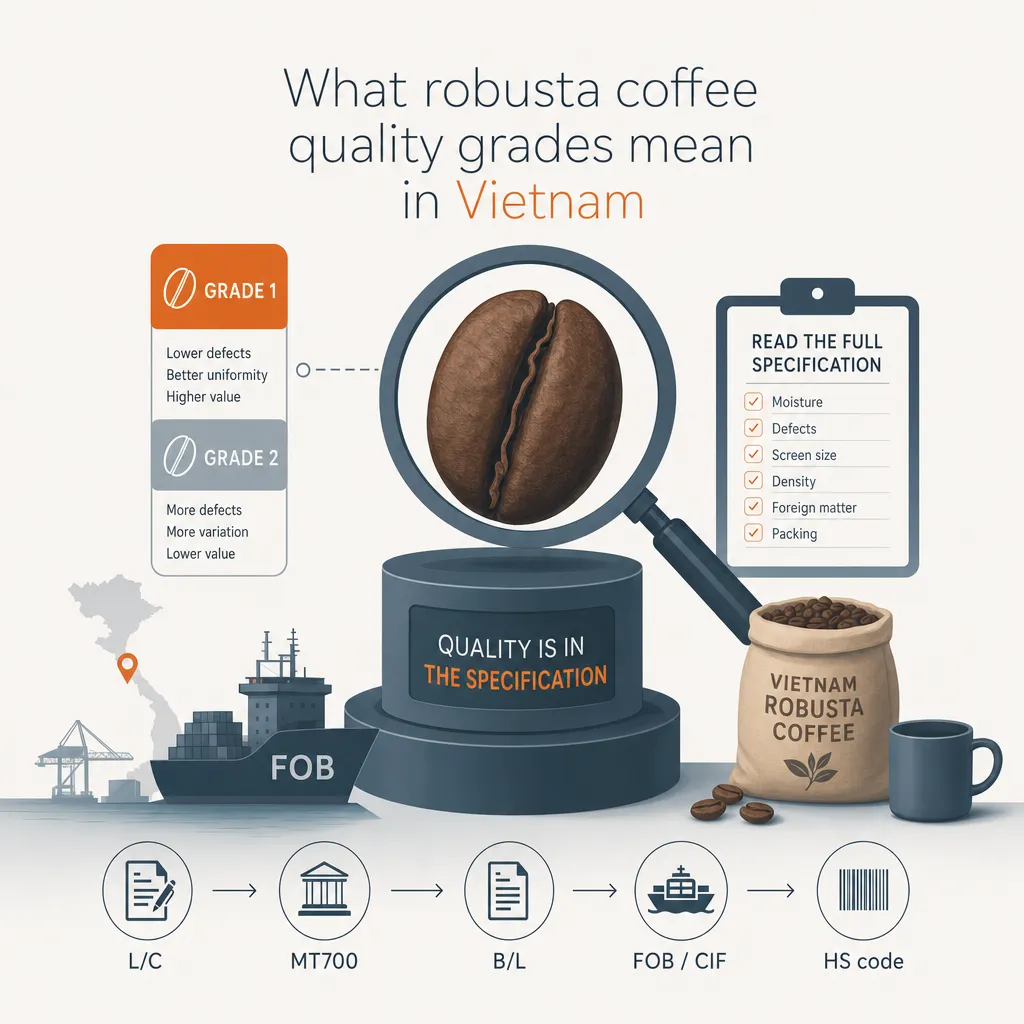
Vietnam robusta coffee quality grades are commercial shorthand. They are not all equal across suppliers. A buyer should read the full specification rather than relying only on “Grade 1” or “Grade 2.” In practice, Grade 1 often points to a larger screen and cleaner cup potential, while Grade 2 is the common bulk export benchmark for soluble coffee, blends, and price-sensitive roasting.
A simple comparison looks like this:
| Buyer phrase | Common meaning | What to confirm |
|---|---|---|
| Grade 1, screen 18 | Larger beans, cleaner sorting | Defect limit, moisture, polish |
| Grade 1, screen 16 | Mid-large beans | Whether wet polished is included |
| Grade 2, screen 13 | Common commercial robusta | Black and broken bean limit |
| FAQ terms like AA or AAA | Not a standard Vietnam robusta basis | Ask for screen and defect sheet |
Moisture is central because coffee can change during storage and sea transit. Many buyers target a moisture level near 12.5%, but the acceptable level should be written into the proforma invoice and contract. Defects also matter. A 2% black and broken limit is not the same product as a 5% limit, even if both are called robusta.
Origin adds another layer. Đắk Lắk, Gia Lai, Lâm Đồng, and Đắk Nông have different farm networks, processors, and harvest timing. MARD agriculture updates can help buyers follow Vietnam agriculture policy and crop context, but lot-level inspection still matters. Before you send a deposit, verify a Vietnamese coffee supplier and request sample photos, recent export documents, and a clear quality clause.
Cat Lai coffee FOB quote checklist for buyers
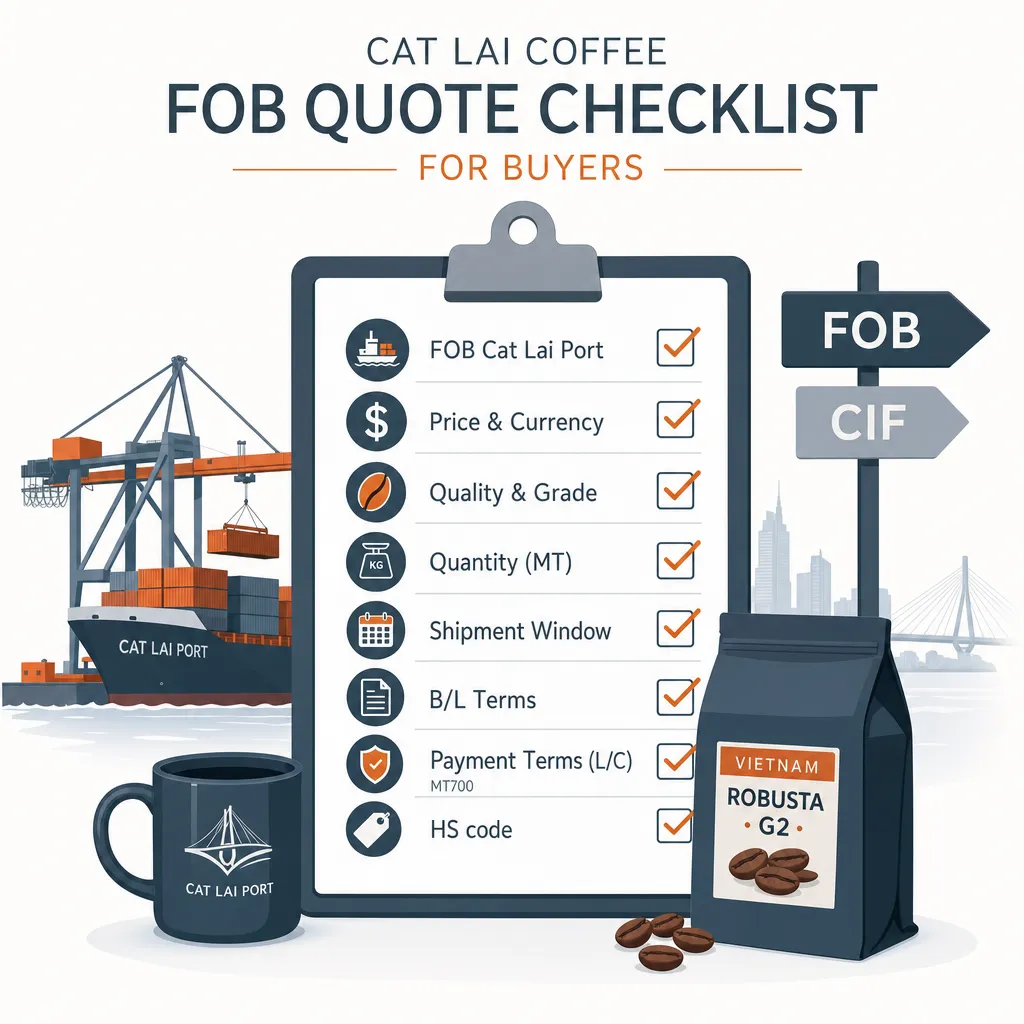
A Cat Lai coffee FOB quote should read like an operational offer, not a vague price message. Cat Lai is a common container gateway for exporters serving Ho Chi Minh City trading houses and Central Highlands processors. The quote should state the port, shipment window, bagging format, quantity, and documents included.
Here is a practical quote checklist: - Product: Vietnam robusta green coffee beans - Grade: Grade 1 screen 18, Grade 1 screen 16, or Grade 2 screen 13 - Quality: moisture limit, defects, foreign matter, smell, and cup notes - Packing: jute bags, PP bags, or buyer-specified export bags - Term: FOB Cat Lai under Incoterms rules - Documents: commercial invoice, packing list, bill of lading, origin certificate if needed, and plant health document when required - Payment: T/T schedule or L/C at sight with named bank
FOB means the seller handles export clearance and delivery on board at the named port. The buyer handles main freight, insurance if desired, and destination clearance. For the official trade-term framework, see the ICC Incoterms rules. For paperwork flow, read the commercial invoice guide and the L/C at sight guide.
Do not compare a Cat Lai FOB quote with a warehouse price or CIF destination price without adjustment. Freight, insurance, financing, and port charges can change the landed cost. A clean RFQ should make every supplier quote on the same basis. That is the fastest way to see whether a price gap comes from real market access, grade difference, or missing services.
How to judge price versus grade without overpaying
The goal is not to buy the lowest-looking line. The goal is to buy the grade that fits your roast plan, extraction target, or resale specification. A Grade 1 screen 18 robusta may make sense for single-origin Vietnamese robusta, espresso blends, or buyers who need a cleaner visual profile. Grade 2 screen 13 may be enough for soluble coffee, private-label blends, or markets where price stability matters more than bean appearance.
Use a “spec first, price second” sequence: - Define the final use: roasting, blending, soluble, or resale - Choose screen size and defect tolerance before asking for price - Request a pre-shipment sample from the same lot or same processing line - Confirm whether wet polishing, extra sorting, or special bag marking is included - Check whether the quote validity is short during volatile weeks
ITC Trade Map is helpful for checking Vietnam coffee trade flows by destination, but it will not tell you if a supplier’s lot cups clean. That requires samples and a written acceptance process. If possible, compare two samples: one from the offer lot and one retained as a reference. The retained sample reduces disputes if arrival quality differs.
With ViRFQ’s supplier workflow, buyers can place the same RFQ in front of multiple Vietnam exporters and compare replies side by side. Pair that with your own lab test or third-party inspection. If the grade is not written clearly, ask again before negotiating price. A vague grade can make an attractive quote expensive after defects, claims, or replacement costs.
Supplier verification for Vietnam robusta FOB sourcing
Supplier verification protects both price and delivery. A real exporter should be able to explain where the coffee is collected, how it is processed, which warehouse holds the stock, and which forwarder handles Cat Lai bookings. They should also provide company registration, export history indicators, and sample documents with sensitive fields redacted.
Start with a basic due-diligence pack: - Business registration name and tax code - Factory, warehouse, or trader role in the supply chain - Recent bill of lading sample for coffee or similar agricultural cargo - Bank account matching the contracting party - Quality control process and inspection point - Clear claim procedure for moisture, defects, or short shipment
Then match documents against behavior. A credible supplier answers grade questions directly. They do not rush you into a deposit before the grade sheet, contract, and payment term are aligned. They also understand the difference between FOB Cat Lai and destination pricing.
For a wider process, use this Vietnam supplier due diligence checklist and compare it with how to import Vietnamese coffee. If you are replacing broad marketplace browsing, you can also compare Vietnam sourcing alternatives. ViRFQ helps buyers turn those checks into a structured RFQ, so suppliers respond against the same grade, port, and document requirements.
FAQ
What drives Robusta coffee Vietnam FOB price differences?
The main drivers are London robusta futures, Vietnam physical differential, grade, screen size, defects, moisture, port, shipment month, and payment term. A Grade 1 screen 18 lot usually prices differently from Grade 2 screen 13 because sorting and usable yield differ. Always compare quotes on the same FOB port and specification.
Which quality grades are common for Vietnam robusta FOB?
Common export phrases include Grade 1 screen 18, Grade 1 screen 16, and Grade 2 screen 13. Buyers should not rely on the grade name alone. Ask for moisture limit, black and broken bean limit, foreign matter limit, polish status, sample policy, and pre-shipment inspection point.
Is Cat Lai the normal port for Vietnam robusta coffee FOB?
Cat Lai is a common FOB port for many exporters around Ho Chi Minh City and the Central Highlands supply chain. It is not the only possible port, so the quote must name the port clearly. FOB Cat Lai and FOB another port can produce different total landed costs.
Are AA and AAA standard Vietnam robusta grade terms?
AA and AAA are not the clearest basis for Vietnam robusta green coffee buying. They may appear in supplier marketing, but buyers should convert those labels into measurable terms: screen size, defect limit, moisture, processing method, and sample approval. Measurable specifications are easier to inspect and enforce.
How should I compare robusta FOB offers from Vietnam suppliers?
Create one RFQ with the same grade, port, shipment window, packing, payment term, and document list. Then compare price, sample quality, response clarity, export history, and contract terms. If one offer is much lower, check whether it excludes polishing, inspection, documents, or realistic shipment timing.
If you need Vietnam robusta for roasting, blending, or resale, start with one clean specification: grade, screen, moisture, defect limit, port, and shipment month. ViRFQ will route that RFQ to relevant Vietnamese exporters and help you compare like-for-like offers. Start here: post your coffee RFQ on ViRFQ.
Sources
Reviewed by
Founder & CEO, ViRFQ
Phan Hà Thái is the founder and CEO of ViRFQ, the buyer discovery and buyer management platform (and B2B marketplace) for Vietnamese agricultural exporters. His background is in international trade finance and Vietnamese agricultural exports. He writes and reviews the ViRFQ blog analyses on FOB pricing, Letter of Credit (L/C) workflows, EUDR compliance, and supplier verification.
Related articles
Vietnam Black Pepper Price 2026 Guide
9 phút
How to Import from Vietnam — Full Process Guide 2026
9 phút
Vietnam supplier verification — 10-step due diligence 2026
9 phút
Vietnam pangasius fillet supplier — sourcing playbook 2026
9 phút
Vietnamese Cashew W320 Exporter Specifications 2026
9 phút