Vietnam Cashew Suppliers Guide 2026
Reviewed by Phan Hà Thái, Founder ViRFQ
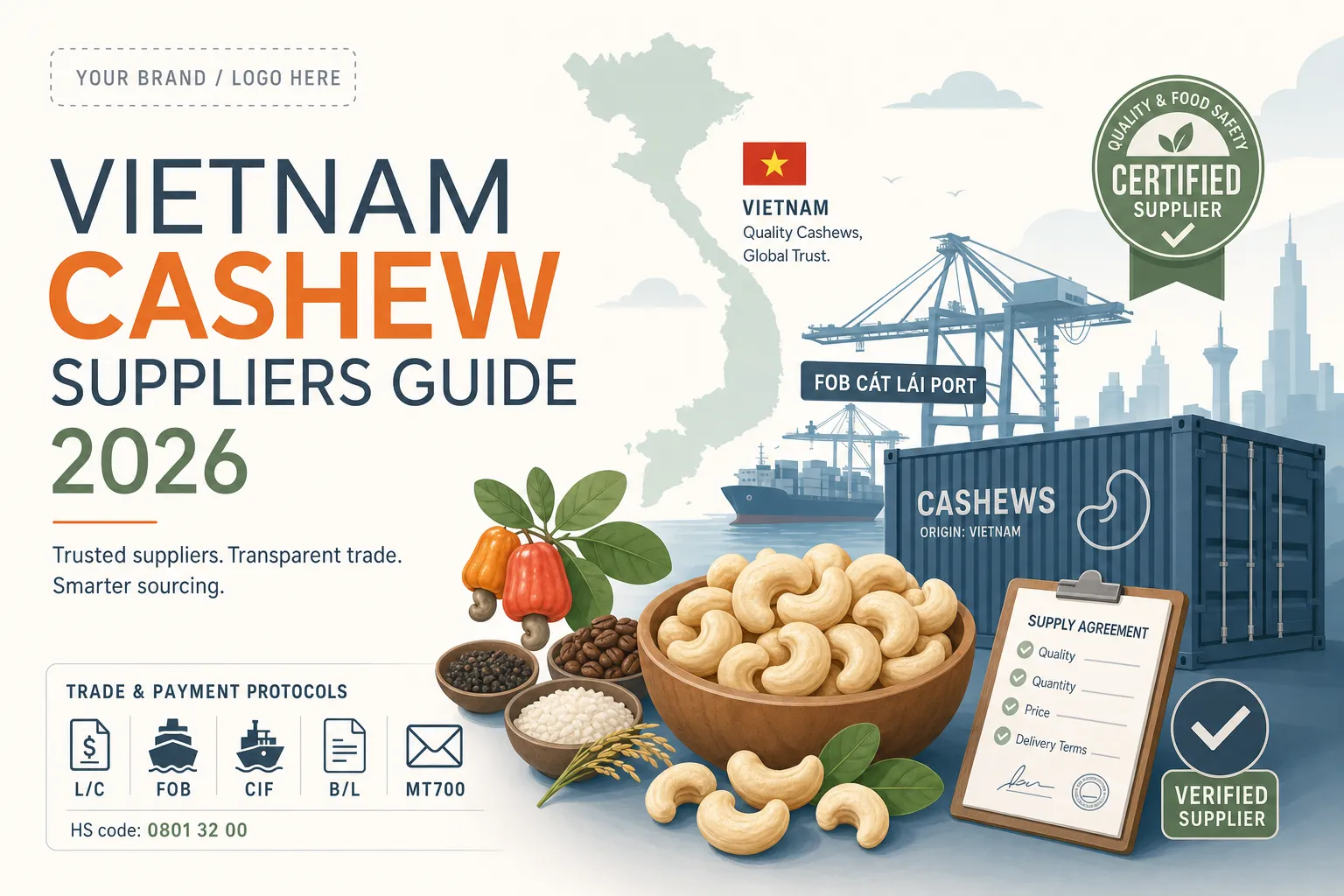
vietnam cashew suppliers ship kernels to more than 90 markets via Vietnam Customs and source raw nuts from 30-plus origins via UN Comtrade, making Vietnam a scale processing hub. ViRFQ explains how buyers verify grades, factories, food safety files, and RFQ terms before awarding volume.
Why buyers choose Vietnam cashew suppliers
Vietnam is a major cashew processing and export base because it combines factory density, port access, and long experience with kernel grading. Buyers usually look at Vietnam after comparing India, Côte d’Ivoire, Cambodia, and Brazil. The practical reason is simple: Vietnam has many processors that can handle raw nut imports, shelling, peeling, grading, roasting, and export packing near Ho Chi Minh City and Cát Lái.
The country’s role is visible across public trade systems. Vietnam Customs tracks national export flows, UN Comtrade lets buyers compare cashew trade by origin and destination, and FAOSTAT crops data helps separate farm production from processing trade. That distinction matters. A supplier may process Vietnamese-grown cashews, imported raw cashew nuts, or a blend. You should ask which source applies to your order.
The buyer intent behind this search is not just “find a list.” Importers need a shortlist they can trust. Many search results name exporters, but they often miss practical checks: plant ownership, grade consistency, allergen controls, carton markings, and payment terms. This guide focuses on those checks.
A good Vietnam cashew nuts exporter should answer four questions clearly: - Which kernel grades can you ship regularly? - Which factory processes the order? - Which documents will be sent before loading? - Which Incoterms and payment terms are acceptable?
If a supplier cannot answer those points, treat the offer as unready for an international purchase order. If the answers are specific, you can move to samples, contract terms, and a commercial comparison.
Cashew grades, kernel styles, and what W320 really means
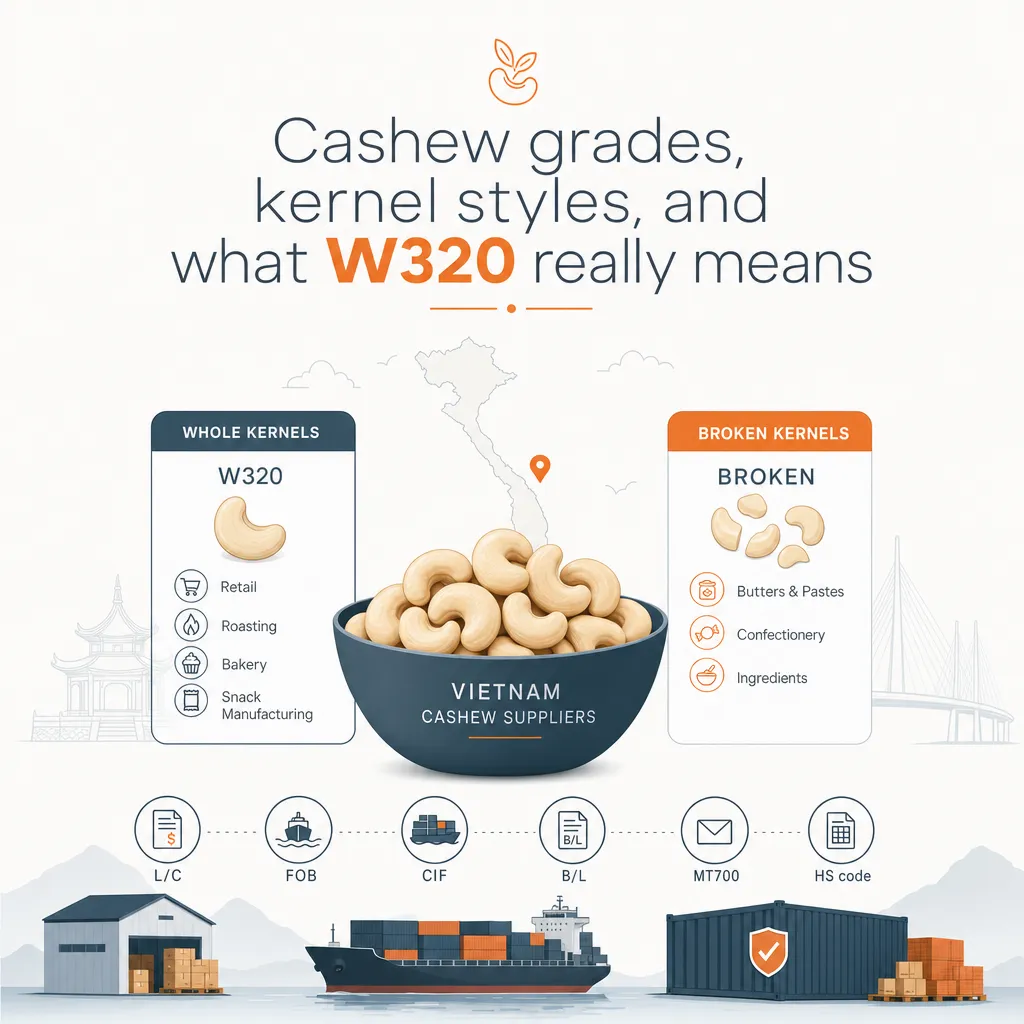
Cashew grades describe size, color, breakage, and kernel style. Whole white kernels are common in retail, roasting, bakery, and snack manufacturing. Broken kernels work for butters, pastes, confectionery, and ingredients where visual uniformity matters less. Your quote should state the exact grade, not only “Vietnam cashew kernels.”
Two common whole-kernel grades are W320 (AFI Standards) and W240 (AFI Standards). The letters usually refer to whole kernels, while the number indicates a count range under industry grading practice. Buyers should still ask for the supplier’s specification sheet because grading language can vary by contract, buyer market, and inspection practice.
Use this simple buying map:
| Use case | Common buying focus | What to verify |
|---|---|---|
| Retail pouch | Whole kernels, clean color | Uniform size, low defects, pack design |
| Roasted snacks | Whole or split kernels | Moisture, breakage after roasting |
| Bakery | Splits or pieces | Flavor, foreign matter controls |
| Nut butter | Pieces | Aflatoxin controls, oil stability |
| Food service | Whole or broken mix | Carton strength, shelf-life file |
Food safety is the other half of grade quality. Cashews can face aflatoxin, foreign matter, and rancidity concerns. Buyers selling into the European Union should review EU contaminant rules. Buyers selling into the United States should understand the FDA FSVP rule. For broader food code references, Codex Alimentarius is useful.
Do not rely only on a beautiful product photo. Ask for recent lab reports, lot traceability, shelf-life basis, and sample photos under neutral light. A serious Vietnam W320 cashew supplier will welcome those questions.
Where cashew suppliers are concentrated in Vietnam
Supplier geography tells you a lot about reliability. Bình Phước is strongly associated with cashew growing and processing. Ho Chi Minh City, Đồng Nai, Bình Dương, and Long An are common locations for trading offices, roasting lines, warehouses, and export coordination. Orders often move through Cát Lái or nearby container terminals, depending on carrier routing and warehouse location.
That geography creates several supplier types. First, there are integrated processors that own or control shelling and peeling capacity. Second, there are exporters that buy finished kernels from partner factories. Third, there are trading companies that consolidate orders across grades. All three can work, but the verification method differs.
For an integrated processor, ask for factory photos, production flow, pest-control records, and a recent third-party audit summary. For an exporter using partner factories, ask for the partner factory name and whether the same plant will process your order. For a trader, ask how they control lot identity from purchase to loading.
The Vietnam Cashew Association, often cited as VINACAS, is a useful industry reference for association activity and sector context. Expert quote: VINACAS has often framed processing discipline, raw nut supply, and export quality as central to Vietnam’s cashew competitiveness. Buyers should translate that message into factory-level questions, not accept a logo as proof.
Logistics also matters. World Bank logistics data can help buyers compare country-level logistics conditions, but your order still depends on the supplier’s forwarder, packing date, vessel schedule, and documentation speed. A supplier near a port is not automatically reliable; a supplier with clear loading control is stronger.
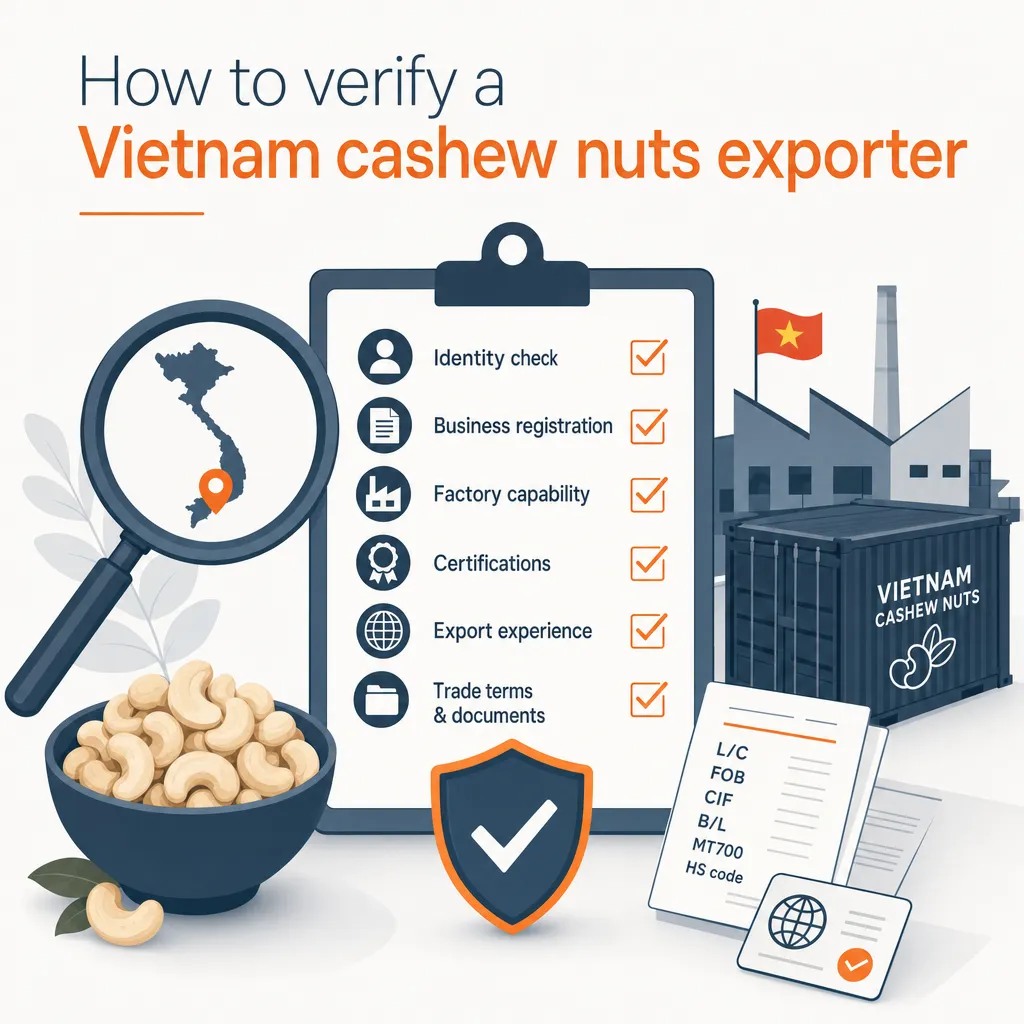
How to verify a Vietnam cashew nuts exporter
Verification should happen before price negotiation becomes serious. A low quote from an unverified seller can waste weeks and create payment, sample, or documentation problems. Start with identity checks, then move to factory capability, then product evidence.
A practical verification flow looks like this: - Confirm legal name, tax code, address, and export contact. - Ask whether the supplier is a processor, exporter, or trader. - Request product specification for the exact grade. - Request recent lab reports for moisture, aflatoxin, and microbiology where relevant. - Ask for sample policy, sample courier account, and expected sample timeline. - Check whether carton markings match your import and warehouse needs. - Confirm who issues the commercial invoice and packing list.
For importers who buy across several Vietnam categories, it also helps to compare Vietnam sourcing with broad marketplaces through /en/blog/alibaba-alternative-vietnam. General marketplaces are useful for discovery, but cashew buying needs deeper file checks because grades, defect tolerance, and food safety documentation can decide whether the shipment clears smoothly.
On ViRFQ, a strong cashew RFQ asks suppliers to upload specification sheets, export documents, and factory evidence before final negotiation. That saves time because each quote answers the same questions. You can then compare exporters on grade match, document readiness, payment terms, and shipping plan rather than only price.
You should also check trade compliance for your market. The WTO SPS Agreement explains the broader framework for sanitary and phytosanitary measures. For a practical import file, your customs broker may still require market-specific documents, labels, and test reports. Always align the supplier file with your broker before deposit or letter of credit issuance.
RFQ template for cashew kernels from Vietnam
A clear RFQ is the fastest way to separate serious suppliers from casual sellers. If you send only “price for cashew,” you will receive quotes that cannot be compared. Your RFQ should define grade, quantity, packing, destination, Incoterm, sample need, and document requirements.
Use this structure when you post a buying request:
| RFQ field | Example detail to include |
|---|---|
| Product | Whole white cashew kernels, exact grade stated |
| Origin request | Vietnam processed; state if Vietnam-grown is required |
| Packing | Vacuum bag, tin, pouch, or bulk carton requirement |
| Destination | Port, inland warehouse, or buyer country |
| Incoterm | FOB Cát Lái, CIF destination, or other term |
| Documents | Invoice, packing list, bill of lading, origin certificate if needed |
| Food safety file | Lab report, allergen statement, traceability record |
| Samples | Required grade, pack, and courier method |
Use ICC Incoterms rules when you choose the delivery term. The delivery term decides who handles inland freight, export customs, ocean freight, insurance, and destination costs. A supplier quote under FOB is not directly comparable with a CIF quote unless you normalize freight and insurance.
If you need a broader procurement route, you can view RFQs across categories at /en/rfq. If cashew is the main item, use a category request so processors see the right product details. Buyers who also source pepper, coffee, rice, or spices can keep the same RFQ discipline across categories.
Before sending the RFQ, review Vietnam cashew export basics at /en/blog/xuat-khau-hat-dieu-viet-nam. That background helps you understand common Vietnamese exporter language and documents, even if the article is written for exporters.
Price comparison without chasing the cheapest quote
Cashew price comparison should account for grade, defect level, moisture, packing, payment term, inspection, and freight. A cheaper offer can become more expensive if it uses weaker cartons, unclear grade language, slow documents, or a payment term that increases financing cost. Compare landed cost and rejection risk, not only FOB number.
Because public prices move with raw cashew nut supply, kernel demand, exchange rates, and freight, this guide does not publish stale price points. Instead, use a comparison sheet with the same fields for each supplier. Include grade, origin statement, pack format, shelf-life basis, document set, shipment window, payment term, and inspection option. Ask suppliers to quote the same Incoterm and the same port.
Payment terms change your real cost. Telegraphic transfer may be simple for repeat buyers, but many first orders use documentary controls. If you use a letter of credit, review ICC UCP rules with your bank. The wording must match the supplier’s document capability. A small mismatch between invoice, packing list, and bill of lading can delay payment and cargo release.
Inspection is also part of price. You may request pre-shipment inspection, container loading photos, or lab tests for high-value retail programs. For European importers, EU RASFF portal alerts can help your quality team understand recurring food safety issues across categories. For UK-facing programs, UK Food Standards Agency mycotoxin guidance is a useful reference.
The right comparison question is: which supplier gives the cleanest confirmed specification, strongest document fit, and most realistic shipment plan for the total landed cost?
Documents, shipping, and quality control before loading
Cashew import files usually involve a commercial invoice, packing list, bill of lading, certificate of origin when requested, test reports, and sometimes a phytosanitary or health-related document depending on market rules and buyer policy. Your broker should confirm the exact file before the supplier prints final documents.
Document consistency is critical. Product description, net weight, gross weight, carton count, buyer name, seller name, vessel details, and origin statement should match across documents. If your warehouse requires barcode labels, pallet marks, or allergen text, add that requirement before production. Do not wait until the container is already loaded.
Two internal checks are useful before shipment. First, prepare the packing list using /en/blog/packing-list-la-gi so carton count and weight fields are complete. Second, check bill of lading details with /en/blog/bill-of-lading-la-gi before originals or telex release instructions are finalized.
For quality control, ask for photos at three stages: empty cartons or packing material, finished goods before stuffing, and container loading. Ask the supplier to identify lot numbers in the photos. If the order is for retail, add pouch artwork approval and metal-detection or foreign-matter controls to the production checklist.
Vietnam’s agriculture authority, Vietnam MARD, is a useful reference point for agriculture-sector information, but shipment clearance depends on the rules of your importing country. Treat the supplier’s document claim as a starting point. Your broker and quality team should confirm whether the file matches destination law, retailer policy, and insurer expectations.
Shortlist process: from sample to purchase order
A structured shortlist keeps your sourcing team from overreacting to the first attractive quote. Start with a broad list of Vietnam cashew suppliers, then remove companies that cannot provide basic identity, factory, grade, and document information. After that, run samples and commercial negotiation with a smaller group.
A practical shortlist has four stages. Stage one is screening: legal identity, export experience, product range, and response quality. Stage two is sample review: appearance, flavor, breakage, moisture feel, pack integrity, and lab file. Stage three is commercial comparison: Incoterm, payment, shipment window, inspection, and claims process. Stage four is pilot order: limited first shipment with strict document and loading control.
ViRFQ supplier profiles and RFQ responses are built to support that sequence. You can ask each supplier the same questions, request the same documents, and compare answers side by side. That does not replace your own quality approval, but it makes the first shortlist faster and cleaner.
Be careful with supplier lists that rank companies without explaining the criteria. A strong list should state whether it measures export volume, factory capacity, retail capability, certifications, or buyer feedback. Those are different signals. A processor with excellent retail packs may not be the right supplier for bulk ingredient pieces. A trader with fast quotes may still need stronger traceability evidence.
For most importers, the goal is not to find one famous name. The goal is to build a reliable bench: one main supplier, one backup processor, and one specialist for alternative grades or packing formats. That bench protects your program when raw nut supply, freight schedules, or buyer demand changes.
FAQ
Does Vietnam produce cashew nuts and process imported raw nuts?
Yes. Vietnam has domestic cashew production and a large processing sector that also uses imported raw cashew nuts. Buyers should ask whether the offered kernels are Vietnam-grown, Vietnam-processed from imported raw nuts, or a blended sourcing program. That origin detail can affect labeling, story, and document needs.
Are cashews from Vietnam good for retail and ingredients?
Vietnamese cashew kernels can work well for both retail packs and ingredient use when the grade, defect tolerance, moisture, and food safety file match your market. Do not judge by country alone. Ask for specification sheets, samples, lab reports, and photos from the actual lot before awarding a purchase order.
Who is the biggest supplier of cashew nuts globally?
The answer depends on whether you mean farm production, raw nut supply, processing, or kernel exports. Vietnam is a major cashew processing and kernel export hub, while African origins are important raw nut producers. Use trade databases and supplier verification instead of relying on a single broad ranking.
Are cashews cheap in Vietnam compared with other origins?
Vietnam can be competitive because of processing scale and export experience, but price depends on grade, raw nut cost, freight, packing, and payment terms. A quote that looks cheaper may have weaker documentation or a different defect tolerance. Compare total landed cost and supplier reliability.
What is the common grade for Vietnam W320 cashew supplier quotes?
W320 is a common whole-kernel grade used in international cashew trade, especially for retail, roasting, and snack programs. Buyers should still request the supplier’s specification because grade interpretation, color, breakage, moisture, and tolerance details must be clear in the contract.
Which documents should I request from Vietnam cashew suppliers?
Start with a commercial invoice, packing list, bill of lading draft, product specification, lab report, and origin document if required by your market. Depending on destination rules, your broker may request more. Confirm the document set before deposit, production, or letter of credit issuance.
How do I avoid weak cashew supplier lists online?
Look for lists that explain selection criteria, not only company names. Useful criteria include factory role, product grades, document readiness, audit history, export markets, sample policy, and response quality. Treat any directory as a starting point, then verify identity, factory, samples, and shipment documents.
Can I source cashew and other Vietnam products in one RFQ flow?
Yes, but keep each product specification separate. Cashew kernels, pepper, rice, coffee, and spices need different grade terms and food safety files. A shared RFQ workflow can save time, while separate product sheets keep supplier quotes accurate and easier to compare.
Ready to compare verified cashew quotes without chasing scattered directories? Build one clear specification, attach your grade and document requirements, then post a cashew RFQ on ViRFQ at /en/rfq/cashew. You can invite Vietnam processors, compare responses side by side, and move from sample request to purchase order with a cleaner supplier file.
Sources
- Vietnam Customs trade data portal
- United Nations Comtrade Plus
- FAO FAOSTAT Crops and Livestock Products
- Vietnam Cashew Association
- Association of Food Industries standards page
- FAO/WHO Codex Alimentarius
- European Union contaminant maximum levels regulation
- US FDA Foreign Supplier Verification Programs rule
- ICC Incoterms rules
- ICC Uniform Customs and Practice for Documentary Credits
- World Bank Logistics Performance Index
- World Trade Organization SPS Agreement
- European Commission Rapid Alert System for Food and Feed
- UK Food Standards Agency mycotoxins guidance
- Vietnam Ministry of Agriculture and Rural Development
Reviewed by
Founder & CEO, ViRFQ
Phan Hà Thái is the founder and CEO of ViRFQ, the buyer discovery and buyer management platform (and B2B marketplace) for Vietnamese agricultural exporters. His background is in international trade finance and Vietnamese agricultural exports. He writes and reviews the ViRFQ blog analyses on FOB pricing, Letter of Credit (L/C) workflows, EUDR compliance, and supplier verification.