Guide to vietnam dragon fruit suppliers 2026
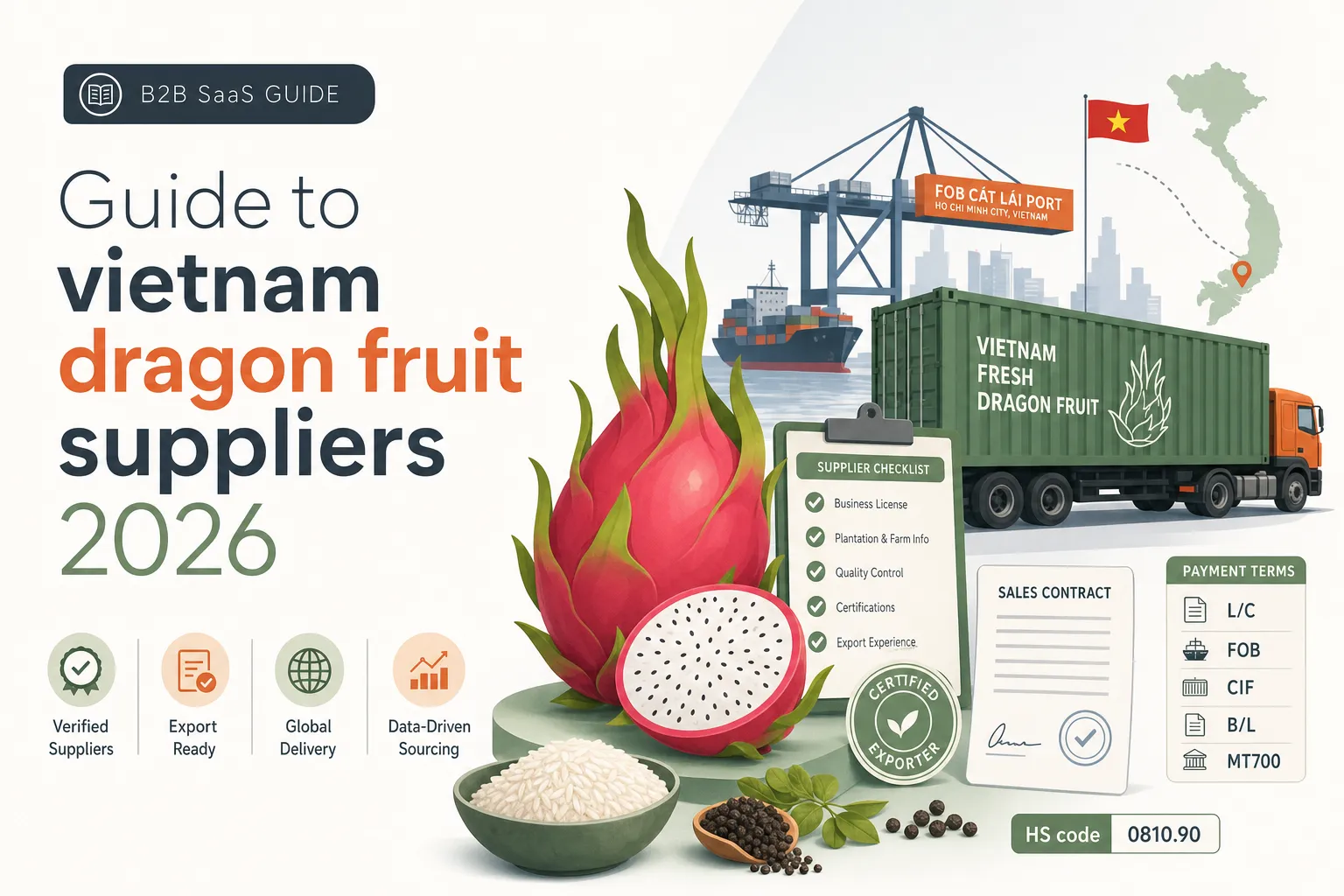
vietnam dragon fruit suppliers need verification beyond glossy lists: Vietnam ships fresh fruit through Cát Lái and Cai Mep, while EU plant health Regulation 2016/2031 is the importer’s legal baseline EU law. Incoterms 2020 sets 11 trade terms ICC; this guide turns sourcing into a practical ViRFQ checklist.
Why Vietnam dragon fruit exporters matter for buyers
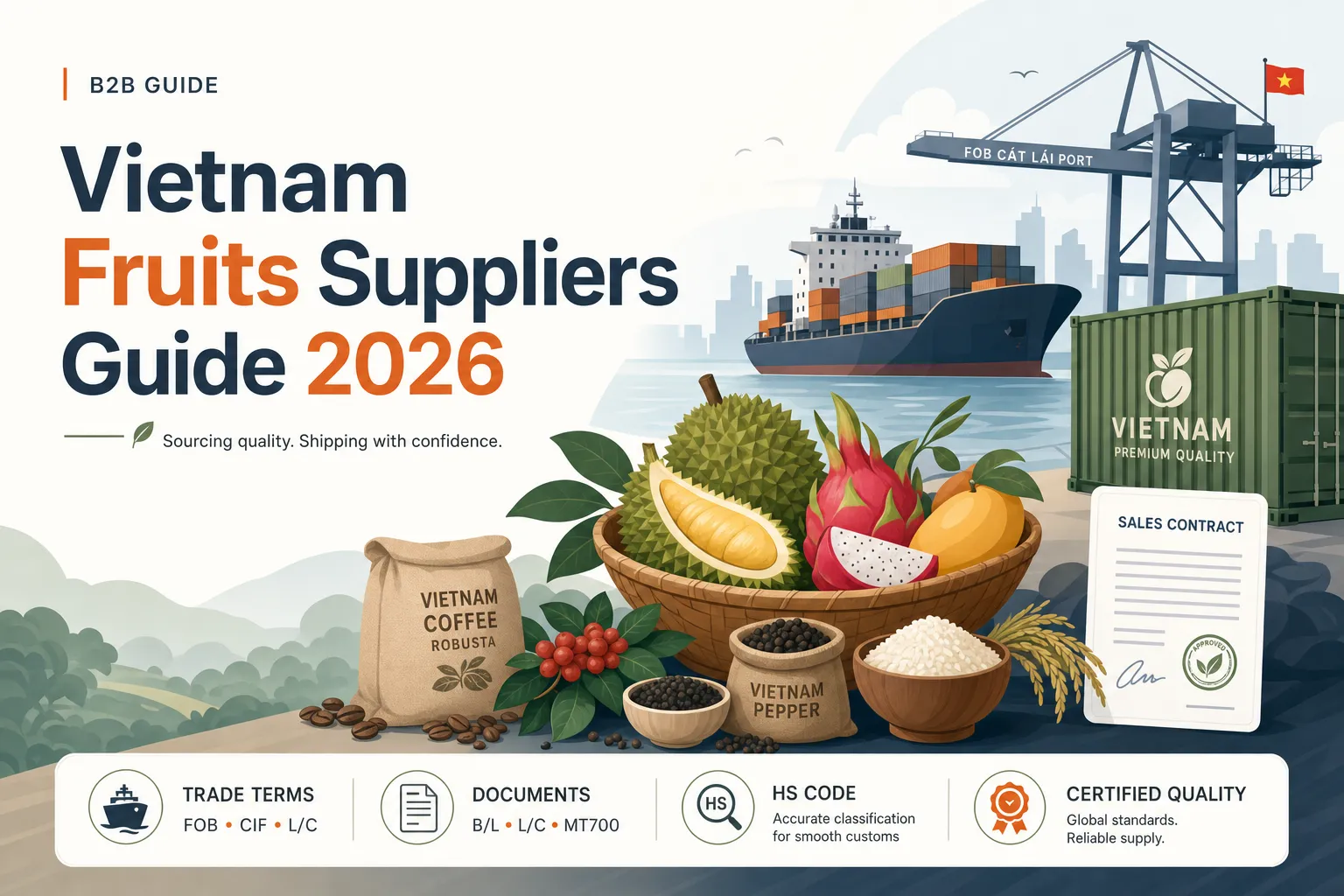
Vietnam is a core origin for fresh dragon fruit export Vietnam because it combines large producing zones, experienced packhouses, and regular reefer routes from southern ports. Buyers usually source white flesh dragon fruit for price-sensitive retail programs and red flesh dragon fruit Vietnam for food service, juice, and higher-color display needs.
The main production map is simple. Bình Thuận is widely associated with dragon fruit farms and packhouses. Long An and Tiền Giang add southern supply close to Ho Chi Minh City logistics. These locations help exporters move fruit by truck to Cát Lái or Cai Mep before ocean shipment.
Use public data for market context, not supplier claims alone. The FAOSTAT crops database is useful for checking Vietnam fruit production categories over time. Vietnam Customs publishes trade releases that help buyers compare declared export momentum with what suppliers say in sales decks. MARD Vietnam also tracks agriculture policy, plant health notices, and export-market updates.
SERP pages often list a few farms, but many do not show packhouse controls, shipment history, or claim evidence. That is the gap this guide fills. A serious importer should compare region, variety, packing specification, cold-chain plan, document workflow, and payment terms before asking for a trial container.
For broader category context, compare Vietnam with wider fruit sourcing and see fruit export context before you shortlist farms. Dragon fruit behaves differently from durian, mango, banana, and passion fruit. It has its own sensitivity around skin scarring, weight loss, color, and shelf-life planning.
Supplier types in wholesale dragon fruit Vietnam sourcing
Wholesale dragon fruit Vietnam sourcing usually involves four supplier types. Each can work, but each needs a different verification path.
- Grower-exporter: owns or controls farms and operates a packhouse. This model gives better traceability and faster issue resolution.
- Packhouse-exporter: buys fruit from farmer networks, then grades, packs, cools, and exports. This model can scale quickly if incoming fruit controls are documented.
- Trading company: consolidates orders across packhouses. This can help mixed fruit programs, but buyers need proof of source and packing responsibility.
- Cooperative: aggregates farmer output and may partner with an export packhouse. This can fit traceability requests when records are disciplined.
Do not judge only by a product gallery. Ask who controls harvest date selection, pesticide records, washing, sorting, carton printing, pre-cooling, and container loading. A supplier may be excellent at sales but weak at cold-chain execution.
A practical shortlist should include at least one farm-linked exporter and one packhouse-exporter. That comparison shows whether the price gap comes from real cost structure or missing controls. If a trader quotes far below the others, ask which packhouse will appear on the phytosanitary document and commercial invoice.
Importers should also map supplier geography to shipping plans. Bình Thuận packhouses may need longer inland transport to Cát Lái than Long An packhouses, but they may offer deeper dragon fruit know-how. Tiền Giang can fit mixed fruit consolidation near Mekong Delta suppliers.
To build a broader Vietnam process, check import documents from Vietnam. For a supplier-level process, review Vietnam supplier verification before you send payment or book inspections.
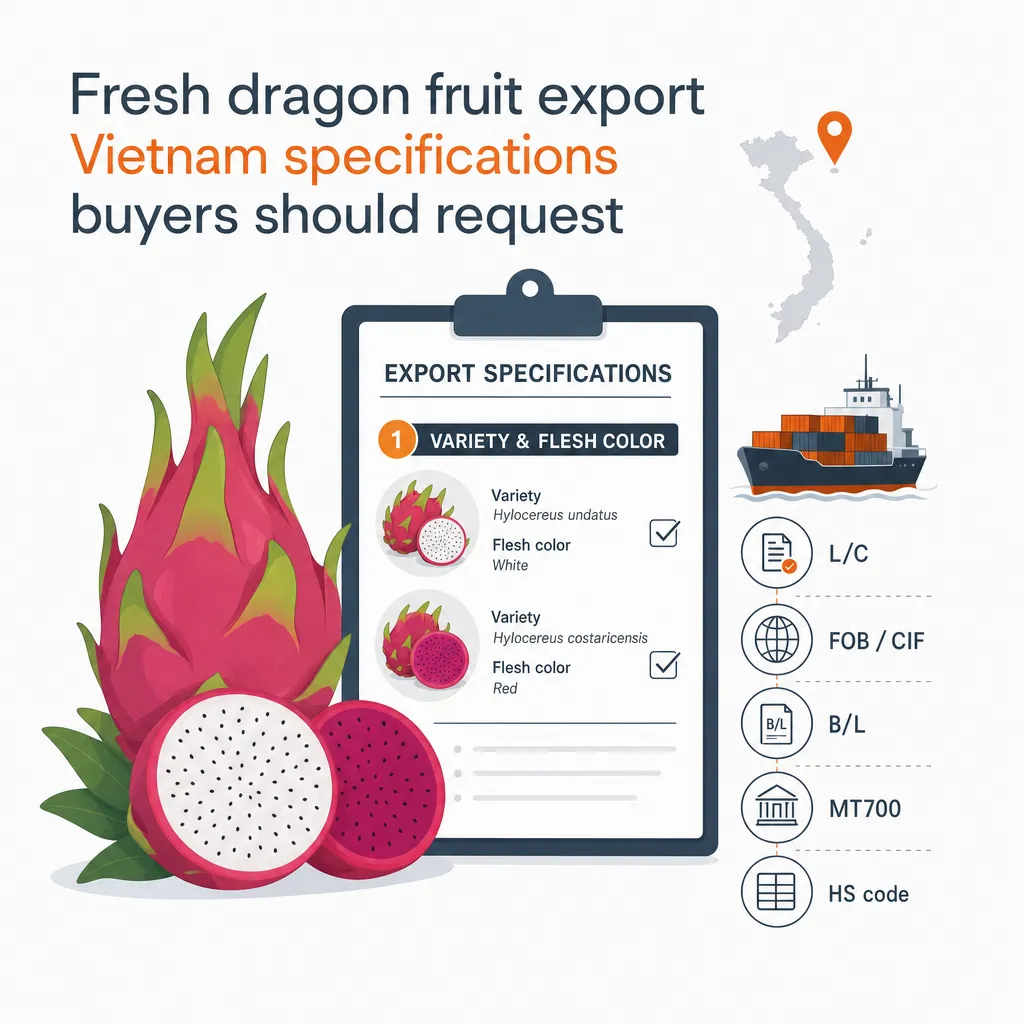
Fresh dragon fruit export Vietnam specifications buyers should request
Fresh dragon fruit export Vietnam specifications should be written before price negotiation. If the specification is vague, suppliers quote different quality assumptions and the comparison becomes useless.
Start with variety and flesh color. White flesh is common for mainstream import programs. Red flesh has stronger visual impact and can fit smoothie, juice, and specialty retail use. Ask for photos from the current harvest week, not only library photos.
Then define appearance. A buyer can specify clean skin, natural color, no soft spots, no visible rot, controlled blemish allowance, and uniform bract condition. Dragon fruit skin can mark easily, so you need a clear tolerance for scars and handling marks. Use plain language and attach reference photos.
Next define size and carton style. Avoid only saying “large” or “medium.” Ask suppliers to quote by agreed count per carton, net weight per carton, carton strength, ventilation, label language, and pallet pattern. If your market needs retail-ready labels, ask whether the packhouse prints lot codes and exporter information.
Cold-chain details matter as much as grading. Ask for harvest-to-pack timing, pre-cooling method, storage temperature range, container set point, pulp-temperature check, and loading photos. A beautiful carton can still fail if fruit enters the reefer warm.
Finally, align documents with the specification. Your purchase order should match the proforma invoice, packing list, commercial invoice, phytosanitary certificate, and bill of lading. To reduce document gaps, understand phytosanitary certificates before the first shipment.
Expert note: FAO and WHO Codex work frames food standards as tools for consumer health and fair trade; buyers can use that lens when asking suppliers for clear, written specifications Codex.
Dragon fruit supplier verification checklist
Dragon fruit supplier verification should test both existence and capability. A company registration alone is not enough. You need evidence that the exporter can supply the variety, grade, volume range, documents, and cold-chain process you need.
Ask for these records during the first qualification round:
- Business license and export function under the same legal entity that will invoice you.
- Packhouse address, photos, and video walk-through from the current season.
- Recent export documents with buyer names redacted.
- Farm or grower network description, including province and traceability method.
- Food safety certification with audit year and certificate ID if the supplier claims one.
- Sample policy, including who pays courier, inspection, and replacement cost if samples fail.
- Reference shipment examples by market, container type, and arrival feedback.
Use a video call to cross-check details. Ask the supplier to show carton stock, sorting tables, pre-cooling space, and loading area. Ask who signs quality release before fruit enters the container. If the salesperson cannot answer, request the packhouse manager on the next call.
Be careful with copied certificates. Match the legal name, address, product scope, validity period, and certificate ID. If the certificate belongs to a sister company, ask for the contract that connects that entity to your shipment.
Payment history also matters. For a first order, avoid large advance exposure. Consider a small trial shipment, third-party inspection, or documentary payment route. UCP 600 is the widely used ICC framework for letters of credit ICC UCP 600. ViRFQ encourages buyers to qualify the supplier, the packhouse, and the document workflow together, not one by one.
Documents for importing Vietnamese dragon fruit
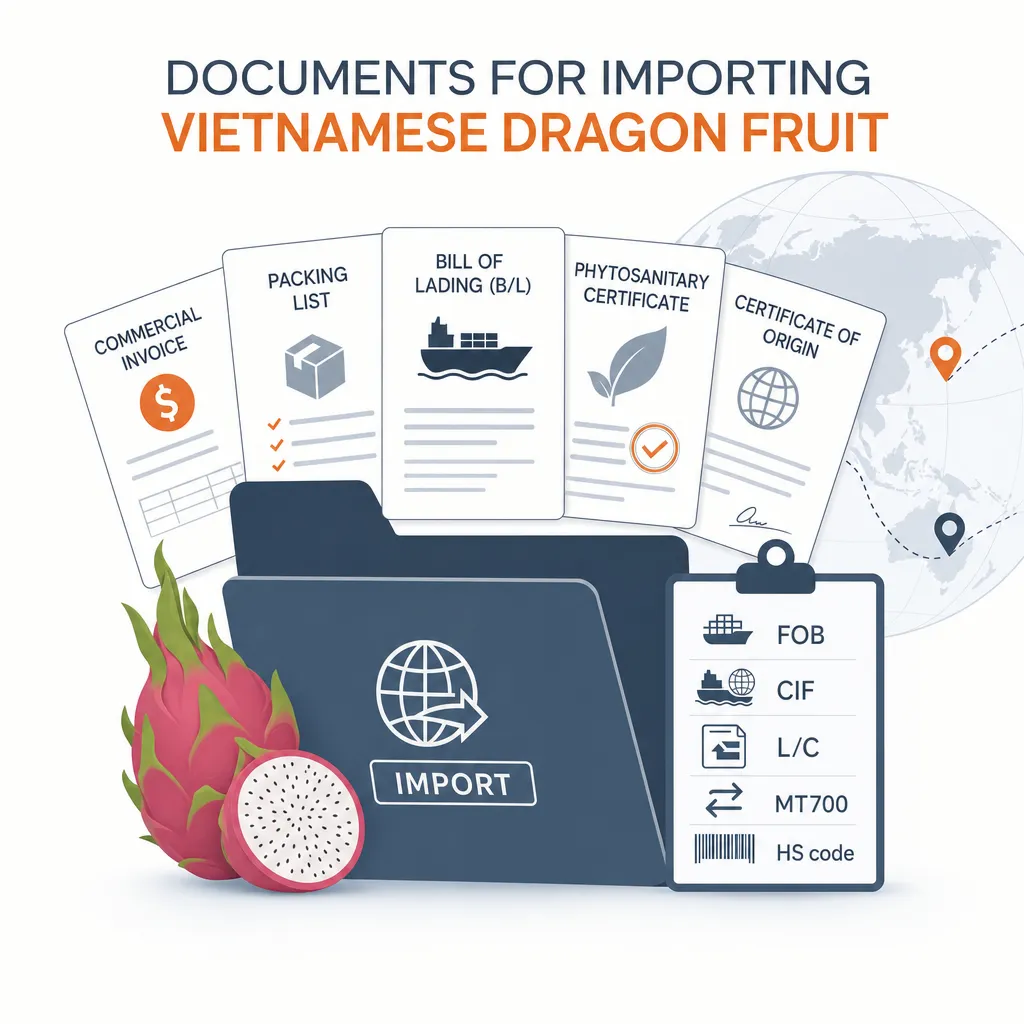
Most dragon fruit shipments need a tight document set. The exact list depends on destination, buyer contract, and customs broker advice, but the common pack includes commercial invoice, packing list, bill of lading, phytosanitary certificate, certificate of origin when requested, and any market-specific food or plant health declarations.
For the European Union, importers should study the EU plant-health system before quoting. Regulation 2016/2031 is the core plant health law EU Regulation 2016/2031, and the European Commission explains plant-product imports from non-EU countries on its official page EU plant health trade. Your broker should confirm inspection route, notification steps, and any origin-specific rule updates.
For the United States, USDA APHIS is the first place to check plant import and export controls USDA APHIS plants. Do not assume that a supplier’s prior shipment to one country clears another country. Plant health rules can change by commodity, origin, treatment, and port.
For organic claims, use official systems and certificate IDs, not carton artwork. The USDA international trade page gives context for organic certification and trade recognition USDA organic trade. If your program is conventional, say that clearly so the supplier does not price unnecessary documentation.
The International Plant Protection Convention country page helps buyers identify Vietnam’s plant protection authority context IPPC Viet Nam. Still, the buyer’s broker should confirm the destination requirement before shipment.
Keep document language consistent. Supplier name, buyer name, carton count, net weight, vessel, container, and origin should align across documents. Small mismatches can cause clearance delay.
Price structure, Incoterms, and payment terms
Dragon fruit price comparison should separate fruit cost from logistics, packaging, inspection, finance, and service. If you ask only for “FOB price,” you may miss whether the quote includes carton printing, palletizing, pre-cooling, local trucking, port charges, export documents, and inspection support.
Incoterms 2020 is the common trade-term reference for international sales ICC Incoterms 2020. For fresh fruit, FOB and FCA can both appear, but the right term depends on how the container is handed over and who controls booking. CIF can be convenient, yet buyers should still ask for carrier, transit route, reefer settings, and arrival responsibility.
A quote table helps you compare suppliers:
| Quote item | What to ask |
|---|---|
| Fruit grade | Variety, flesh color, count, defect tolerance |
| Packing | Carton type, labels, pallet pattern, ventilation |
| Cold chain | Pre-cooling, set point, loading photos |
| Documents | Phytosanitary, origin certificate, invoice, packing list |
| Logistics | Port, sailing frequency, transit estimate |
| Payment | Deposit, balance trigger, inspection condition |
For payment, align method with relationship maturity. A new buyer may use deposit plus balance against documents, documentary collection, or letter of credit when order size justifies bank cost. A repeat buyer may use more flexible terms after successful arrivals.
Do not treat the lowest quote as the right quote. A low price can hide weaker grading, slower packing, missing documents, or poor container handling. Ask suppliers to explain assumptions line by line. A transparent mid-range quote can be cheaper after claims, delays, and rejected cartons are considered.
Cold chain, shelf life, and inspection planning
Dragon fruit sourcing lives or dies in the cold chain. Fruit may look strong at packing, then show shriveling, softness, or decay after a long route if harvest maturity, field heat, and container handling are poorly managed.
Build the cold-chain plan before the purchase order. Ask when fruit is harvested, how quickly it reaches the packhouse, how it is cleaned and sorted, when it is pre-cooled, and who checks pulp temperature before loading. Request time-stamped photos or short videos for packing, pallet loading, container number, seal number, and reefer display.
Inspection should not be a ceremonial step. Your inspection plan should cover carton count, net weight, flesh color, skin condition, bract condition, defects, temperature, label accuracy, and document match. For first shipments, many buyers inspect before container loading. For repeat programs, random checks can be paired with arrival scoring.
Transit route affects specification. A short regional route may tolerate a different maturity window from a longer ocean route. Ask the supplier to recommend maturity based on destination and transit days, but keep final approval in writing. If the supplier claims long storage performance, ask for arrival records from a similar market and season.
World Bank logistics and Vietnam country context can help importers understand infrastructure development and trade environment World Bank Vietnam. For border procedures and official trade steps, the Vietnam Trade Portal is also useful.
Finally, create an arrival feedback loop. Share photos and temperature records with the supplier within a few days of discharge. Good exporters use that data to adjust maturity and packing on the next shipment.
How to source through RFQs instead of supplier lists
Supplier directories can help discovery, but RFQs create better comparison because each supplier answers the same requirement. That matters for dragon fruit, where variety, size, cold chain, and document assumptions change the quote.
A strong RFQ should include:
- Product: white flesh or red flesh dragon fruit Vietnam.
- Use case: retail, wholesale market, food service, processing, or mixed fruit container.
- Destination: country, discharge port, and target delivery window.
- Trade term: FOB, FCA, CIF, or another agreed term.
- Packing: carton type, count, label language, pallet requirement.
- Quality: defect tolerance, maturity preference, photo references.
- Documents: phytosanitary certificate, origin certificate, invoice, packing list, and buyer-specific forms.
- Verification: certificate IDs, packhouse video, sample plan, and inspection step.
This format makes suppliers respond with comparable assumptions. It also discourages vague claims and pushes packhouse-level detail into the first conversation.
ViRFQ helps buyers turn that RFQ into a structured Vietnam supplier search. You can ask for dragon fruit quotes, compare packhouse responses, and route follow-up questions through one workflow. If your program includes mango, passion fruit, banana, or durian, the same format can be adapted for mixed shipments.
Before you award a trial order, make a shortlist scorecard. Give weight to document readiness, cold-chain discipline, communication speed, price clarity, and evidence from prior shipments. A supplier that answers slowly during quotation may also answer slowly when a port issue appears.
Use RFQs to find fit, not just price. The right supplier is the one whose farm network, packhouse, documents, and logistics match your market’s import rules.
FAQ
How do I verify vietnam dragon fruit suppliers before ordering?
Start with legal identity, packhouse address, export documents, and current-season product photos. Then check food safety certificates with certificate IDs when claimed. Ask for a video walk-through of sorting, packing, pre-cooling, and loading areas. For a first shipment, add third-party inspection and clear payment milestones.
Which provinces are known for Vietnamese dragon fruit exporters?
Bình Thuận is strongly associated with dragon fruit farming and export packing. Long An and Tiền Giang are also important southern sourcing areas. Province alone is not enough, though. Buyers should verify the packhouse, grower network, cold-chain process, and export document history before committing to a supplier.
What documents are needed for fresh dragon fruit export Vietnam?
Common documents include commercial invoice, packing list, bill of lading, phytosanitary certificate, and certificate of origin when requested. Some markets require additional plant health or food declarations. Confirm the exact list with your customs broker and destination authority before the supplier packs the container.
Is red flesh dragon fruit Vietnam different from white flesh?
Yes. Red flesh dragon fruit has deeper color and is often used for visual retail display, juice, smoothies, and specialty food service. White flesh is common in broader wholesale programs. Specification should cover flesh color, size, skin condition, carton type, maturity, and cold-chain requirements.
Should I buy wholesale dragon fruit Vietnam on FOB or CIF?
FOB gives buyers more control over freight, carrier choice, and arrival monitoring. CIF can be convenient when the supplier has strong logistics relationships. In either case, define reefer settings, documents, inspection, claims process, and responsibility points using Incoterms 2020 guidance from ICC.
How can an RFQ improve dragon fruit supplier comparison?
An RFQ makes every supplier quote against the same variety, packing, quality, documents, destination, and trade term. That prevents vague comparisons and exposes missing assumptions. It is especially helpful for dragon fruit because cold-chain details and defect tolerance can change the true cost.
What should be in a dragon fruit sample request?
A sample request should state flesh color, size band, carton or sample packaging, harvest timing, photos, documents, and evaluation criteria. For fresh fruit, courier samples may not fully reflect container performance, so pair samples with packhouse checks and prior shipment evidence.
Are certificates enough to choose Vietnam dragon fruit exporters?
No. Certificates are useful only when valid, in scope, and tied to the entity handling your shipment. Buyers should also review packhouse practice, traceability, cold-chain discipline, document accuracy, communication, and arrival history. Certification is one input, not the full decision.
Ready to compare vietnam dragon fruit suppliers without chasing scattered lists? ViRFQ lets you post a fruit RFQ on ViRFQ, request packhouse evidence, and compare exporter replies in one workflow. Share your variety, destination, packing, documents, and timing, then start with a focused shortlist at /en/rfq.
Sources
- EUR-Lex Regulation 2016/2031
- ICC Incoterms Rules
- FAO FAOSTAT Crops and Livestock Products
- Vietnam Customs
- Vietnam Ministry of Agriculture and Environment
- FAO WHO Codex Alimentarius
- ICC Uniform Customs and Practice for Documentary Credits
- EUR-Lex Regulation 2016/2031
- European Commission Plant Health Trade
- USDA APHIS Plant Imports and Exports
- USDA AMS Organic International Trade
- International Plant Protection Convention
- ICC Incoterms Rules
- World Bank Vietnam Overview
- Vietnam Trade Portal
Reviewed by
Founder & CEO, ViRFQ
Phan Hà Thái is the founder and CEO of ViRFQ, the buyer discovery and buyer management platform (and B2B marketplace) for Vietnamese agricultural exporters. His background is in international trade finance and Vietnamese agricultural exports. He writes and reviews the ViRFQ blog analyses on FOB pricing, Letter of Credit (L/C) workflows, EUDR compliance, and supplier verification.