Vietnam Star Anise Suppliers Guide 2026
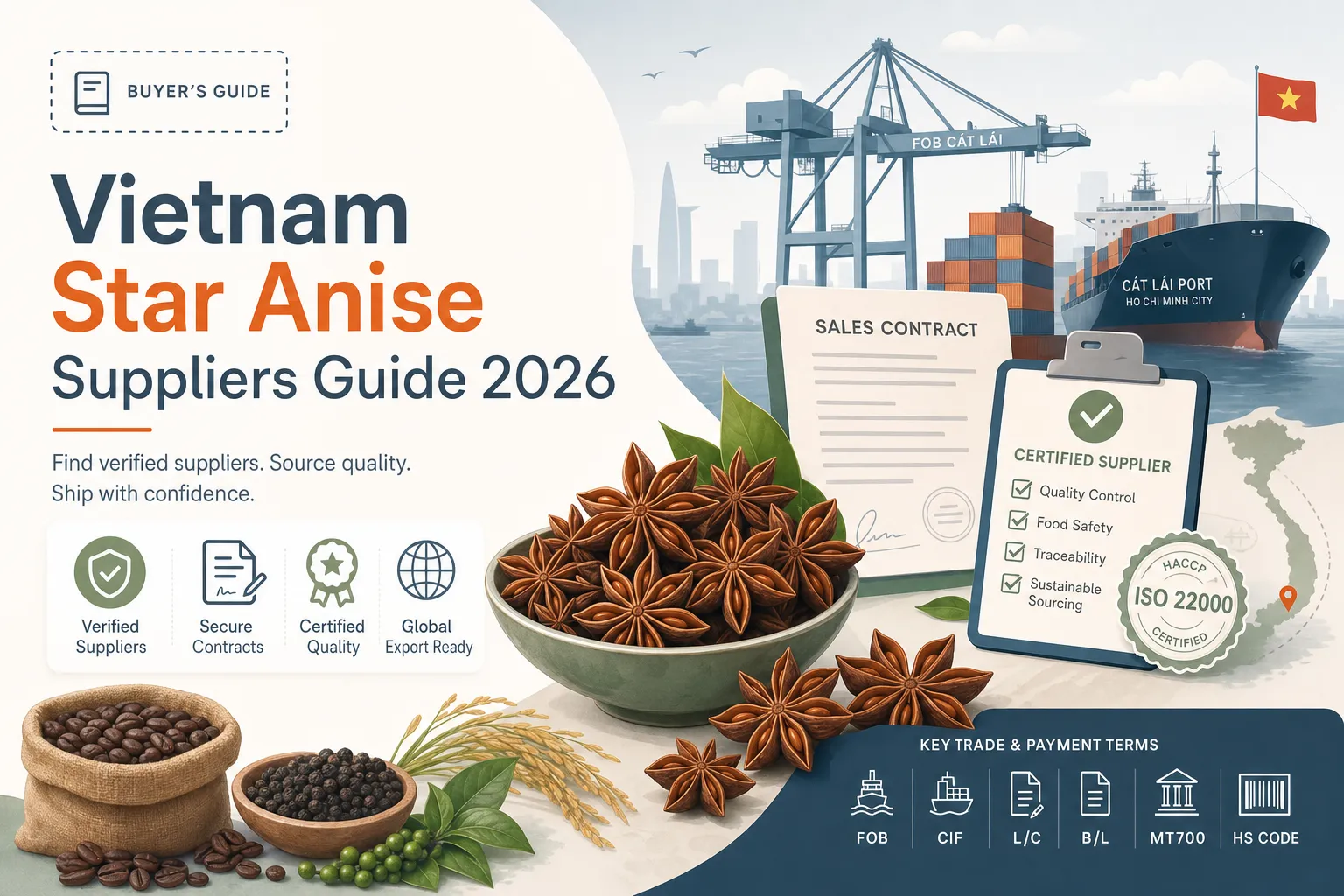
Vietnam star anise suppliers serve importers through HS 090961 and HS 090962 tracked by ITC Trade Map HS data, while EU residue checks follow EU Regulation 396/2005. This ViRFQ guide focuses on origin, specs, verification, documents, and RFQ wording for buyers sourcing bulk star anise from Vietnam.
Why do buyers source star anise from Vietnam?
Vietnam star anise exporter conversations usually start with three factors: aroma, origin, and buyer access to small or mid-sized packing houses. The crop is associated with northern provinces such as Lạng Sơn and Cao Bằng, where hilly terrain, cooler seasons, and household farming create a strong origin story for spice importers. Buyers use star anise in tea blends, broth bases, meat seasoning, bakery mixes, and botanical extraction.
The product is not a single uniform commodity. A buyer may ask for whole pods with eight points, broken pieces for grinding, or powder for retail spice blends. Whole pods attract stricter visual inspection. Broken material is more practical for extraction or milling. Powder needs more control over moisture, mesh size, metal detection, and contamination from old stock.
Vietnam also fits a sourcing gap in the current search results. Many pages sell small jars or give generic spice facts. Few explain how to verify farm origin, factory capability, fumigation status, and payment terms for bulk import. That is where a structured RFQ helps. If you need a broader market view, read our Vietnam spices supplier guide before shortlisting star anise factories.
For trade classification, buyers normally discuss star anise under HS 090961 and HS 090962 in ITC Trade Map HS data. Those codes may also include related seeds depending on national customs practice, so your customs broker should confirm the exact line before shipment. Vietnam export procedures can also reference official customs releases from Vietnam Customs trade information. The practical point is simple: do not treat a supplier’s marketing page as enough evidence. Ask for the commercial invoice draft, packing list draft, and HS code confirmation during quotation, not after deposit.
Which Vietnam star anise grades should importers specify?
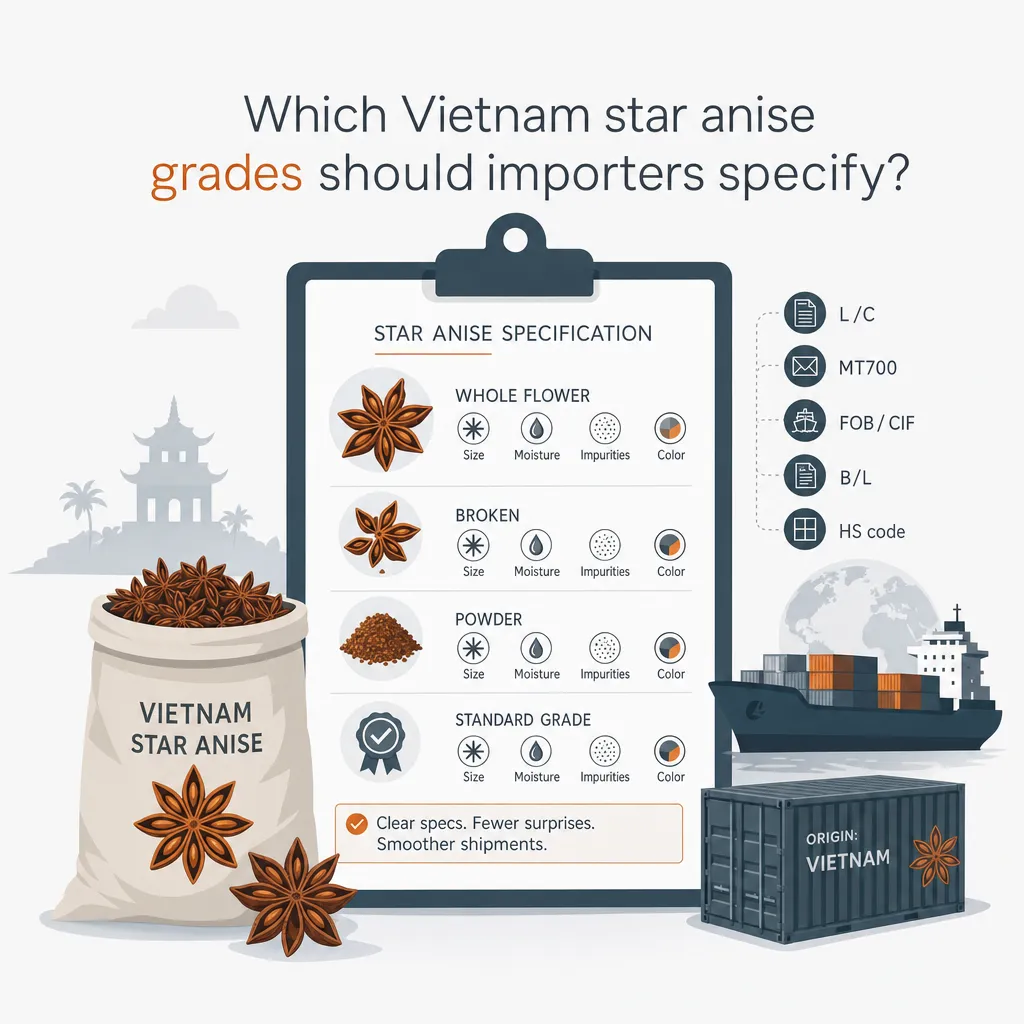
Bulk star anise Vietnam orders should begin with a plain-language specification sheet. Suppliers may use terms like whole flower, broken, powder, or standard grade, but those labels vary by factory. A good RFQ turns those labels into measurable requirements.
Use a table like this when asking for quotes:
| Attribute | What to specify | Why it matters |
|---|---|---|
| Form | Whole pods, broken pieces, or powder | Controls use case and inspection method |
| Origin | Province or collection area | Supports traceability and flavor story |
| Moisture | Supplier test method and limit | Reduces mold and caking issues |
| Foreign matter | Visual tolerance and sorting method | Protects retail and foodservice quality |
| Color | Brown-red, dark brown, or buyer sample | Affects shelf appeal |
| Aroma | Buyer sample or retained sample match | Reduces dispute after arrival |
| Packing | Bulk bag, carton, or inner liner | Controls moisture during transit |
Ask for photos from the current lot, not only catalog images. A serious supplier can show lot labels, weighing area, inner liner, carton markings, and storage conditions. For powder, ask whether the supplier mills in-house or subcontracts. Subcontracted milling is not automatically bad, but it adds another point to verify.
Food safety expectations differ by market. EU buyers care about pesticide residue limits under EU Regulation 396/2005. US importers should understand supplier control duties under the FDA FSVP rule. Buyers in Japan, Korea, and the Gulf often ask for lab tests, sanitation records, and a clear packing date. If a seller claims third-party audited status, request the certificate number, audit date, scope, and issuing body. Do not accept a logo alone.
A useful buying rule: the more processed the product, the more documentation you need. Whole pods can be checked visually. Powder hides defects and blending. For powder, request a retained sample, microbial test, heavy metal screen if your market requires it, and a written statement on allergen handling.
How can you verify a Vietnam spices supplier before payment?
Star anise supplier verification is a sequence, not a single document. Start by matching the business identity across the quotation, tax registration, bank account, export documents, email domain, and factory photos. Mismatched names can be normal in trading groups, but the supplier must explain the relationship clearly.
A practical first screen includes:
- Company registration name and address
- Export experience for spices, not only general agriculture
- Factory or warehouse location
- Product forms handled in-house
- Recent shipment documents with buyer details hidden
- Lab test from a recognized laboratory
- Clear bank account name matching the contracting party
- Video call from the packing or warehouse area
Use our Vietnam supplier verification checklist if your team needs a repeatable due diligence workflow. It helps separate real exporters, brokers with good networks, and risky intermediaries. Brokers can still be useful, especially for small lots, but you should know who controls sorting, packing, and final inspection.
Also check whether the supplier understands your import market. EU importers need traceability and residue control aligned with EU General Food Law 178/2002. US buyers need a supplier approval file, because the FDA FSVP rule places duties on importers. These rules do not require every small exporter to speak legal language. They do require buyers to collect enough evidence before import.
For payment, avoid sending funds to a personal account. Ask for a proforma invoice, signed sales contract, and bank details under the same legal entity. If the supplier proposes a different payee, request written justification and supporting documents. ViRFQ recommends documenting each clarification in the RFQ thread so your procurement, finance, and logistics teams see the same record.
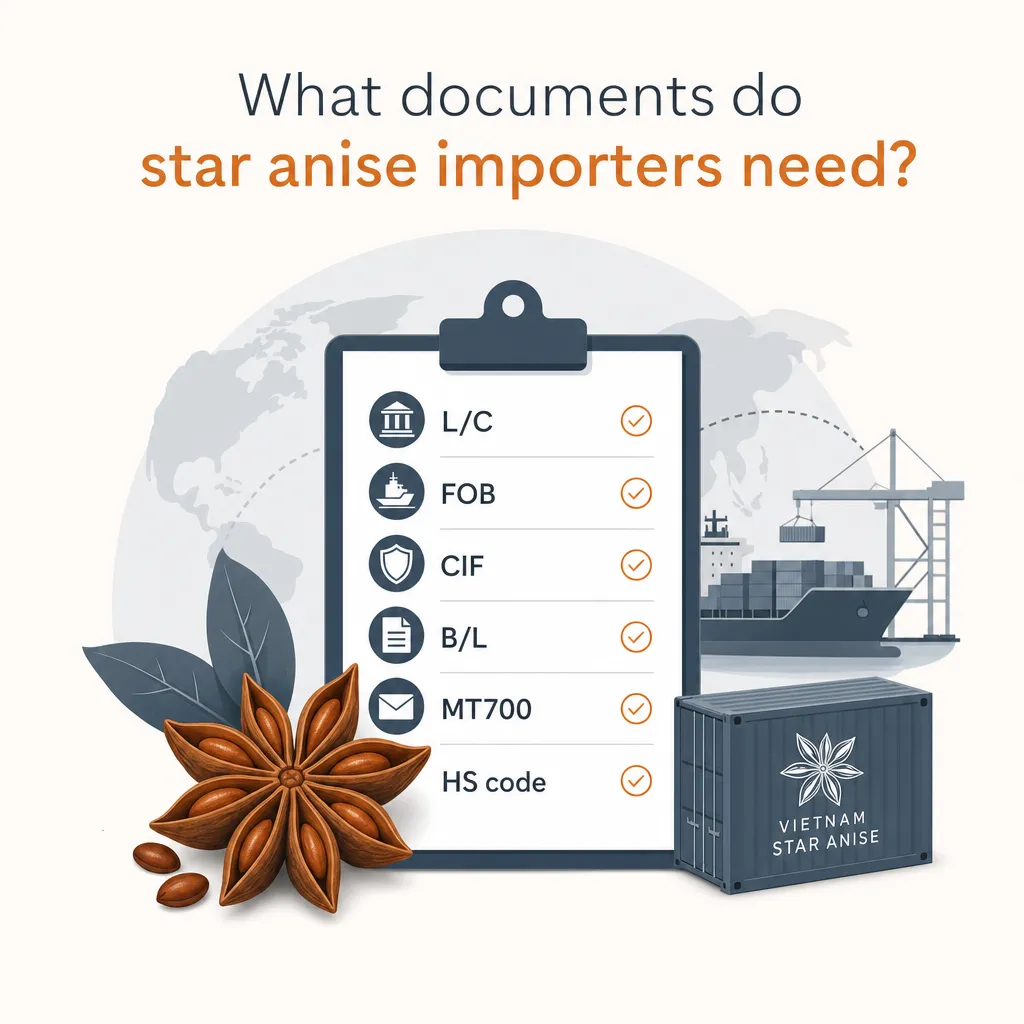
What documents do star anise importers need?
Star anise import requirements depend on destination market, product form, and buyer channel. Retail spice brands may need more testing than an industrial buyer using star anise in extraction. Still, most shipments begin with a common document set.
Ask your Vietnam star anise supplier for:
- Proforma invoice before payment
- Commercial invoice for customs clearance
- Packing list with net and gross weight
- Sales contract with agreed Incoterms rule
- Bill of lading or airway bill
- Certificate of origin when useful for duty review
- Phytosanitary certificate when required by destination rules
- Fumigation certificate when packaging or destination rules require it
- Lab test report aligned with buyer market
- Photos of final packing and container loading when shipped by sea
For plant products, the importing authority may ask for phytosanitary controls. The IPPC phytosanitary standards are a useful global reference, while your broker confirms the local rule. If your team is new to this document, our phytosanitary certificate guide explains how the certificate supports customs and quarantine review.
Shipping documents also deserve attention. A bill of lading controls cargo release and must match the commercial invoice, packing list, consignee, notify party, port, and package count. If your team handles sea freight, bookmark our bill of lading guide before the first booking.
Food hygiene language should be specific. General claims are weak. Ask for cleaning records, pest control records, metal detection records for powder, and lab testing by lot. The Codex food hygiene texts provide a recognized framework for hygienic handling. For EU buyers, align residue testing with EU Regulation 396/2005. For US buyers, build the supplier file around the FDA FSVP rule.
How should buyers compare FOB, CIF, and payment terms?
Many sourcing mistakes happen after the buyer finds a good product. The quote looks attractive, but the Incoterms rule, packing, destination charges, and payment method are unclear. Star anise is light, aromatic, and moisture-sensitive, so logistics details matter.
FOB is common when the buyer controls freight. The supplier delivers cleared goods to the named port, and the buyer handles main carriage. CIF may help smaller buyers compare landed cost faster, but it can hide insurance limits and local destination charges. Discuss Incoterms wording using the official ICC Incoterms 2020 rules rather than informal shorthand.
Your RFQ should state:
- Named port or airport
- Product form and packing type
- Minimum and target order volume in words, not vague phrases
- Inspection point before shipment
- Required documents
- Payment method and deposit schedule
- Sample cost and courier responsibility
- Latest shipment window
For payment, bank transfer is common for smaller orders after verification. Documentary credit may fit larger shipments or new relationships. If using a letter of credit, align wording with ICC UCP 600 rules and keep document requirements realistic. Overly complex L/C wording can delay payment even when the cargo is acceptable.
When comparing quotes, do not choose only by unit price. Compare landed cost, loss allowance, packing quality, testing cost, and how fast the supplier answers technical questions. A lower quote with weak documents can become expensive at customs. If you want an RFQ-first workflow instead of browsing catalog listings, compare ViRFQ vs Alibaba sourcing and decide which model fits your procurement style.
What quality checks reduce disputes on bulk star anise Vietnam orders?
A strong inspection plan protects both buyer and supplier. Star anise disputes usually involve moisture, broken ratio, odor, mold, foreign matter, color, or lab results. The solution is to agree on the inspection method before the purchase order.
Start with a pre-shipment sample from the actual lot where possible. The sample should be sealed, labeled, photographed, and referenced in the contract. For whole pods, inspect size, completeness, color, aroma, insects, stones, stems, and excess dust. For broken pieces, define the acceptable broken profile. For powder, define mesh size, aroma, caking, color, and whether the lot passes metal detection.
Use lot-based testing. A supplier may have one clean report from an earlier shipment, but that does not prove the new lot. For regulated markets, align tests with destination rules. EU importers should pay special attention to pesticide residue screening under EU Regulation 396/2005. US importers should keep records that support supplier approval under the FDA FSVP rule.
Packaging is another quality control point. Star anise absorbs odor and moisture. Ask for clean inner liners, dry cartons or bags, pallet condition if used, and container inspection photos. Avoid loading with strong-smelling goods. If fumigation is required, confirm the method, date, and certificate wording before sailing.
ViRFQ buyers often include a dispute clause tied to retained samples and third-party inspection. Keep it simple: define who pays for re-testing, which lab is accepted, and what happens if the lot fails the agreed standard. Clear rules reduce conflict and help good suppliers protect their reputation.
How do price signals work for Vietnam star anise exporter quotes?
Star anise prices move with crop availability, quality, origin, drying conditions, labor cost, freight, and buyer specification. Public price benchmarks are limited compared with coffee, rice, or pepper. That is why buyers should treat every quote as a bundle of variables, not a single commodity number.
Useful price signals include:
- Whole pod share versus broken material
- New crop versus older stock
- Moisture level and drying method
- Sorting intensity and manual labor cost
- Powder milling cost and contamination control
- Testing scope requested by the buyer
- Packing format and inner liner quality
- Port, freight route, and shipment timing
- Payment terms and deposit size
For macro context, buyers can review agricultural commodity and trade data through FAOSTAT crop data, UN Comtrade trade data, and ITC Trade Map HS data. These databases help with direction, but they may group star anise with related spices. They do not replace supplier-level quotes.
When requesting prices, ask for quote validity in days, not an open-ended offer. Ask whether the supplier can hold the lot after sample approval. If the answer is yes, define the deposit requirement and storage condition. If the answer is no, plan a faster approval process.
For comparison, build a landed-cost sheet. Include product price, inland transport, export handling, document fees, freight, insurance when applicable, customs duty, lab testing, inspection, and local delivery. A slightly higher FOB quote may win if it reduces rejection, rework, or document delays. Buyers who need multiple Vietnam categories can request quotes from Vietnam suppliers and compare star anise alongside cinnamon, pepper, cashew, or rice.
What should your RFQ include when contacting Vietnam star anise suppliers?
A clear RFQ gets better replies. Suppliers respond faster when they can understand the buyer, product, destination, packing, documentation, and buying timeline. Vague messages like “send price for star anise” often receive generic offers that are hard to compare.
Use this RFQ structure:
- Buyer company, country, and import role
- Product form: whole pod, broken, or powder
- Target origin if required, such as Lạng Sơn or northern Vietnam
- Intended use: retail, foodservice, blending, extraction, or milling
- Packing format and private-label needs if any
- Destination port or airport
- Incoterms rule and named place
- Required documents and lab tests
- Sample request and courier account
- Target order size in words
- Payment preference
- Shipment window
- Photo and video requirements
Add one sentence about your decision process. For example: “We will shortlist suppliers after sample review, lab test review, and document check.” This tells suppliers you are serious and organized.
Here is a concise RFQ message you can adapt:
“Hello, we import spices for foodservice buyers in Germany. We are sourcing whole Vietnamese star anise from the current crop, packed in food-grade inner liner and carton. Please quote FOB Ho Chi Minh City under ICC Incoterms 2020 rules, with photos from the current lot, lab test options, packing details, payment terms, and sample cost. Please also confirm whether you can provide certificate of origin, phytosanitary certificate if required, fumigation certificate if required, commercial invoice, packing list, and bill of lading.”
This wording keeps the conversation practical. It filters out suppliers that cannot document the product. It also gives capable exporters enough detail to quote accurately. To start with multiple vetted responses, post a spices RFQ and compare supplier answers side by side.
FAQ
How do I find reliable Vietnam star anise suppliers?
Start with a clear RFQ, then verify the company name, factory or warehouse address, export documents, bank account, sample quality, and lab testing ability. Ask for current-lot photos and a video call from the packing area. Use a structured supplier checklist before paying any deposit.
Which Vietnamese provinces are known for star anise origin?
Buyers often associate Vietnamese star anise with northern mountain provinces such as Lạng Sơn and Cao Bằng. Origin matters because it supports traceability, aroma story, and buyer positioning. Ask the supplier to show collection area records or lot labels rather than relying on a catalog claim.
What documents are common for star anise imports?
Common documents include proforma invoice, commercial invoice, packing list, sales contract, bill of lading, certificate of origin, lab test report, and phytosanitary certificate when required. Fumigation documents may also be needed depending on packaging, destination market, and buyer policy.
Is whole star anise better than broken star anise for import?
Whole pods are better for retail display, premium foodservice presentation, and buyers who inspect visual quality. Broken star anise can be practical for milling, extraction, or blends where appearance matters less. The right choice depends on use case, inspection method, and target customer.
How should I compare Vietnam star anise exporter quotes?
Compare product form, moisture, origin, lot photos, testing scope, packing, Incoterms rule, document set, payment terms, and shipment window. Do not compare only unit price. A higher quote with stronger documentation can be safer for regulated import markets.
What tests should buyers request for bulk star anise Vietnam?
Common checks include moisture, foreign matter, pesticide residues for regulated markets, microbial screening for powder, and heavy metal screening when required by the buyer’s market. For powder, ask about milling control, metal detection, retained samples, and lot traceability.
Can Vietnam star anise suppliers handle private-label packing?
Some suppliers can pack under buyer labels, but capability varies. Ask about minimum order size, label control, carton printing, barcode handling, inner liner material, and photo approval before shipment. For retail packs, request packaging samples before confirming the purchase order.
What payment terms are common with new spice suppliers?
New relationships often use a deposit with balance before shipment, or documentary credit for larger orders. The safer approach depends on supplier verification, order value, banking cost, and document complexity. Keep the payee name aligned with the contracting company.
Do US buyers need extra checks for Vietnamese star anise?
US importers should maintain supplier approval records, review hazards, and keep documents that support import compliance. Many buyers request lab reports, facility information, traceability records, and packing details. Your customs broker or food safety consultant should confirm market-specific duties.
Ready to compare Vietnam star anise suppliers without chasing scattered catalog pages? ViRFQ helps importers structure RFQs, collect comparable quotes, and review supplier documents for spices, coffee, pepper, rice, cashew, and more. Share your spec, destination, packing needs, and document requirements, then start with qualified Vietnamese exporters. Your next step: post a spices RFQ at /en/rfq/spices.
Sources
Reviewed by
Founder & CEO, ViRFQ
Phan Hà Thái is the founder and CEO of ViRFQ, the buyer discovery and buyer management platform (and B2B marketplace) for Vietnamese agricultural exporters. His background is in international trade finance and Vietnamese agricultural exports. He writes and reviews the ViRFQ blog analyses on FOB pricing, Letter of Credit (L/C) workflows, EUDR compliance, and supplier verification.