Vietnam Jasmine Rice Wholesale Buyer Guide 2026
Reviewed by Phan Hà Thái, Founder ViRFQ
Vietnam jasmine rice wholesale — buyer guide helps importers buy fragrant long-grain rice from the Mekong Delta with clearer specs. Vietnam regularly exports more than 7 million tonnes of milled rice a year, per USDA rice market data; common RFQs ask for 5% broken and 14% moisture, aligned with Codex rice standards. ViRFQ angle: RFQ-first supplier comparison.
Why Vietnam jasmine rice works for bulk jasmine rice import
Vietnam jasmine rice is a practical choice when you need fragrant rice with a soft texture, steady export capacity, and flexible packing. Most export programs are linked to the Mekong Delta, including Long An, An Giang, Đồng Tháp, Cần Thơ, and Sóc Trăng. These areas have dense milling capacity, container access through Cát Lái and nearby river ports, and a long history of supplying Asian, MENA, EU, and North American importers.
For context, Vietnam remains a major rice producer in FAOSTAT country data, while export availability is tracked in USDA rice market data. That matters because jasmine rice buyers do not only compare aroma. They compare shipment reliability, crop season, milling consistency, and whether a supplier can repeat the same specification after the first container.
Vietnamese jasmine rice normally competes with Thai Hom Mali, Cambodian fragrant rice, and domestic fragrant varieties in destination markets. It may not match every premium aroma profile, but it often gives importers a good balance of fragrance, grain length, and sourcing flexibility. The key is to define your segment before requesting quotes:
- Retail bag programs need clean grain appearance, stable aroma, and strong packaging control.
- Foodservice buyers usually care more about cooking yield and repeatable texture.
- Ethnic grocery distributors may ask for Vietnamese branding, private label bags, or mixed container programs.
- Humanitarian and institutional tenders focus on clear specs, inspection, and shipping deadlines.
If you are comparing rice with coffee, cashew, or pepper sourcing from the same country, explore broader Vietnam agri sourcing to understand supplier clusters and export routines.
Vietnam rice FOB price signals and jasmine rice specifications
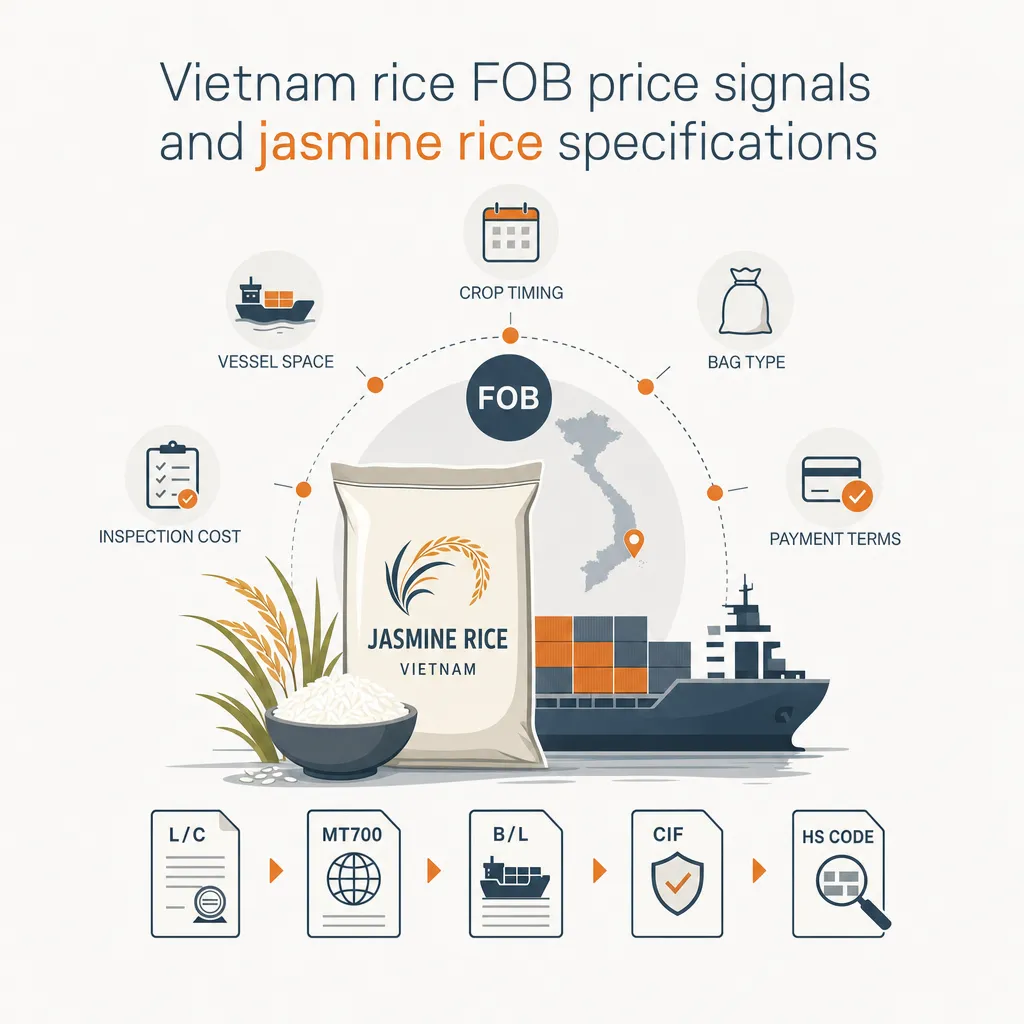
A serious Vietnam rice FOB price discussion starts with specifications, not a single web listing. Public pages may show attractive numbers, but a live export quote changes with crop timing, vessel space, bag type, inspection cost, and payment term. Use World Bank commodity markets for broad rice price direction, then ask suppliers for firm FOB offers with a short validity window.
For jasmine rice, your RFQ should state the exact commercial grade. A clear specification reduces quote gaps and makes supplier comparison easier.
| RFQ field | Typical buyer choice | Why it matters |
|---|---|---|
| Variety | Vietnamese jasmine or fragrant long grain | Sets aroma and cooking profile |
| Broken ratio | 5% or lower for retail; higher for value channels | Changes appearance and price |
| Moisture | Often 14% maximum | Affects shelf stability |
| Milling | Well-milled, double polished, silky polished | Impacts grain shine and dust |
| Foreign matter | Low tolerance, stated in contract | Protects retail acceptance |
| Packing | 5 kg, 10 kg, 25 kg, or 50 kg bags | Drives cost and destination handling |
| Load term | FOB Cát Lái, CIF destination, or CFR destination | Defines freight responsibility |
For bulk jasmine rice import, ask suppliers to quote the same format: product name, crop season, quantity, packing, load port, shipment month, payment term, and validity. If one quote includes printed bags, pre-shipment inspection, and fumigation while another does not, the cheaper-looking offer may not be cheaper on landed cost.
Also ask for a sample before contract signing. Cook the rice against your market benchmark, then compare aroma after cooling. Jasmine rice can smell strong at milling but weaken after poor storage, so sample handling and warehouse conditions matter.
How to verify Vietnam jasmine rice suppliers before purchase
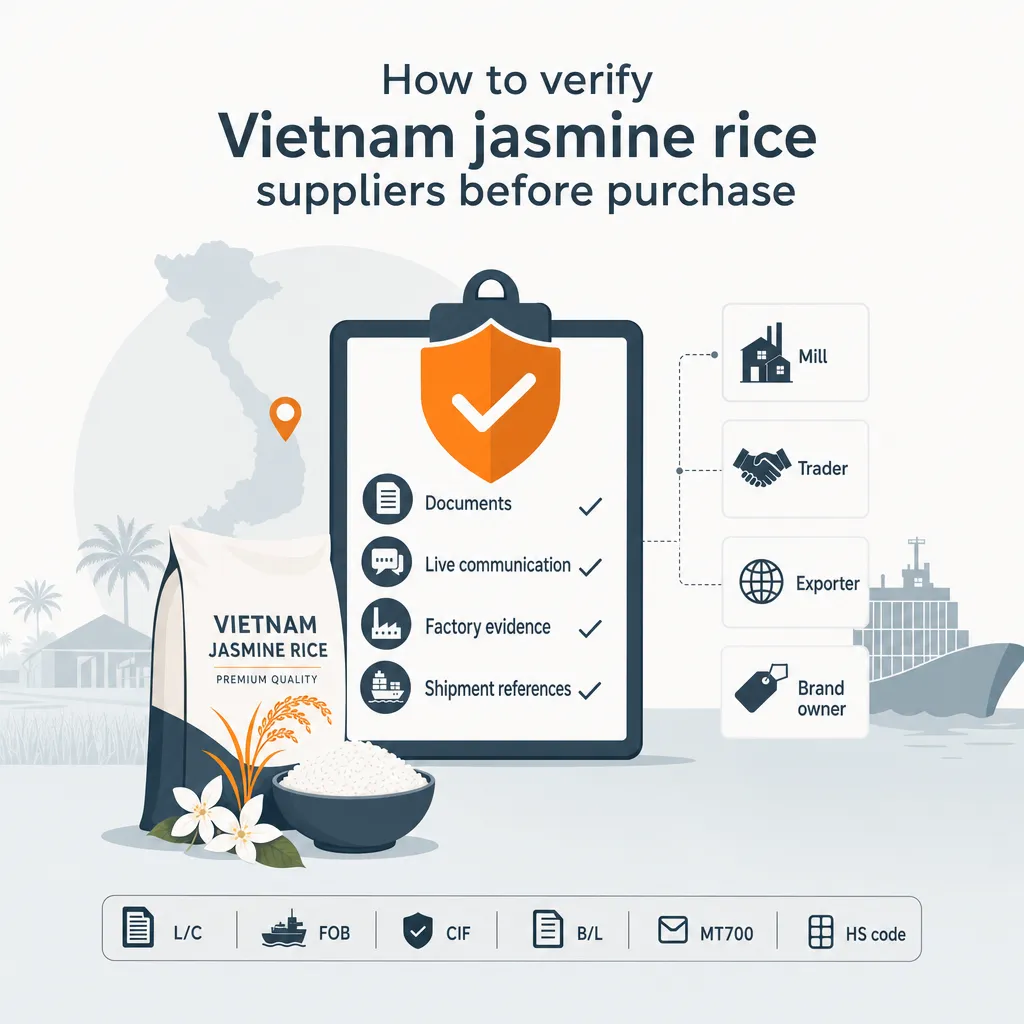
Supplier verification should combine documents, live communication, factory evidence, and shipment references. Do not judge a rice exporter only by a catalogue page. Ask whether the company is a mill, trader, exporter, or brand owner. Each model can work, but each has different control over stock, packing, and documentation.
Start with company basics: business registration, export experience, product range, mill or warehouse address, and recent shipment lanes. Then ask for a proforma invoice, draft sales contract, packing details, and product photos from current stock. For HS classification, rice commonly falls under HS code 1006 in ITC TradeMap; confirm the exact subheading with your customs broker because destination rules vary.
Next, verify operational details:
- Can the supplier show a current lot photo with your requested packing?
- Can they arrange third-party pre-shipment inspection if your buyer policy requires it?
- Do they understand phytosanitary paperwork for your destination?
- Can they provide a recent bill of lading sample with sensitive data hidden?
- Do they answer technical questions about moisture, broken ratio, and milling, not only price?
For food safety, ask for third-party audited documents or food safety certification with traceable certificate details. Avoid accepting screenshots without issuer names, audit dates, or certificate scope. If your destination requires plant health paperwork, review MARD food safety guidance through MARD food safety guidance and confirm requirements with your importer of record.
You can compare Vietnam rice suppliers for broader criteria such as factory type, export lanes, and payment methods. When checking logistics documents, check bill of lading basics so your team can review shipper, consignee, notify party, vessel, container, and clean-on-board wording.
Export documents, Incoterms, and payment terms for jasmine rice
A rice shipment is only as good as its document set. Before you send a deposit, agree on which documents are included in the quoted price and which are charged separately. Common files include commercial invoice, packing list, sales contract, bill of lading, certificate of origin, phytosanitary certificate, fumigation certificate when required, and quality or weight inspection report.
For origin and customs checks, many buyers use the Vietnam customs portal to understand export administration and coordinate with local agents. Your customs broker should confirm destination duties, import permits, labelling rules, and any rice-specific quota rules before the purchase order is issued.
Incoterms affect both cost and control. FOB Cát Lái can work well if you have a freight forwarder and want control over ocean freight. CFR or CIF may be easier if you want the supplier to arrange freight, but you still need clarity on insurance, claims, and delay handling. If your team is new to trade terms, learn how Incoterms 2020 work and cross-check with ICC Incoterms rules.
Payment terms vary by relationship and market. New buyers commonly see telegraphic transfer with deposit and balance against scanned documents, or L/C at sight for larger programs. L/C can reduce document disputes when drafted well, but it adds bank cost and strict wording. The ViRFQ workflow encourages buyers to state payment preference inside the RFQ so suppliers quote on the same basis.
Before shipment, set a document review checkpoint. Confirm product name, bag count, net weight, gross weight, container number, seal number, and consignee details. Small document mistakes can delay customs clearance even when rice quality is acceptable.
Where to find Vietnam jasmine rice suppliers without catalogue noise
Many importers begin with search results, trade directories, or social media posts. Those channels can help with discovery, but they often mix mills, brokers, outdated listings, and retail resellers. A better process is to turn your buying need into a structured RFQ and invite exporters to respond with comparable offers.
On ViRFQ, buyers can describe rice variety, volume, packing, destination, payment term, and inspection needs in one request. Suppliers then respond around the same buying brief, which reduces back-and-forth and makes it easier to compare price, stock readiness, and document capability. If you want a broader sourcing lane, request quotes from Vietnam exporters across rice and other agricultural categories.
Use this shortlist method before selecting a supplier:
- Send the same RFQ to several verified exporters.
- Ask each supplier for current stock photos and packing options.
- Request a sample and cook it using your normal market method.
- Compare FOB, CFR, or CIF on landed cost, not only unit price.
- Check whether the supplier can repeat the same spec for the next shipment.
- Review document samples before paying a deposit.
For rice-specific background, compare Vietnam rice suppliers and note how jasmine differs from ST25, long-grain white rice, and broken rice. If your company already imports from China or broader Asia platforms, review an Alibaba alternative Vietnam workflow to understand why an RFQ-first model can reduce irrelevant supplier replies.
The final choice should balance aroma, price, documentation, shipment timing, and communication quality. A supplier that answers technical questions clearly is often easier to manage than one that sends a fast but vague quote.
FAQ
Is Vietnam jasmine rice good for wholesale imports?
Yes, Vietnam jasmine rice can work well for wholesale imports when you need fragrant long-grain rice, flexible packing, and steady export support. Buyers should compare aroma, broken ratio, moisture, crop season, and document readiness before selecting a supplier.
What specs matter in Vietnam jasmine rice wholesale RFQs?
The main specs are variety, broken ratio, moisture, milling degree, foreign matter, crop season, packing size, load port, shipment month, and payment term. Clear specs help suppliers quote the same product and make price comparisons more accurate.
How do I check Vietnam jasmine rice suppliers?
Check business registration, export role, mill or warehouse details, current stock photos, sample quality, document samples, and response quality. Ask technical questions about moisture, milling, packing, and shipment timing to see whether the supplier understands export execution.
What documents come with a jasmine rice shipment?
Common documents include commercial invoice, packing list, sales contract, bill of lading, certificate of origin, phytosanitary certificate, fumigation certificate when required, and inspection report if agreed. Confirm the document set before deposit payment.
Which Incoterm should rice importers request?
FOB is useful when you control freight through your forwarder. CFR or CIF can be simpler when the supplier arranges ocean freight. Choose based on your logistics capacity, insurance needs, and ability to manage destination customs.
Ready to source jasmine rice from Vietnam with clearer specs and comparable supplier replies? Prepare your RFQ with variety, broken ratio, packing, destination port, payment term, and inspection needs. Then invite verified exporters to quote against the same brief. When you are ready, post your rice RFQ on ViRFQ.
Sources
Reviewed by
Founder & CEO, ViRFQ
Phan Hà Thái is the founder and CEO of ViRFQ, the buyer discovery and buyer management platform (and B2B marketplace) for Vietnamese agricultural exporters. His background is in international trade finance and Vietnamese agricultural exports. He writes and reviews the ViRFQ blog analyses on FOB pricing, Letter of Credit (L/C) workflows, EUDR compliance, and supplier verification.
Related articles
Vietnam Black Pepper Price 2026 Guide
9 phút
Robusta coffee Vietnam FOB: price + quality grades 2026
9 phút
How to Import from Vietnam — Full Process Guide 2026
9 phút
Vietnam supplier verification — 10-step due diligence 2026
9 phút
Vietnam pangasius fillet supplier — sourcing playbook 2026
9 phút