Vietnamese Cashew W320 Exporter Specifications 2026
Reviewed by Phan Hà Thái, Founder ViRFQ
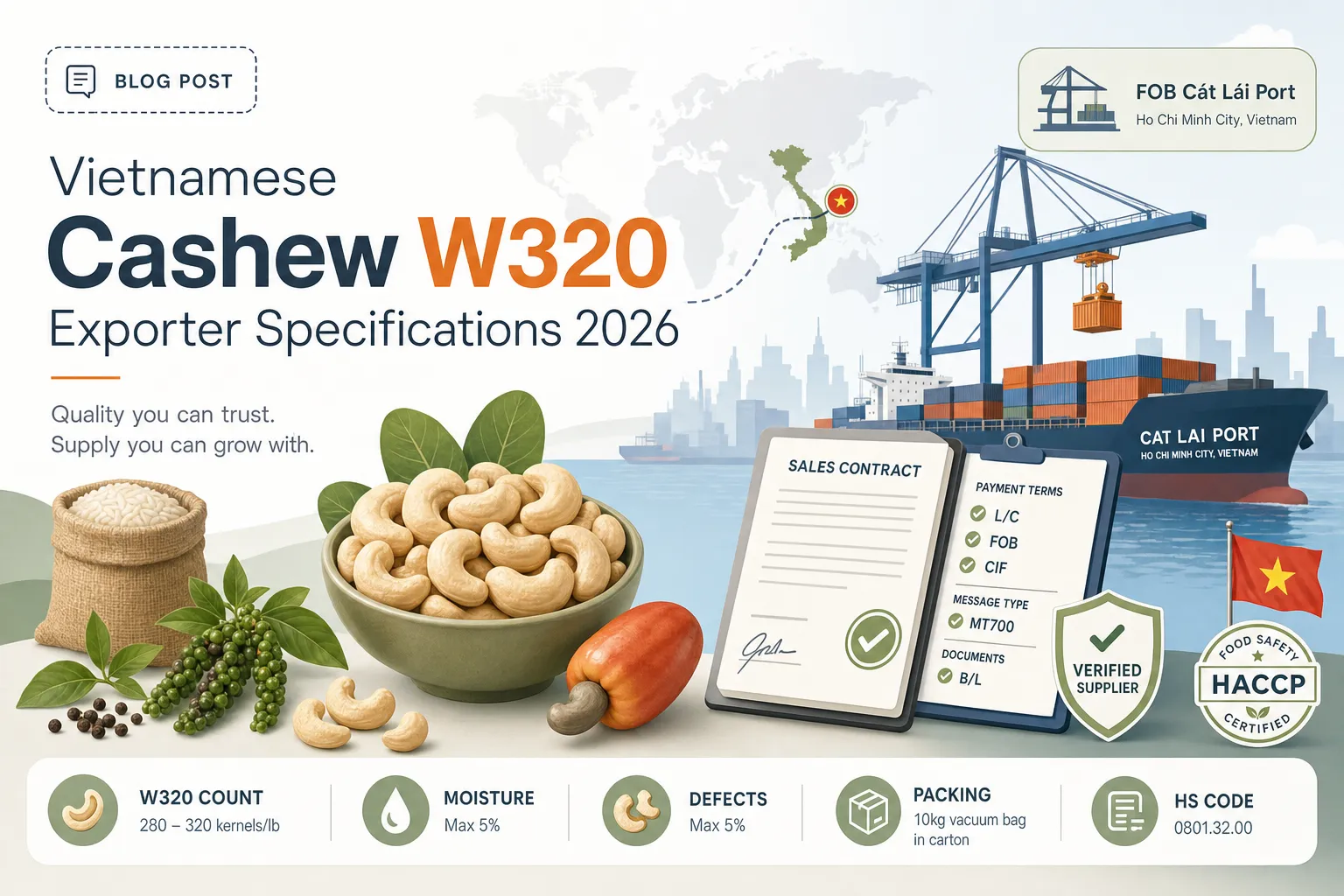
Vietnamese cashew W320 exporter specifications (INC quality standards) usually mean 300–320 kernels per pound (AFI standards) and 660–706 per kg (INC quality standards), with moisture commonly capped at 5%. Vietnam remains a major shelled-cashew supplier in ITC Trade Map 2024; this guide turns buyer snippets into an RFQ-ready checklist.
What a whole white kernel grade means for importers
A whole white kernel grade describes size, shape, color, and basic defect tolerance. For the common W320 grade, use the buyer-facing shorthand only when you also attach a recognized reference such as AFI standards or INC quality standards. Those references help both sides avoid a vague promise like nice kernels or export grade.
For this grade, the count is the first check: 300–320 kernels per pound (AFI standards) and about 660–706 kernels per kg (INC quality standards). The letter W means whole. The color expectation is white, pale ivory, or light ash, depending on crop, drying, and peeling. A buyer should also ask how the supplier separates scorched, dessert, broken, spotted, and shriveled kernels.
A practical RFQ should include these lines: - Product: whole white cashew kernels, W320 grade with INC quality standards reference. - Origin: Vietnam, with processing location such as Bình Phước or nearby provinces when available. - Moisture: commonly max 5%, confirmed by pre-shipment test. - Defect tolerance: state your buyer limit for broken, scorched, spotted, and foreign matter. - Crop and shelf life: ask for production month, packing date, and storage condition.
If you want supplier comparison rather than one-off quotes, source cashew RFQ on ViRFQ and require the same specification sheet from every exporter. That makes price differences easier to read because the grade, color, moisture, packing, and documents are aligned.
How to read moisture, defects, and lab terms
Moisture is a small line in the offer, but it affects shelf life, mold risk, and claims after arrival. Many Vietnam cashew offers state max 5% moisture. Ask whether the result comes from in-house testing or a third-party inspection. A serious exporter should be able to share a recent test report, lot number, and sampling method.
Defects need plain language. Broken pieces reduce usable yield for snack packing. Scorched kernels affect color. Spotted or shriveled kernels can signal raw nut issues or processing stress. Foreign matter is a food safety and customer complaint issue. Instead of accepting a single word such as standard, ask suppliers to fill a table.
| Check item | Buyer question | Evidence to request |
|---|---|---|
| Moisture | What is the max result for this lot? | Lab report or inspection note |
| Color | Is it white, pale ivory, or light ash? | Lot photos under neutral light |
| Broken kernels | What is the accepted limit? | Sorting report or sample review |
| Foreign matter | How is it controlled before packing? | Metal detection and cleaning record |
| Odor | Any rancid or chemical odor? | Pre-shipment inspection comment |
For contaminants, do not rely on a casual statement. Use recognized food safety references such as Codex standards and your destination market rules. The EU, United States, Japan, Korea, and MENA buyers may ask for different testing packages.
ViRFQ asks suppliers to answer in a structured quote format, so procurement teams can compare Vietnam cashew kernel grade details without retyping emails. This is useful when you compare Vietnam cashew suppliers across Bình Phước processors, Ho Chi Minh City trading houses, and direct factory exporters.
Packing standards and container loading questions
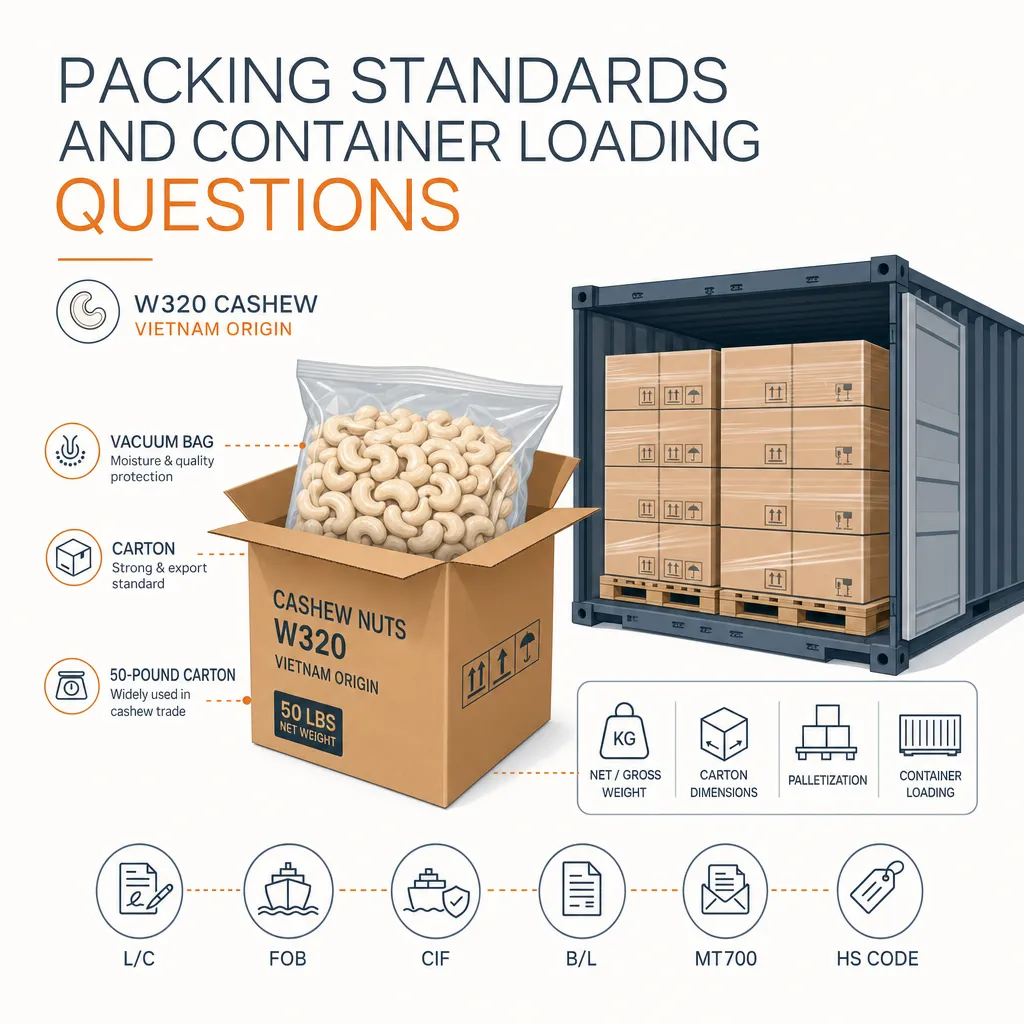
Packing is where many weak offers become visible. The common export pack is a vacuum bag inside a carton. A fifty-pound carton is widely used in cashew trade, but buyers should confirm net weight, gross weight, carton dimensions, palletization, and whether nitrogen flushing is used. These details affect freight, warehouse handling, and customer shelf life.
A good packing clause should say: - Inner pack: vacuum bag, food-contact liner, or nitrogen-flushed option. - Outer pack: export carton with grade, lot code, origin, and net weight. - Marking: buyer label, production date, lot number, and destination mark. - Container: dry container condition, odor check, clean floor, and no water stains. - Photos: sealed carton, open carton, inner bag, and container loading photos.
When you request quotes from Vietnam exporters, ask them to quote the same packing unit. Otherwise, one supplier may price loose cartons, another may include pallet cost, and another may add private label printing later. That makes the cheapest-looking offer hard to compare.
Incoterms also matter. If the quote says FOB Cat Lai, the seller usually handles export clearance and delivery to the named port under Incoterms 2020. If the quote says CIF Rotterdam, the seller includes freight and insurance to the destination port under the same Incoterms 2020 framework. Review FOB vs CIF terms before you accept the first freight-inclusive number.
For cashew kernels, ask for the loading plan before deposit. It should match the packing list, commercial invoice, and container seal record. You can also prepare a packing list template early, so the exporter does not create a document that conflicts with your customs broker instructions.
Which export documents should be in the RFQ pack?
Specifications are not complete without documents. A buyer sourcing from Vietnam should ask for the document set at RFQ stage, not after shipment. This protects your customs clearance timeline and helps screen suppliers that are not export-ready.
The usual cashew document pack includes: - Commercial invoice with product name, grade, quantity, unit price, Incoterm, and payment term. - Packing list with carton count, net weight, gross weight, and container details. - Bill of lading draft for shipper, consignee, notify party, vessel, and port data. - Certificate of origin when the buyer needs tariff treatment or origin proof. - Phytosanitary or health-related document when requested by the destination authority. - Fumigation or container cleanliness evidence when required by buyer policy. - Test report for moisture, microbiology, pesticide residue, or aflatoxin when relevant.
Vietnam Customs publishes trade and procedure information through Vietnam Customs, while agricultural export policy is also tracked by MARD Vietnam. Use those official channels for regulatory context, then ask your broker for destination-specific clearance rules.
Payment documents matter too. If you use a letter of credit, align wording with UCP 600 before the supplier prints documents. Tiny mismatches in product description, port name, or date format can delay bank review.
Before shipment, check bill of lading details against the commercial invoice and packing list. A practical ViRFQ workflow is simple: collect supplier quote, sample result, document draft, and payment term in one thread before you release a purchase order.
RFQ checklist for comparing Vietnam cashew offers
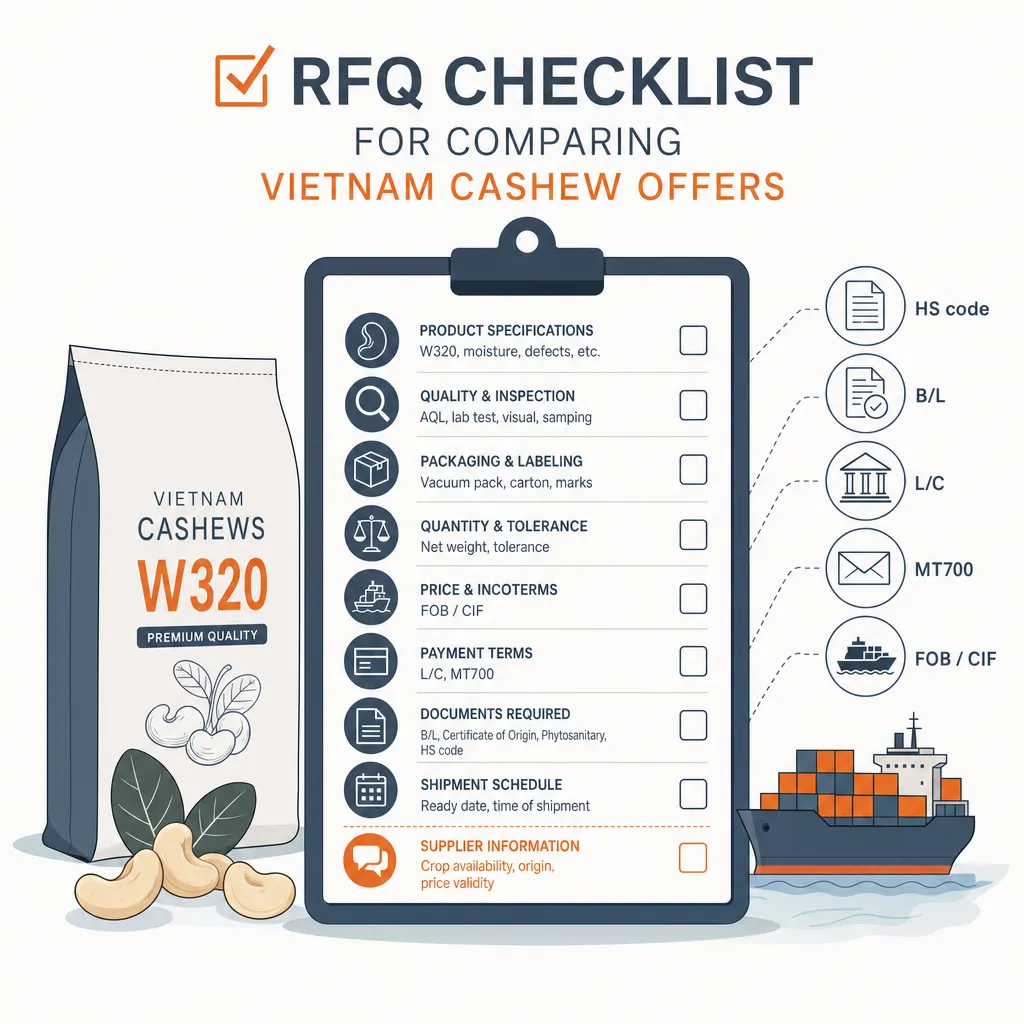
A strong RFQ removes guesswork. It should tell exporters what you buy, how you inspect it, which documents you need, and when you want shipment. It should also leave space for the supplier to explain crop availability and price validity.
Use this checklist when writing a cashew RFQ: - Product line: whole white cashew kernels with recognized grade reference. - Count: 300–320 kernels per pound (AFI standards) if you are buying the W320 grade. - Origin and processor: Vietnam origin, factory or trader role, and processing province. - Quantity: trial order, repeat monthly volume, and acceptable partial shipment. - Packing: vacuum bag, carton net weight, label, pallet, and container preference. - Inspection: moisture, defects, color, odor, and contaminants required by your market. - Documents: invoice, packing list, origin certificate, bill of lading, and test reports. - Trade term: FOB, CFR, or CIF with named port under Incoterms 2020. - Payment: deposit plus balance, documentary collection, or L/C using UCP 600.
Price comparison should follow specification comparison. If one quote has a lower unit price but unclear defects, missing test report, or vague packing, the total buying cost may be higher. Samples help, but samples must represent the shipment lot.
Trade context also matters. Check ITC Trade Map 2024 for Vietnam cashew export flows and monitor Vietnam Customs for official shipment context. Then shortlist exporters that answer clearly, share documents early, and accept inspection language. ViRFQ can route your request to verified suppliers and keep replies in a comparable RFQ format.
FAQ
What specification should importers request for Vietnam cashews?
Request whole white cashew kernels with a recognized grade reference, count, moisture limit, color range, defect tolerance, packing, documents, Incoterm, and payment term. For the common W320 grade, cite AFI standards and ask suppliers to confirm 300–320 kernels per pound in the offer.
How should buyers verify a cashew exporter specification sheet?
Compare the supplier sheet against INC quality standards, then request lot photos, a sample, recent lab results, and a draft packing list. The sheet should state grade, moisture, color, defects, packing type, crop period, and whether the exporter is a processor or trader.
Is Vietnam a strong origin for cashew kernel sourcing?
Yes. Vietnam is a major processing and export origin for shelled cashew kernels, and buyers can validate trade flows through ITC Trade Map 2024 and official updates from Vietnam Customs. Buyer due diligence should still focus on lot evidence, documents, and inspection terms.
What packing details should be fixed before deposit?
Fix net weight, inner vacuum bag, carton marking, pallet use, lot code, label language, and container loading photos before deposit. Packing details should match the commercial invoice, packing list, and bill of lading draft, so your broker can clear the shipment without avoidable document edits.
Which payment term is safer for a first cashew order?
Many buyers use a deposit with balance after document review, or a letter of credit for larger orders. If you choose L/C, align product wording and document requirements with UCP 600 before shipment, not after the container leaves Vietnam.
Need comparable cashew quotes instead of scattered supplier messages? ViRFQ helps buyers send one structured RFQ, collect exporter specifications, compare packing and documents, and shortlist verified Vietnam suppliers. Start with your grade, quantity, destination port, and inspection needs, then submit your cashew request at /en/rfq/cashew.
Sources
Reviewed by
Founder & CEO, ViRFQ
Phan Hà Thái is the founder and CEO of ViRFQ, the buyer discovery and buyer management platform (and B2B marketplace) for Vietnamese agricultural exporters. His background is in international trade finance and Vietnamese agricultural exports. He writes and reviews the ViRFQ blog analyses on FOB pricing, Letter of Credit (L/C) workflows, EUDR compliance, and supplier verification.
Related articles
Vietnam Black Pepper Price 2026 Guide
9 phút
Robusta coffee Vietnam FOB: price + quality grades 2026
9 phút
How to Import from Vietnam — Full Process Guide 2026
9 phút
Vietnam supplier verification — 10-step due diligence 2026
9 phút
Vietnam pangasius fillet supplier — sourcing playbook 2026
9 phút